
FROM THE DIRECTOR
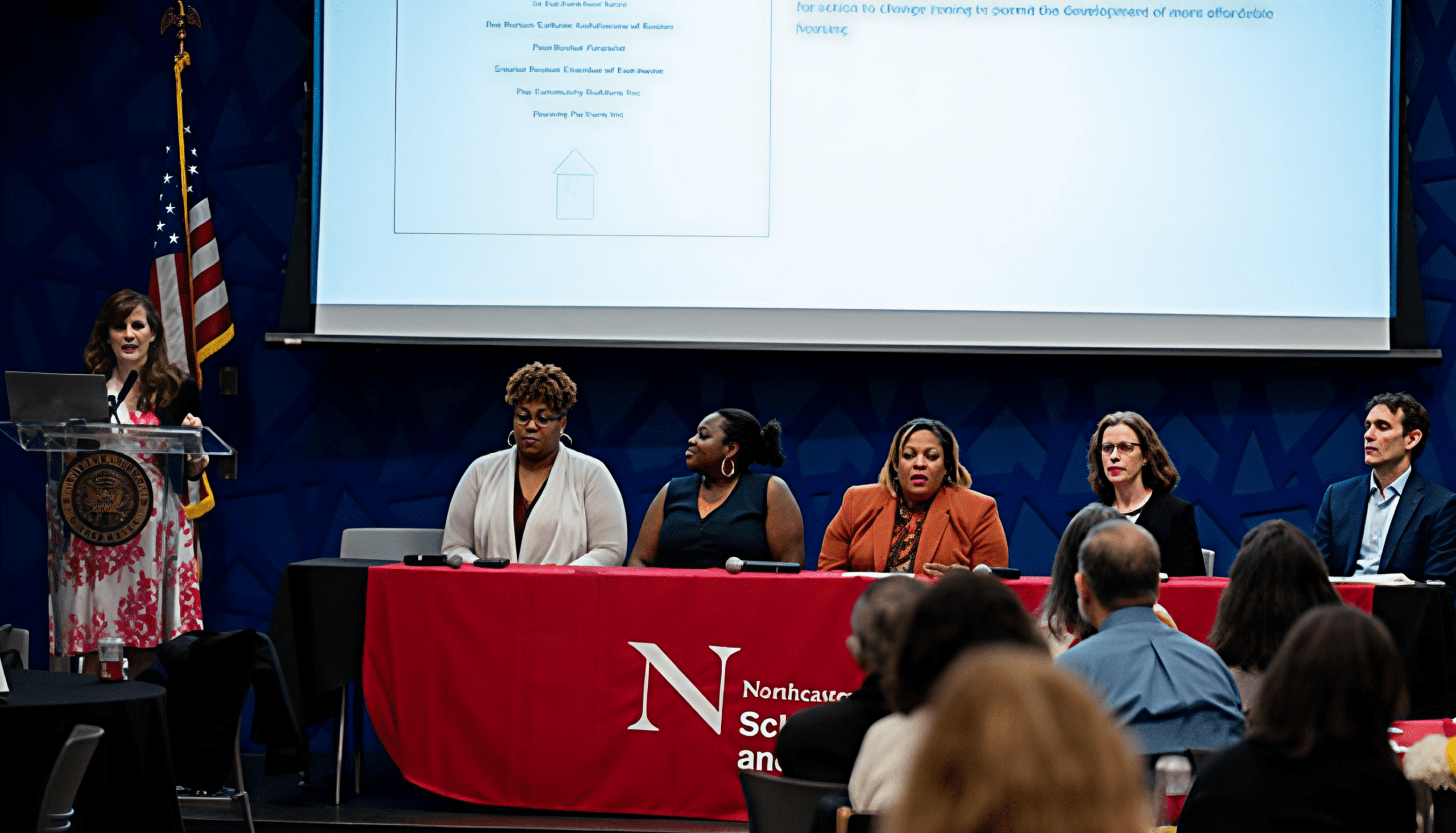
This panel brought together researchers, practitioners, developers, and policy advocates to examine one of Greater Boston’s most urgent challenges: a housing crisis decades in the making and accelerating in its impact. With generous support from the Boston Foundation—a longstanding partner of the Dukakis Center’s Greater Boston Housing Report Card since its founding—this conversation connected data-driven analysis with on-the-ground community experience.
The discussion ranged from the hard numbers of housing supply and affordability to the lived realities of residents navigating development in their neighborhoods, the mechanics of local zoning, and the legislative progress being made at the state level. Panelists represented an unusually wide arc: academic researchers who center resident voices, a civic-engagement leader from a major developer, the incoming CEO of the Massachusetts Housing Partnership, and a senior advocate at CHAPA. Together they offered a rare synthesis of perspectives on why housing production has stalled—and what it will take to change that.
We hope the insights captured in this brief will be useful to residents, policymakers, developers, and advocates working toward a more affordable and equitable Greater Boston.
Alicia Modestino
Moderator · Associate Professor & Director, Dukakis Center for Urban & Regional Policy, Northeastern University


Moderator Alicia Modestino opened the panel by drawing on the Dukakis Center’s long history with the Greater Boston Housing Report Card — a project that began in 2000 and ran for two decades in partnership with the Boston Foundation. The data she presented, drawn from Boston Indicators, told a consistent story: demand for housing in Greater Boston has persistently outpaced supply, and the gap is widening.
Population in the region has continued to grow, but housing unit permits have not kept pace. Despite efforts to accelerate production after COVID — which produced a brief uptick in completions — permitting has since fallen sharply. Because housing is a pipeline industry, the consequences of today’s under-permitting will be felt for years. As Modestino put it: if you’re not permitting, you’re not building.
The affordability crisis is not simply a matter of high incomes in a high-cost region. Incomes have not kept pace with rent increases, which means that even in a high-wage metro, a growing share of residents are spending far more than 30% of their income on housing — the federal threshold for cost burden. The result is increased pressure on shelters, which Massachusetts, as a right-to-shelter state, is obligated to provide — though shelter is far from the ideal housing outcome.

Patrice C Williams and Robyn Gibson presented the work of the Healthy Neighborhoods Research Consortium (HNRC), which spans nine communities across Greater Boston — Lynn, Chelsea, Everett, Brockton, Fall River, New Bedford, Roxbury, Mattapan, and Dorchester — and brings together residents, grassroots organizations, public agencies, and academic partners. Its founding insight was the connection between housing conditions and health outcomes; one of its organizing principles is that residents closest to a problem are best positioned to solve it.
The HNRC operates the Healthy Neighborhood Study (HNS) (2015-present), which is believed to be the largest mixed-methods, longitudinal, participatory action research (PAR) study on neighborhood change and health equity collected from a resident perspective. Rather than researchers extracting data from communities, HNS trains residents as co-researchers — collaboratively design survey instruments, , data collection, and analysis of findings. Over 4,000 residents across the nine communities have been surveyed. The result is not just data, but community ownership of the process and its findings.
“The best way to understand a complex problem is by trying to solve it — and the people closest to the problem are in the best position to do that.”
— Patrice Williams, on the principles of Participatory Action Research
This resident-driven agenda has led to the development of three practical tools, all publicly accessible at hns.mit.edu:
The Affordability Scorecard gives residents, developers, and city officials a structured framework for evaluating whether a proposed or existing development aligns with community needs. A key feature is its use of actual neighborhood median income — rather than Area Median Income (AMI) — to assess what residents can genuinely afford. In communities like Mattapan, the gap between AMI-based affordability thresholds and real local incomes is stark, and the Scorecard makes that visible in practice.
The Housing Mapper allows users to enter a census tract and view detailed neighborhood-level data: changes in median income and rent over time, the effective affordability threshold using the federal 30% standard, shifts in real estate taxes (a potential signal of speculative development activity), and how local conditions compare to the broader city. Residents asked for this tool to give context when evaluating new development proposals.
Who Owns Mass? is a portfolio research tool allowing residents to look up developers and landlords by address or name, see their portfolio size, and review their eviction histories. The goal is to help communities distinguish between developers with a track record of responsible stewardship and those with histories of displacement.
Research from the HNS found that residents who have a greater sense of agency and ownership over what happens in their communities report better individual health outcomes — a finding with powerful implications for policy approaches to neighborhood development.

Dr. Aisha Miller offered perspective from both sides of the civic-development equation: as the former Chief of Civic Engagement for the City of Boston, and in her current role at Related Beal, a firm that has built its legacy on workforce and affordable housing. Her message was direct — not all developers are adversaries, and the tools being developed by community researchers can help separate those committed to equity from those who are not.
She pointed to the Beverly, a Related Beal development adjacent to TD Garden, as a tangible example: 239 income-restricted workforce housing units — the first new residential development of its kind in downtown Boston in 25 years. The Beverly was built with community benefit at its center, not as an afterthought.
“When development comes into Black and Brown neighborhoods, they automatically assume you’re going to ignore them. Some communities get enormous community benefits. Others get a room to have a meeting.”
— Dr. Aisha Miller
Miller was candid about the distrust that development triggers in Black and Brown communities — distrust rooted in decades of broken promises, displacement, and unequal community benefit agreements. Where some neighborhoods receive substantial financial community benefits from development, others are offered only a meeting room. That asymmetry is not abstract; it shapes how residents receive any new proposal, regardless of its merits.
Her experience in civic engagement reinforced the point raised throughout the panel: that standard public meeting formats systematically exclude people who work during the day, cannot arrange childcare, or have long since stopped believing that attendance changes anything. Meeting people where they are — in churches, through clergy, in community rooms — is not optional. It is the work. Seniors, legacy homeowners, and long-term residents must be actively sought out, not just invited to participate in a process designed for someone else.
Miller expressed genuine enthusiasm for the HNS Affordability Scorecard as a tool that can serve good-faith developers as well as communities — helping developers understand what a neighborhood actually wants before proposing something, rather than engaging in the expensive, adversarial cycle of propose, resist, shrink, and delay.

Rachel Heller, in her first weeks as CEO of the Massachusetts Housing Partnership, provided a structural account of why Greater Boston produces so little housing — and why changing that requires confronting the foundations on which local zoning was built.
Massachusetts zoning rules were designed in the late 1960s and early 1970s on a framework of racial and economic exclusion — redlining made policy. The state devolves zoning authority to 351 cities and towns, creating 351 different processes, requirements, and definitions of what can and cannot be built. The result, nationally, is the smallest zoning jurisdictions in the country. In practice, what currently exists in Greater Boston could not be rebuilt under current rules: an acre of land is technically required to add a single new home in many communities. The triple-deckers and apartment buildings visible on most streets would simply not be permitted today.
Research by Katherine Einstein at Boston University, documented in Neighborhood Defenders, makes the stakes concrete. People who show up to local land-use hearings are systematically unrepresentative of their communities: predominantly white, male, wealthier homeowners, often opposed to change. When Newton conducted focus groups targeting renters, seniors, and people with disabilities — those typically absent from public meetings — the composition of opinion flipped entirely. At a public meeting, 85% opposed new development. In focus groups, 85–100% supported it. The current process is not democratic; it is the democracy of those who show up.
“What we see around us could not be rebuilt under current rules. So that’s really important to keep in mind when imagining what new development could look like.”
— Rachel Heller, Massachusetts Housing Partnership
Progress is being made. The MBTA Communities Act requires 177 communities served by the MBTA to zone for multifamily housing. As of the panel date, 166–167 communities had achieved compliance, with more than 8,000 homes now in the pipeline. Developers report looking at communities they had never previously considered, simply because the zoning now permits it. The Accessory Dwelling Unit law, led by Governor Healy, goes a step further: rather than requiring communities to update their zoning, it allows small homes by right statewide, adding over 1,000 additional homes to the pipeline. The legislature also changed the town meeting voting threshold for affordable housing from a supermajority to a simple majority — and communities moved quickly; Lynn passed measures that had previously failed within weeks of the change.
Heller closed by framing the political moment as genuinely unusual. Housing costs have become painful enough — for renters, for would-be buyers, for employers struggling to attract workers — that the conversation at the state level has shifted in ways not seen in decades. The goal is to ensure that as housing production accelerates, it expands access for everyone, not just those at the top of the income distribution.

CHAPA’s advocacy director offered a frank assessment: the policies and investments now moving through Beacon Hill will not solve the housing crisis soon. Housing doesn’t move like a switch — building 222,000 new homes across Massachusetts, the estimated gap, is a decade-long undertaking. But the seriousness of the crisis has, for perhaps the first time in a generation, focused the minds of legislators in a sustained way. When members report that their top three constituent issues are “housing, housing, and housing,” they respond accordingly.
On the immediate front, Massachusetts’ own state rental assistance programs are being protected and expanded even in a budget environment strained by approximately $650 million in federal Medicaid cuts from the Budget Reconciliation Act — with over a billion dollars expected annually once fully phased in. The Massachusetts Rental Voucher Program (MRVP) received increases in both the governor’s budget and the House budget; CHAPA is working to secure further expansion in the Senate. The Alternative Housing Voucher Program for individuals with disabilities has also been protected.
On the longer-term production side, the MBTA Communities Act remains the anchor — 94% compliance among eligible communities, and a small but persistent minority of legislators attempting to weaken or delay it who have been turned back, repeatedly, by strong legislative majorities. An unprecedented capital investment bill for affordable housing, passed in 2024, is now moving into appropriation. Site plan review standardization — addressing the patchwork of 351 different local permitting processes — has a real chance of codification this session, which would meaningfully reduce timelines for development approvals.
“The extent of the challenge has become so great that it has focused the mind of policymakers in a way I don’t think we’ve seen in a long, long time.”
— Matt, CHAPA
On federal policy, uncertainty has been the dominant theme. HUD’s shift away from a Housing First model has created real harm for individuals experiencing homelessness, and litigation has followed. While Congress has blocked the most damaging proposed cuts, the volatility continues. Massachusetts’ state-level tenant protections and fair housing laws provide a floor that residents of many other states do not have — but they do not insulate the Commonwealth entirely.
CHAPA’s Municipal Engagement Initiative and the new Housing Leadership Academy are working to build a sustained local infrastructure for pro-housing voices — educating elected officials at the town and city level, and ensuring that when MBTA Communities compliance votes happen, the room reflects a broader and younger constituency. Matt shared a pointed example from his own town of Wakefield: a Wednesday night town meeting where procedural delay tactics stretched a vote past 11:30 PM — after childcare had ended at 9:30 — cost critical pro-housing votes. The same vote, held on a Saturday morning at 8:30 AM, passed two-to-one.

What has been the impact of the Trump administration on affordable housing in Massachusetts? Panelists agreed the federal climate has been damaging, particularly around HUD’s retreat from Housing First principles and the cascading effects on supportive housing for people experiencing homelessness. The Budget Reconciliation Act’s Medicaid cuts — $650M this year, over $1B projected next year — have forced the state to make difficult tradeoffs. Massachusetts’ state-level protections offer relative insulation, but do not eliminate the harm.
How are 40R and 40S smart growth laws performing? Barry Bluestone noted that 40R — which incentivizes communities to zone for multifamily and mixed-use development near transit by offering state payments — has generated about 18,000 zoned units, though only roughly 4,000 have been built. Its companion law, 40S, reimburses communities for school cost increases resulting from new residents. Both have been incorporated into MBTA Communities compliance frameworks, offering an additional pathway for communities to combine incentives.
What would a proposed state income tax reduction to 4% mean for housing? Combined with federal cuts, a reduction of this scale — removing approximately another billion dollars from state revenue — would significantly constrain investment in housing programs at precisely the moment the state is trying to expand them.
What causes the longest delays in housing production, and how can they be shortened? Panelists identified a cascade of delay points: zoning approval, financing assembly (which now routinely requires 15 or more separate funding sources), inter-agency coordination, and litigation from neighbors opposed to specific projects. Community distrust — particularly in Black and Brown neighborhoods — adds further friction when developers have not done the work of genuine engagement. The Healy-Driscoll administration’s barrier identification commission, on which MHP participated, produced a practical roadmap of policy changes at each stage of the development pipeline.
Acknowledgments
This panel was made possible by the generous support of The Boston Foundation, a longstanding partner of the Dukakis Center’s Greater Boston Housing Report Card. Data presented was drawn from Boston Indicators.
We are grateful to our panelists — Dr. Patrice C Williams, Robyn Gibson, Dr. Aisha Miller, Rachel Heller, and Matt from CHAPA — for the depth and candor of their contributions, and to the audience members who brought their expertise and questions to the conversation.
This panel was convened in the spirit of Kitty Dukakis’ advocacy for community involvement in environmental decision-making and her longstanding framing of environmental protection as a public health issue. We are grateful to our panelists — Sarah Carr, Chris Osgood, Sherry Ruane, and Gregory King — for the depth and practicality of their contributions.
The community research tools referenced in this brief — the Affordability Scorecard, Housing Mapper, and Who Owns Mass? — are publicly accessible at hns.mit.edu and were also featured as interactive exhibits at the conference.