
FROM THE MODERATOR
This panel was convened in the spirit of Kitty Dukakis’ enduring legacy — a legacy defined not only by her public service, but by her extraordinary courage in sharing her own experiences with substance use and mental health at a time when doing so carried real personal risk. Long before the phrase “lean in” entered the cultural vocabulary, Kitty Dukakis was demonstrating what genuine vulnerability in public life looks like, and what it makes possible for others.
In the decades since, our language, our science, and our systems have evolved in meaningful ways. We have moved away from frames of “addiction” and “abuse” toward a deeper understanding of trauma, behavioral health, and the social conditions that shape a person’s life path. But progress has been uneven, and stigma — public, institutional, and internalized — remains one of the most stubborn barriers between people who need care and care that works.
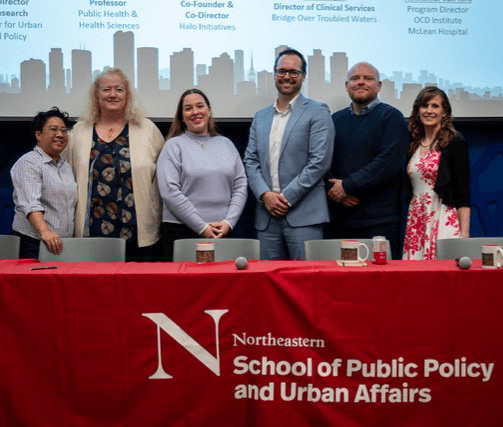
This panel brought together researchers, practitioners, and advocates working across the full arc of the behavioral health system: from infancy to young adulthood, from community health centers to residential treatment programs, from overdose bereavement support to OCD research. What united them was a shared commitment to building resilience, meeting people where they are, and centering the voices of those with lived experience. We hope this brief captures the depth and humanity of that conversation.
Kim Lucas
Moderator · Associate Director of Civic Research, Dukakis Center for Urban & Regional Policy, Northeastern University


Dr. Beth Molnar opened the panel by grounding the conversation in a body of research that has shaped how Massachusetts approaches early childhood behavioral health. Her argument was both scientific and humanistic: that the foundations of resilience — or its absence — are established in the earliest years of life, and that intervening during this window, within the settings families already trust, produces outcomes that follow children for decades.
Healthy early childhood development, she explained, rests on four interconnected capacities: the ability to explore and learn; the ability to form close, secure relationships; the ability to experience, regulate, and express emotions; and the development of self-regulation and the capacity to recover from adversity. These capacities do not develop in isolation — they unfold within family, community, and cultural contexts that must shape any effective intervention. What looks like healthy emotional expression in one community may look very different in another.
Since 2012, Dr. Molnar has worked with the Boston Public Health Commission and the Massachusetts Department of Public Health to evaluate Massachusetts Project LAUNCH — a SAMHSA-funded model that pairs master’s-level early childhood mental health clinicians with family partners, paraprofessionals with their own lived experience raising a child who faced social, emotional, or behavioral challenges. These teams are embedded directly within pediatric practices at community health centers, making them part of the medical homes that low-income families of color in Boston already access.
“When we meet families where they are, with culturally grounded partners who understand their lives, we can help put children on a healthier developmental path.”
— Dr. Beth Molnar
The study followed 225 children ages 0 to 8 and their caregivers across three community health centers. What made the findings striking was not just that children improved, but that caregivers did too — suggesting that the program was addressing the family system as a whole, not isolating the child. The family partner role proved central to this effect: when a family partner shares pieces of their own story, parents feel understood rather than assessed, and are more open to services.
The model has since been expanded to additional communities across Massachusetts, piloted within the foster care system in collaboration with the Department of Children and Families, and is now being extended into home visiting programs. A toolkit for communities interested in replicating the model is available at ecmhmatters.com. Current work at Northeastern, in collaboration with the Community to Community Impact Lab and the Center for Design, is focused on developing technology to better support family partners — reducing their exposure to vicarious trauma, supporting their professional development, and improving communication with families.

Bridge Over Troubled Waters has been serving young people in Boston since the late 1960s, when a group of Sisters of St. Joseph noticed youth — separated from family and resources — gathering in Boston Common and Cambridge. They began with food and casual conversation that grew into counseling, and they partnered with physicians from Massachusetts General Hospital to launch a mobile medical van that became a national model. Both the street outreach and mobile medical programs are still in operation today.
Over more than fifty years, Bridge has grown into a comprehensive continuum of services for young people ages 14 to 24. The organization’s day program offers shower facilities, food, laundry, case management, groups and activities, and secure storage for belongings. On-site behavioral health therapy, psychiatric care, and medical care are available without requiring young people to navigate separate systems. A high school equivalency prep class and — added in recent years — an on-site testing center mean that young people no longer need to travel elsewhere to sit for exams. Career development programming and a financial literacy course accompany the organization’s continuum of shelter and residential options, including transitional living and graduate living programs where young adults can live independently for up to two years at $275 per month.
“Your colleagues may be in this building with you, but your colleagues are also everywhere out in the community. Every referral you make is also building your next partnership.”
— Jade Bulger, Bridge Over Troubled Waters
Jade Bulger emphasized that the fundamental model — meeting young people where they are, building trust before anything else, and offering access rather than demands — has remained constant even as the specific services have expanded. A newly formalized research center, named after one of Bridge’s founders, reflects the organization’s growing investment in documenting and improving its practice.
On the question of resilience, Bolger was clear: Bridge’s work with young people is not just about meeting immediate needs, but about helping them develop a toolkit they can draw on long after they leave. Life will bring challenge and stress regardless — the goal is to build enough internal resource that when it does, young people can find their way through.

HALO Initiatives began not with a plan, but with an unmet need that no one else was addressing. Brendan Little, then working in substance use policy at the City of Boston, was fielding constituent calls from family members who had lost a loved one to overdose and needed help with burial costs. There were no resources to offer. No city department had anything. He started paying for funerals himself, in partnership with his colleague Elsa Gomes-Bondlow, with no infrastructure and no funding — and kept doing it for five years, serving 16 families.
The invisibility of the problem was itself part of the problem. When Little raised it with people in positions of power, the response was that the need did not exist in the data. It was not in the data because no one had reached those families. They had reached HALO because HALO reached them — and now there is data, which means there is a documented problem that can be addressed at scale.
“Before we were doing it, the problem didn’t exist. It wasn’t documented. Now it’s documented. That’s how you make an invisible problem visible.”
— Brendan Little, HALO Initiatives
A Boston Globe op-ed Little and Gomes-Bondlow wrote argued that opioid settlement dollars — flowing into communities across the country as a result of litigation against manufacturers and distributors — should be directed toward this kind of intervention. The City of Boston responded with a Request for Proposals, HALO applied, and in its first year of formal operation served 50 families with $220,000 in support covering funeral expenses, behavioral health services, child wellness supports, and legal fees. A Rise Massachusetts grant is now supporting expansion across the state.
HALO’s approach is deliberately designed to reach populations that recovery support systems have historically underserved. The past year’s work in Boston was primarily with Black and Brown residents — a point of pride for an organization that understands, from lived experience, that not all stigma operates the same way. A white man saying publicly that he is in recovery receives applause. A Black or Brown person saying the same carries a different weight and a different set of risks. HALO’s work tries to meet that reality honestly, using financial support as a lever for trust and access — and making the path to behavioral health support less conditional on a person’s willingness to perform recovery in a particular way.

Dr. Nathaniel Van Kirk opened by describing what he called the divide between three worlds that rarely interact: clinical practice, research, and lived experience. His own entry into behavioral health was shaped by years of receiving the wrong treatment — and then learning that the problem was not that he was untreatable, but that the treatments he had been given lacked research support. That experience became the engine of his career. The OCD Institute at McLean Hospital, where he serves as program director, is a residential and partial hospital program that accepts Medicare and Medicaid — one of only two such programs in the country. Its rarity is itself diagnostic of a system-wide gap.
Dr. Van Kirk offered a framework for understanding both the promise and the challenge of disseminating evidence-based care. There is approximately a seven-year delay between new research findings on best practices and their adoption in clinical settings. That gap has been especially wide for conditions like OCD, which for many years received little training attention in graduate programs and was poorly understood in the broader mental health community. The result: clients who arrive at the OCD Institute after fifteen, twenty, or thirty years of misdiagnosis, having been told they are untreatable, and who find — often within months — that they are not untreatable at all. They simply had not yet received the right treatment.
“Navigating behavioral health and mental health is the norm. Statistically, it’s part of being human — not the exception to the rule.”
— Dr. Nathaniel Van Kirk, McLean Hospital
On resilience, Dr. Van Kirk was precise. Exposure-based treatments — the evidence base for OCD, anxiety disorders, and fear-related conditions — are not simply about eliminating a specific fear. They are about helping people learn to live with uncertainty, because uncertainty is the condition of being human. The goal is not to eliminate discomfort but to help people discover that they are more capable of facing it than they have been led to believe. One in three people will meet diagnostic criteria for a behavioral health condition over their lifetime; one in two will be significantly affected by it through a loved one. This is not an exceptional experience. It is the norm.
Dr. Van Kirk also drew a careful distinction between public stigma and internalized stigma. While a great deal of awareness-raising work focuses on changing what others think, internalized stigma — the way individuals absorb and assign negative messages to themselves — may be the more significant barrier to seeking care. Research on how to reduce public stigma has found that the most effective method is not presenting data, but creating conditions in which someone learns, almost by accident, that a person they admire has struggled with mental health. The emotional resonance of that discovery is more likely to shift beliefs than any direct argument. How the message is delivered, the panel concluded, matters as much as the message itself.

On collaboration across organizations: Panelists were candid that Boston is, in the words of one, “resource-rich and connection-poor.” The city has an extraordinary density of mental health, substance use, and social services — and they are often siloed from one another. Both Jade Bulger and Brendan Little described concrete examples of cross-organizational collaboration emerging from informal relationships and shared work: Bridge and HALO coordinating outreach to young adults in areas with concentrated substance use; on-site partnerships between Bridge and Boston Health Care for the Homeless, Massachusetts General Hospital, and the Department of Mental Health. Dr. Van Kirk echoed the point that transitions between levels of care — from intensive treatment back into daily life — are often where the system fails most visibly, in part because reimbursement structures do not support the coordination work required.
On social media and behavioral health: Dr. Van Kirk described a complicated picture for the OCD field specifically. Social media raised awareness substantially — but as platforms became more monetized, accuracy was deprioritized in favor of engagement. Misinformation about OCD has proliferated, and the validation dynamics of social media platforms can actively worsen symptoms and erode trust in clinicians. A striking example: it took a year of concerted effort to counter a viral claim that celery juice could treat OCD, during which clients accused researchers of withholding a simple cure. Researchers, he noted, are not naturally skilled at communicating on social media — they qualify and caveat — and that does not build confidence in an environment that rewards certainty. Beth Molnar added that the potential of technology, deployed carefully, is also real: the team at Northeastern is exploring games, monitored chat tools, and peer connection platforms to extend the reach of family partners in a controlled way.
On gender and behavioral health: The panel acknowledged significant gaps in the research base. Much of the foundational research in behavioral health was conducted on men and extrapolated — an assumption that is now being revisited. Postpartum OCD is one area where prevalence rates are only recently being measured: new research suggests that up to 94% of individuals report intrusive distressing thoughts following childbirth, and those who go on to develop postpartum OCD appear to be substantially more common than general OCD prevalence would predict. Dr. Molnar noted from a different research lens that women and girls are disproportionately survivors of sexual violence, making the prevalence of PTSD among women a continuing area of urgent focus.
On the “missing middle”: A question about individuals whose incomes are too high to qualify for public assistance but too low to manage rising costs prompted reflection on the particular strength of opioid settlement funding: there is no income requirement. Because the money flows from legal accountability for corporate malfeasance, it is understood by HALO as rightfully belonging to families who lost someone to overdose, regardless of their financial circumstances. Little described this as a model for how targeted, nimble financial support — paired with peer and behavioral health partners — can interrupt cycles of trauma in ways that means-tested programs cannot.

The panel closed with a direct invitation to the audience — in person and online — to consider one concrete action they could take to support the resilience of people experiencing trauma, behavioral health challenges, or substance use disorders.
Dr. Beth Molnar emphasized early intervention: the struggles that lead to long-term difficulty can be identified from infancy, and evidence-based programs can help families get back on track before challenges become entrenched. Knowing that support can come early — and that families deserve it regardless of how much adversity they have experienced — is itself a form of public education worth spreading.
Jade Bulger called for lifting up the strengths of people who have faced barriers, and for taking seriously the power of social connection. For people experiencing trauma, being a consistent and non-judgmental source of support matters. For those in the audience navigating their own challenges, the invitation was to seek that support out rather than carry it alone.
Dr. Nathaniel Van Kirk asked those with any ability to influence reimbursement policy — whether as voters, advocates, or policymakers — to push for reform. Reimbursement structures are among the most consequential and least visible barriers to care: they determine which services can be sustained, which transitions between levels of care can happen, and which populations can be reached. He also encouraged holding hope for individuals in one’s own life, and approaching their experiences with curiosity rather than assumption.
Brendan Little offered a reminder that lived experience is not monolithic — and that discernment matters. Not all voices claiming lived experience are working to build coalitions or support people. The lived experience worth listening to, whether in personal relationships or in policy decisions, is the kind that is trying to find commonalities, build bridges, and make things better for people — not punish them.
“Kitty Dukakis was saying: this is who I am. And if I can say this, maybe you can too — an invitation to build a community around what people are struggling with, so we can figure out how to get through it together.”
— Kim Lucas, Moderator
Acknowledgments
This panel was held during Mental Health Awareness Month and was convened in recognition of Kitty Dukakis’ longstanding leadership in de-stigmatizing mental health and substance use treatment.
We are grateful to our panelists — Dr. Beth Molnar, Jade Bulger, Brendan Little, and Dr. Nathaniel Van Kirk — for their generosity, candor, and expertise. We also thank the audience members who brought thoughtful questions both in the room and via Slido.
Attendees were invited to visit the Deconstructing Stigma exhibit from McLean Hospital, on display in the lobby and on Northeastern’s campus throughout the month of May.
Resources referenced in this brief: ecmhmatters.com (Massachusetts Project LAUNCH toolkit) · bridgeotw.org (Bridge Over Troubled Waters) · mcleanhospital.org/deconstructing-stigma (Deconstructing Stigma campaign)