
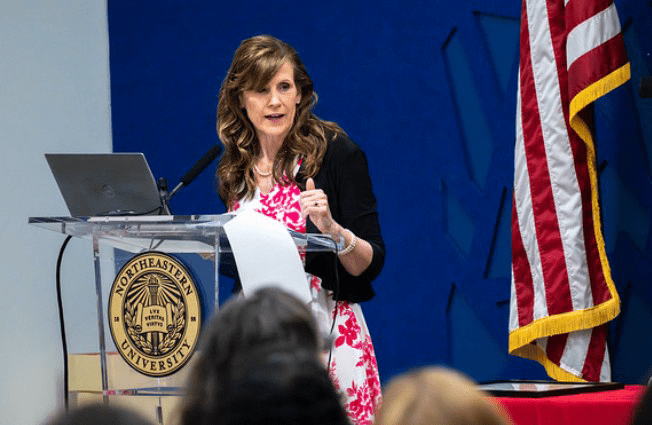
FROM THE DIRECTOR
When we learned of Kitty Dukakis’ passing in the spring of 2025, we wanted to acknowledge her legacy in a way that reflected how she approached everything in her life: not by looking back, but by looking forward. Kitty was not a commemorator. She was a doer. She didn’t organize events to honor progress already made; she organized them to make more progress happen.
So this program was designed in her spirit. Rather than a retrospective, it is a convening of policymakers, practitioners, researchers, and community members who are actively working on the issues she championed: housing, mental health, climate resilience, and the arts. The goal is not reflection for its own sake, but the formation of new coalitions that will generate fresh impact.
We are also marking the Dukakis Center’s 25th anniversary and the launch of the Community to Community Impact Lab — a $4.5 million investment from Northeastern’s provost that expands our capacity for community-engaged research. We have evolved from a think-and-do tank to an engage-think-and-do tank, because we know that every successful initiative starts with a trusting relationship. Today is a celebration of those relationships, and a commitment to building more of them.
Alicia Modestino
Director, Kitty & Michael Dukakis Center for Urban & Regional Policy, Northeastern University

The conference opened in the Cabral Center of the John D. O’Bryant African American Institute, a space whose history was itself an act of framing. Director Alicia Modestino acknowledged the Institute’s namesake John D. O’Bryant, the first African American appointed to Vice President at Northeastern, who served from 1979 until his death in 1992, and was remembered by colleagues as a compassionate, unpretentious, and deeply principled leader. It was, Modestino noted, difficult to imagine a more fitting space to honor Kitty Dukakis.
Modestino offered a portrait of Kitty that was both personal and political: a woman who was never afraid to speak up, who persisted long before persistence became fashionable for women in public life, and who was, above all, a pragmatic activist. She used her platform not for its own sake but as a lever to move resources, shift conversations, and make other people’s lives better in ways both small and large. Her willingness to be publicly vulnerable about her own struggles with mental health and substance use did not mark a departure from her public role; it exemplified it.
“Because I am a public person, there’s a certain amount of interest in what happens to me. I would like to put that attention to positive use.”
— Kitty Dukakis from her book “Now You Know”
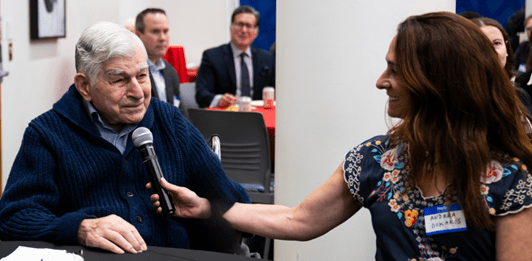
Governor Michael Dukakis acknowledged admiringly that Kitty had always been several steps ahead of him in the work she was doing, steps he often learned about only after the fact. “I didn’t know half the things she was doing,” he said. “She just never told me. Then I’d find out about it later.” The room laughed in recognition. He expressed how much he missed Kitty, and how much he missed Northeastern University.
Andrea Dukakis, the family’s middle child, reflected on what Northeastern meant to her parents, who deeply appreciated that, unlike many of its university peers, it did not lock itself up in ivory towers. Her father had loved it precisely because its students were serious about what they studied and knew from the co-op program how the real world actually worked. Her mother, she said, was motivated the same way: by real people, real needs, real relationships. Kitty didn’t have superficial connections with the people she helped; they became her friends. And she did not always follow the rules in getting them what they needed. “My husband always liked to say that if he were locked up in some faraway prison, the first call he’d make would be to my mother.”
Ted Landsmark situated the moment within a longer arc. He first met Governor Dukakis at the law firm Hill and Barlow, where the governor, alongside young associates including Bill Weld and Deval Patrick, was instilling in a generation of lawyers a sense of professional ethics and personal balance. What Dukakis modeled, Landsmark recalled, was not just mission but proportion: doing billable hours until five, going home to have supper with Kitty, and returning to the office afterward. He modeled how to sustain the long work. Landsmark also acknowledged directly what he called “a very trying time for many of us who hold progressive values.” He drew from Kitty’s life an explicit reminder that maintaining commitment and optimism, even through personal difficulty, is what makes sustained civic contribution possible.
Maria Ivanova, Director of the School of Public Policy and Urban Affairs, framed the day as an act of intergenerational continuity, honoring those who came before while building the foundation for those who follow. She gestured to the word “Dream” painted on the wall of the Cabral Center and named what she saw the Policy School doing: training the next generation of public servants to design a different future and stand for it. Kitty Dukakis, she said, was not a role model for the Policy School. She was a central figure in the space it occupies. Her courage in speaking publicly about mental health and addiction, and her insistence that the arts are not decoration but essential to human dignity, embody what the School aspires to teach.
Provost Beth Winkelstein, in her first year at Northeastern, described the event as a reminder of why she had come to the institution. The Dukakis Center’s model — community-engaged, interdisciplinary, action-oriented — represents what higher education can be when it resists the tendency to fit complex social problems into academic silos. The Center’s 25-year history of working in real time with policymakers and communities, she said, is precisely the kind of work Northeastern is uniquely positioned to do.


Trinh Nguyen, Chief of Boston’s Worker Empowerment Cabinet and the conference’s keynote speaker, opened by honoring the Dukakis family and the Dukakis Center, which has served as her closest research partner for over a decade. She noted that her mother-in-law Dr. Constance Williams served as Governor Dukakis’s Chief of Policy for Human Services from 1983 to 1987 and always referred to him as “her best boss.”
Nguyen described the Worker Empowerment Cabinet, created by Mayor Wu in 2022 to elevate workforce development as a pillar of city policy, and outlined its mission: advancing the well-being of all Boston residents through improved workplace conditions, expanded economic opportunities, and financial education. But the substance of her keynote was the story of how research, conducted in genuine partnership with the Dukakis Center over more than a decade, had translated into policy at scale.
“These little things grow up to huge legacies and decades of improvements over time. Think about what you can do for government — and continue your commitment to the city of Boston.”
— Trinh Nguyen, City of Boston
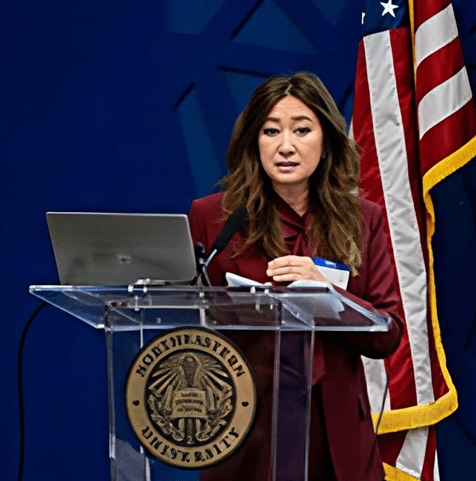
The partnership began when Modestino approached Nguyen, then Director of the Office of Workforce Development, about evaluating Boston’s Summer Youth Employment Program. Nguyen was appropriately skeptical of academics arriving with evaluation frameworks, and direct about her constraints: no budget, no patience for reports that would sit on shelves. What she needed was someone who could tell her what worked and what didn’t, quickly enough to act on it. That alignment of purpose and demand for research that is immediately actionable became the foundation of a decade-long collaboration that has since shaped policy at the city, state, and national level.
Among the milestones Nguyen traced: a 2019 foundational report on workers without bachelor’s degrees that led directly to new employer partnerships and credential programs; early data tracking work that showed students in tuition-free community college were three times more likely to graduate than their peers, leading to a mayoral expansion of the program and, ultimately, to Governor Healy’s Mass Educate and Mass Reconnect initiatives, which now provide tuition-free community college to eligible residents statewide with over $100 million in annual commitment; a causal study linking summer jobs to long-term reductions in violent crime and improvements in graduation and employment; and a climate-ready workforce action plan that secured funding for Boston’s coastal resilience programs.
When COVID disrupted the summer jobs program, Nguyen and Modestino’s team worked together to build four new tracks of programming, including virtual internships and a learn-and-earn model now hosted at Northeastern. Mayor Walsh invested an additional $4 million in CARES Act funding to maintain the program at full scale, citing research showing that more than half of participating youth were using their earnings to help pay household bills. That work eventually reached the White House. President Biden cited Boston’s summer jobs model as a national template for combining youth opportunity with violence prevention.
On the question of how to build a data-driven culture within a city agency, Nguyen was candid: data are essential, but not always the driver. When evidence and lived experience on the ground diverge, the right response is to recalibrate, not to privilege the spreadsheet over what workers and community members are actually experiencing. The iteration, the accountability structures, and the honest check-ins differentiate research that improves policy and research that collects dust.
On maintaining staff energy and institutional momentum in the face of federal funding uncertainty, Nguyen was equally direct. Boston’s impressive strengths — 34 colleges and universities within city limits, over 500 nonprofits, a robust innovation economy, and a AAA bond rating maintained for 13 consecutive years — give it resources that most cities lack. The challenge, and the opportunity, is to deploy those assets creatively rather than waiting for federal direction that may not come.

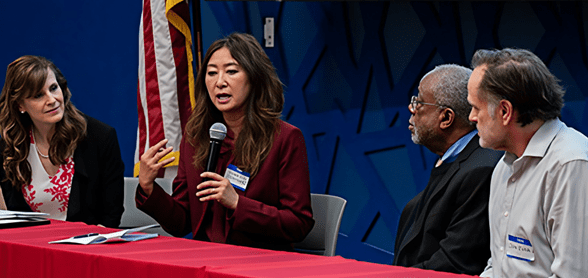
The fireside chat focused on the practical mechanics of the Dukakis Center–Worker Empowerment Cabinet partnership. Participants broke down what it actually looks like to move from research to policy in real time, and how to sustain that work through changing political climates.
Modestino described the collaboration honestly: “It is think, do, publish later because there’s stuff to be done right now.” Biweekly meetings between researchers and cabinet staff, in which data anomalies get immediately contextualized by the people running programs on the ground, are what make the research actionable. When Modestino would flag an unexpected pattern in the data, a program manager could often explain it in seconds — a dropout employer partner, a delayed application window — because they were in constant dialogue. That density of communication is what separates research partnerships that matter from those that do not.
John Dukakis reflected on what his mother brought to every project she touched: passion and impatience. Not impatience as frustration, but impatience as a refusal to accept that the pace of change was fixed. He noted that the Dukakis Center is unmistakably carrying forward his parents’ values by exemplifying the intersection between government and academia that his mother always believed was possible and necessary. “There’s a certain scrappiness in Northeastern’s DNA,” he said, “which has continued and I think is one of the reasons that such extraordinary work is being done.”
Nguyen closed the conversation with a reflection on what it means to serve. She argued that government works best when it is genuinely accountable to the people it serves, relentlessly focused on outcomes rather than outputs, and willing to recalibrate when what it is doing is not matching what communities actually need. The summer jobs program — which has grown from a $4.6 million to a $24 million annual investment and has been cited by a sitting president as a national model — began with a researcher willing to work for free and a city official willing to say exactly what she needed. That, she suggested, is the template.

The fireside chat closed with the inaugural presentation of the Engage, Think, and Do Award from the Dukakis Center to Trinh Nguyen and the full Worker Empowerment Cabinet team in recognition of a decade-plus-long research partnership that has shaped city, state, and national policy. Modestino called the entire cabinet team to the stage, naming staff members who had been part of the research collaboration across its many iterations — the summer jobs data analysis, the tuition-free community college evaluation, the good jobs challenge tracking, the financial literacy and credit-building work, and the new initiative to open Roth IRAs for a thousand young Bostonians in summer 2026. The award was not for any single project but for the City’s ongoing partnership with Northeastern: a sustained, trusting relationship between researchers and practitioners that continuously converts evidence into action.
Modestino called the entire cabinet team to the stage, naming staff members who had been part of the research collaboration across its many iterations — the summer jobs data analysis, the tuition-free community college evaluation, the good jobs challenge tracking, the financial literacy and credit-building work, and the new initiative to open Roth IRAs for a thousand young Bostonians in summer 2026. The award was not for any single project but for the model itself: a sustained, trusting relationship between researchers and practitioners that continuously converts evidence into action.
The award’s name Engage, Think, and Do reflects the Dukakis Center’s own evolution. From its founding as a think-and-do tank, the Center has grown into something that begins with engagement in partnership with communities—including both city leaders as well as the people most affected by the problems being studied. It is that model, Modestino argued, that makes the difference between research that brings meaningful change to the world and people’s live versus academic studies that are read by only a handful of experts. The partnership with the Worker Empowerment Cabinet, she said, offers the ideal case study of what that model looks like and how it can be used to move us closer to the Center’s vision of a world connected by thriving communities where shared knowledge creates equitable access to purpose, power and prosperity.
Acknowledgments
The Dukakis Center is deeply grateful to Richard O’Bryant and the staff of the John D. O’Bryant African American Institute for hosting thisevent in this cherished and fiercely activist space on campus.
We thank Governor Michael Dukakis, Andrea Dukakis, and John Dukakis for joining us and sharing their memories of Kitty, and for their decades of public service that the Center seeks to honor and extend.
We thank Ted Landsmark, whose directorship of the Dukakis Center over the past decade elevated its purpose and its character.
We also thank Barry Bluestone, founder of the Center and the School of Public Policy and Urban Affairs, for the vision that made both possible.
We thank Provost Beth Winkelstein and Policy School Director Maria Ivanova for their institutional support and their investment in the Community to Community Impact Lab that is carrying the Center into its next quarter-century.
We thank Trinh Nguyen and the entire Worker Empowerment Cabinet, as well as every partner, student, and community member who has contributed to the work described today. The little things, as Michael Dukakis often reminded us, add up.
We thank our sponsor, The Boston Foundation, for their generous financial support of this event and their long-term partnership with the Dukakis Center.
We also thank McLean Hospital for donating their mobile Deconstructing Stigma exhibit to the event and allowing Northeastern to host the exhibit on campus throughout the month of May in honor of Mental Health Awareness.
Finally, we thank our exceptional staff for their hard work behind the scenes in making this event such a success: Michele Rosenthal (event coordination), Bev Bellaro (communications), Adam Polgreen of the Pack Network (livestream), Nick Pollard (finance), and Ruth Thermidor and Brian Didio (registration) and our dedicated student volunteers who showed up early and stayed late to help: Sakshi Parikh (web & software development), Sajjad Sharifi (photography), and Grace Magnacca, Hitanshu Pandit, and Sebastian Ramirez (set-up and break-down).