

Closing Note FROM THE DIRECTOR
A day designed to honor Kitty Dukakis’ legacy by looking forward, not backward, closed the way it had to: with young people. Two student awards brought the conference full circle, connecting the historical research of high schoolers to the civic values that had animated every panel. One award carried Kitty’s name. The other carried Ted Landsmark’s. Together, they made a statement about what this community believes: that history matters, that courage is cultivated, and that the next generation is already doing the work.
The closing also became something more personal: a tribute to Ted Landsmark, whose decades of leadership at the Dukakis Center and across Boston’s civic landscape have left an imprint that, as Richard O’Bryant put it, will live at Northeastern for a long time. And it ended, fittingly, with cake.
Alicia Modestino
Director, Kitty & Michael Dukakis Center for Urban & Regional Policy, Northeastern University
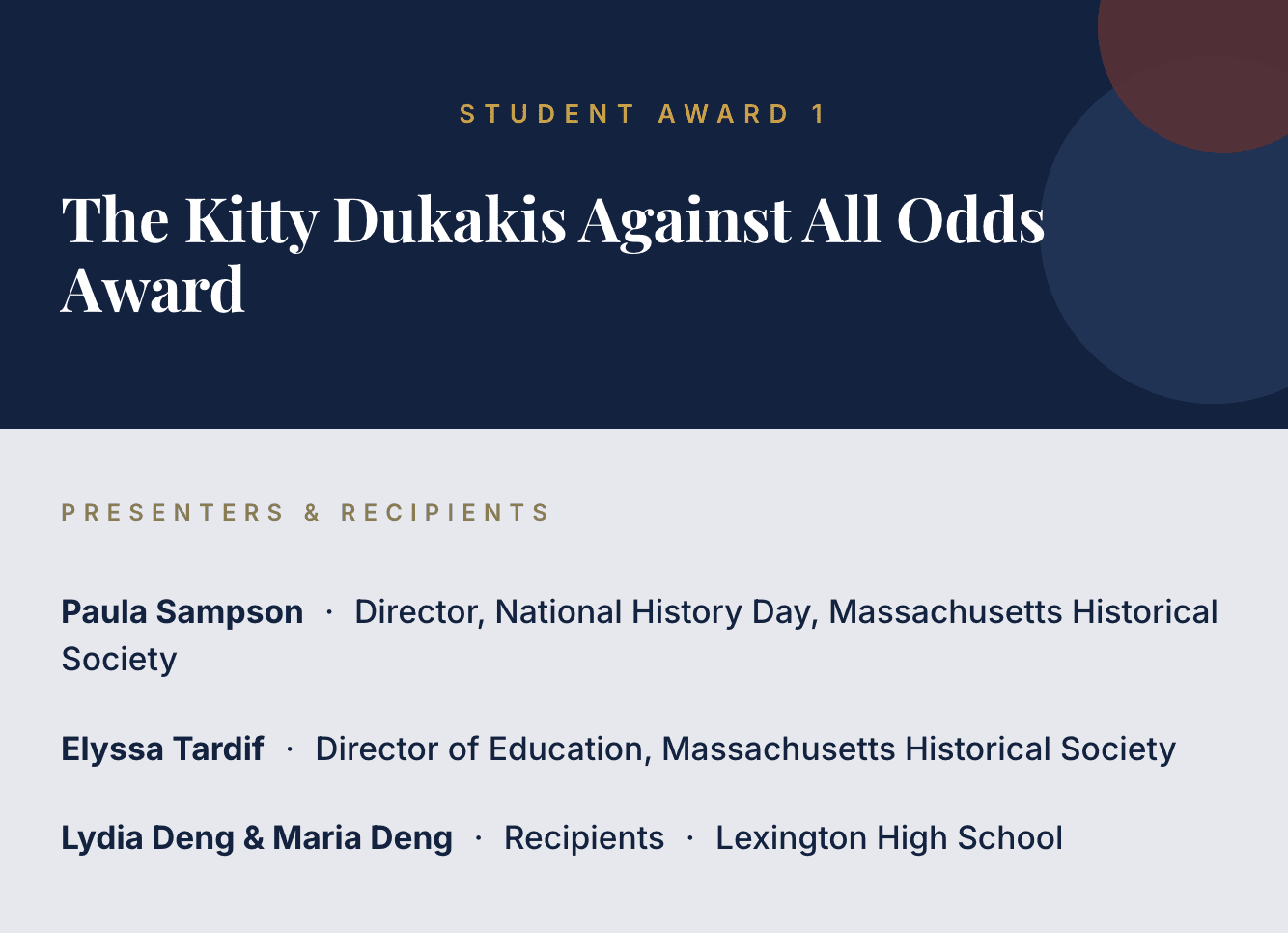

The Kitty Dukakis Against All Odds Award was presented in partnership with the Massachusetts Historical Society’s Massachusetts History Day program. This initiative engages approximately 5,000 Massachusetts students in grades 5 through 12 in deep, primary-source historical research each year, with students producing documentaries, websites, papers, live performances, museum-quality exhibits, and podcasts around an annual theme. This year’s theme: Revolution, Reaction, and Reform in History.

Twin sisters Lydia and Maria Deng received the award for a documentary that began with a question: Why did the first global Asian American movie star have to leave her own country to find lead roles? Their research took them to the Library of Congress and the Smithsonian, where they examined primary sources documenting the systematic exclusion of Asian American actors from Hollywood’s golden age — through practices like “yellowface,” the Chinese Exclusion Act, and anti-miscegenation laws that were used to bar Anna May Wong from roles she was plainly suited to play.
“One story matters because we cannot understand history as just a collection of events that happened long ago. It dictates the stories of today.”
— Lydia Deng, accepting the Kitty Dukakis Against All Odds Award
For the Deng sisters, the project became personal. Sifting through photographs of the 1871 Chinese massacre and xenophobic propaganda used to dehumanize their own community, they also found something else: the resilience of a woman who refused to be confined to a single identity. When Hollywood cast her out, Anna May Wong left for Europe and remade herself. She would not be diminished. In accepting the award, Lydia and Maria connected Wong’s story to the present moment. They called for equitable and inclusive storytelling, and for the founding values of the country to be fully honored, including for women from every background. Their documentary will be presented at the National History Day competition in Washington, D.C.

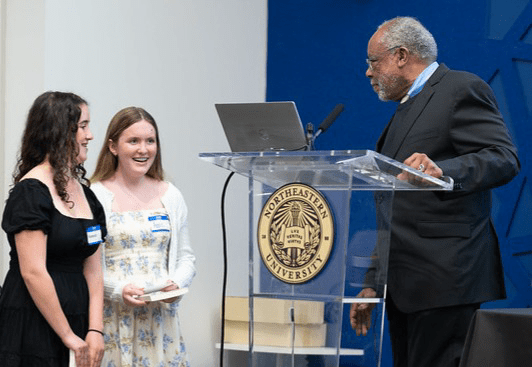
The Ted Landsmark Good Trouble Award — named for Landsmark’s long reputation for principled, persistent, and strategically targeted civic troublemaking, in the tradition of Congressman John Lewis — was presented by Landsmark himself to this year’s recipients.

Anne Kort and Hannah Beezer chose the Soweto Uprising — the 1976 student-led protests in South Africa against apartheid’s imposition of Afrikaans as the medium of instruction — because they were drawn to the fact that students their own age were the ones who sparked a massive shift in history. The bravery of those young people became their inspiration, and the process of researching and telling that story with accuracy and respect left a permanent mark.
“History isn’t just about dates. It’s about the choice to stand up when things are unjust, even if it’s dangerous to do so.”
— Anne Kort & Hannah Beezer, accepting the Ted Landsmark Good Trouble Award
In presenting the award, Landsmark was characteristically direct about what it represents: stirring up the kind of trouble that makes a positive difference. He told the recipients that they had a lifetime ahead of them to continue the work they had started, and that he was deeply honored to have the award associated with his name, not as a personal monument, but as a standard.


Richard O’Bryant closed the formal program with a tribute to Ted Landsmark that was warm, personal, and — in O’Bryant’s own telling — decidedly not a roast, despite Alicia Modestino’s advance billing. What emerged instead was a reflection on what it means to know someone over decades, and to discover, as time passes, the full dimensions of their impact.
O’Bryant described growing up aware of his father’s legacy at Northeastern, learning more about it, as he grew older, through the people who had worked alongside John D. O’Bryant and who kept that memory alive. Ted Landsmark, he said, was one of those people, someone whose presence had helped O’Bryant understand his own history more fully. That kind of contribution, he suggested, is not captured in a CV. It shows up in how people carry themselves and what they pass on.
“Ted the person, Ted the professional, Ted the activist, Ted the artist — all of these things are what impact us and the generations coming behind us.”
— Richard O’Bryant
O’Bryant recalled his early days in Northeastern’s political science department and his welcome by colleagues including Chris Bosso, John Portz, Barry Bluestone, Dennis Sullivan, and Governor Dukakis himself, who spotted him in the hallway, waved him into his office, and proceeded to give him a lesson. The lesson, O’Bryant said, was one that Landsmark also embodies: that no matter how much technology changes political strategy, you still have to knock on doors. Relationships with people are what matter, and always will.
The Good Trouble Award, he said, bore Landsmark’s name for a reason. Landsmark speaks softly and then, before you know it, he has cut straight to the heart of something unjust and refused to let it pass unchallenged. In the tradition of John Lewis, he is someone who has spent decades standing up to what is wrong and making sure it does not go unanswered. Northeastern is fortunate to count him as a colleague, a friend, and above all, a teacher, one whose influence on students’ lives has been, in O’Bryant’s word, immense.

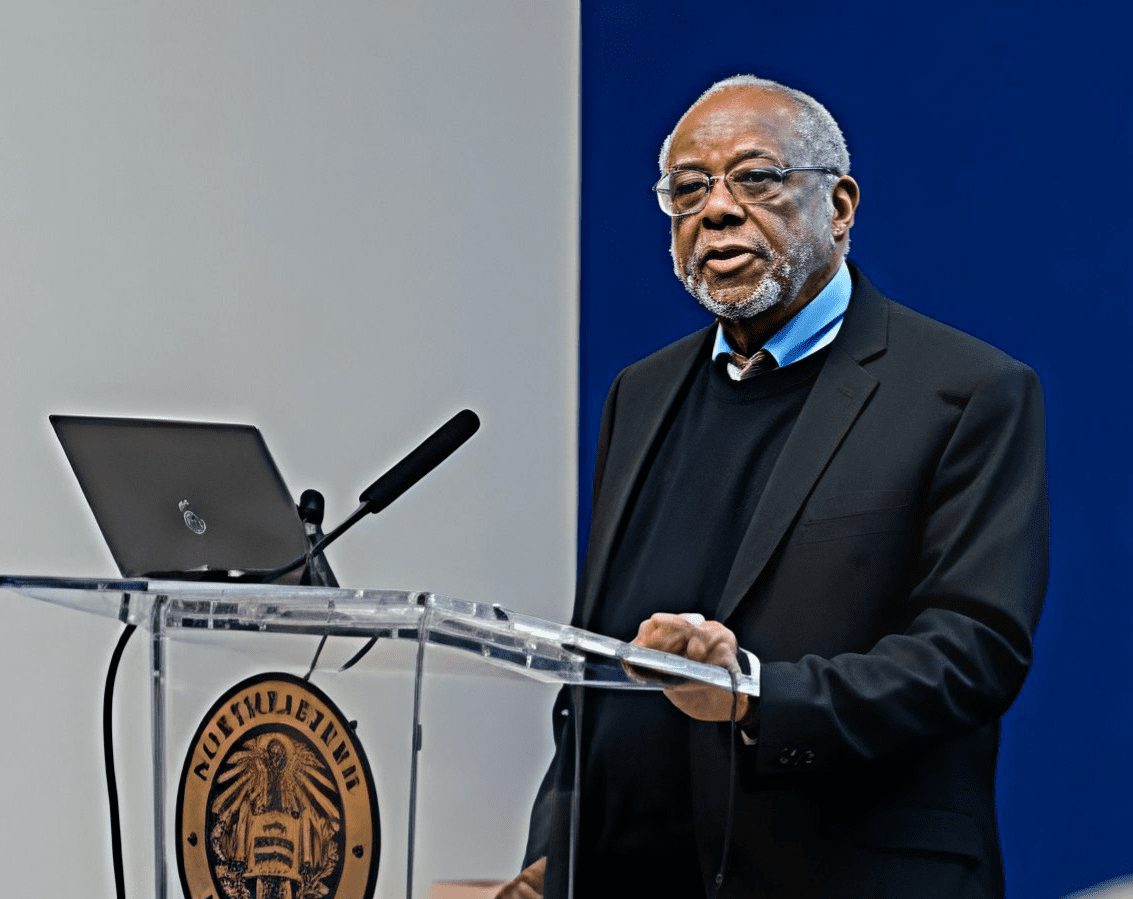
Ted Landsmark closed the conference with brief words fitting for the moment. He acknowledged that the country is going through genuinely troubled times, and did not minimize that. But he offered something more durable than reassurance: the observation that, over a lifetime of civic engagement, the worst does not simply pass on its own. It passes because people persist, because they advocate steadily and refuse to be discouraged, and because the work accumulates.
“If you’re persistent and you’re a steady advocate, the worst passes — not because it just passes, but because of your advocacy. And the worst of this will pass because of the work you’re doing.”
— Ted Landsmark
It was, in its own way, a restatement of everything the day had been about: Kitty Dukakis’ pragmatic optimism, the Dukakis Center’s belief that research and relationships together can make tangible differences, and the students’ demonstration that the next generation is already choosing to stand up. The conference ended with cake and with a birthday song for Ted Landsmark, who, it turned out, had been getting into good trouble for exactly one more year.
Acknowledgments
The student awards were made possible through the partnership of the Massachusetts Historical Society and its National History Day program. We are grateful to Paula Sampson and Elyssa Tardif for their commitment to this work and for bringing these extraordinary students into the day’s program.
We congratulate Lydia and Maria Deng of Lexington High School, recipients of the Kitty Dukakis Against All Odds Award, and Anne Kort and Hannah Beezer from Needham High, recipients of the Ted Landsmark Good Trouble Award. Their research and their courage in telling difficult stories with accuracy and care are exactly what both awards are meant to honor.
We thank Richard O’Bryant for closing the program and honoring Ted Landsmark with the warmth and insight that characterizes everything he does at the John D. O’Bryant African American Institute.
And we thank Ted Landsmark for the decades of leadership, mentorship, advocacy, and good trouble that have shaped this Center, this university, and this community. Happy birthday, Ted!