
Skip to content
Apply
Stories

Northeastern researcher pledges to unlock power of cellphone-generated mobility data to benefit neighborhoods

People in this story

Photo Matthew Modoono/Northeastern University
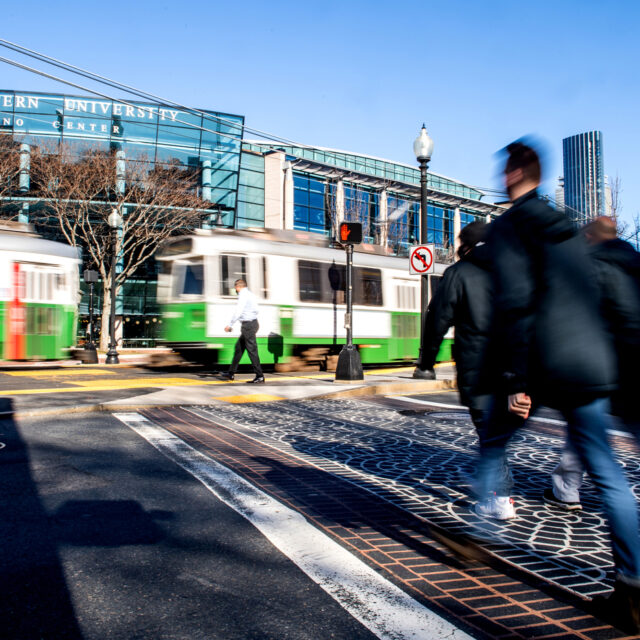
01/25/21 - BOSTON, MA - Members of the Northeastern community cross Huntington Avenue behind a Green Line train on Jan. 25, 2021.

In a joint effort funded by the National Science Foundation, scientists from Northeastern University and Massachusetts Institute of Technology plan to build a public mobility data platform for the Boston area that will help neighborhoods and communities use cellphone-generated data to address issues of social equity, racial and socioeconomic segregation, economic development and climate resilience.

The COVID-19 pandemic and contact tracing demonstrated that cellphone-generated mobility data can be essential for understanding how people move around and interact with society on a daily basis. However, these cutting-edge data have been accessible to only a handful of data scientists as they are both very complex and sensitive.

The new initiative called Mobility Data for Communities, or MD4C, of Northeastern’s Boston Area Research InitiativeBurnes Center for Social Impact and MIT’s Human Dynamics Lab aims to change that.

Continue reading at News@Northeastern.

More Stories

Brian Walshe (left) is on trial for first-degree murder. Prosecutors say Walshe killed his wife in early 2023. (Mark Stockwell/Boston Herald via AP, Pool)

Brian Walshe’s trial is coming to an end. Here’s what you need to know about the unusual court proceedings

12.15.2025
Sarah Connell, associate director for the NULab for Digital Humanities and Computational Social Science, has been part of the collaboration. Photo by Alyssa Stone/Northeastern University

Scientific discovery was slower when women were ignored, research shows

12.12.2025
SNAP sign

Trump administration says it needs to fight SNAP fraud, but the extent of the problem is unclear

12.16.25
All Stories