From Nairobi to Saint-Louis: Carmella Uwineza Rethinks Who Shapes Africa’s Energy Future
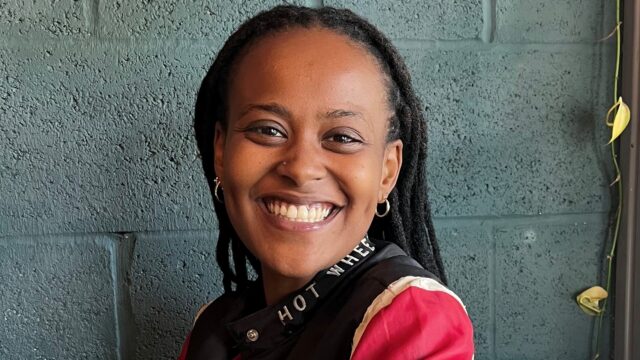
PhD student and Humanities Center Global Fellow Carmella Uwineza spent nearly a year doing fieldwork in Nairobi, Kenya, and in Dakar and Saint-Louis, Senegal, supported by Brown’s Climate Social Science Network, a Sloan grant, and CSSH fellowships. Her dissertation examines how Africa’s national and local energy transition priorities clash with the goals of international climate finance.
“Despairing about the world has never been my ministry, so to speak. So, one thing I took away from fieldwork is how many people are doing very important and cool work while being very clear-eyed about the current limitations and challenges ahead.”
What is your dissertation about, and what drew you to Kenya and Senegal?
My dissertation examines the tensions between national/local priorities and models of energy transitions in Africa, compared with the objectives of international climate and energy finance. I explore how power dynamics operate across multiple scales, from international financial institutions that support energy projects in Africa, to how countries and frontline communities navigate and negotiate these dynamics. The dissertation shows how competing energy priorities across these scales interact, as well as their implications for just and anti-colonial energy transition pathways.
Although my worldview has been shaped by perspectives beyond the continent, Africa has always been my center. So, Africa was always going to be this dissertation’s main focus. Kenya and Senegal, were, of course both an appropriate fit for the research questions since they offer two distinct pathways to the energy transition and engage with international finance using various approaches. Being in both places allowed me to gain an understanding of their priorities and strategies, emerging governance and finance models, and how questions of justice and equity take shape within them.
On a more personal level, I have ties to both places, so that made working there even more special. For Senegal, specifically, I spent a significant portion of my adolescence living in Dakar and it’s where I became conscious of environmental issues, making my return after a decade all the more meaningful.
You spent almost a year doing fieldwork. What did that look like day to day?
The days varied widely, but most of the time I was either interviewing participants or preparing to interview them. In Nairobi, I was based at the African Leadership Centre, which provided wonderful support and a base to work from. I spent a lot of time taking bodas (motorcycle taxis) around the city for interviews with my research assistant Talia Dora. I also did my best to connect with researchers and practitioners by attending events in the city, including a research workshop at the University of Nairobi and the 7th Session of the United Nations Environment Assembly. Nairobi is so vibrant and there was no shortage of live music to listen to, exhibitions to see, out-of-city excursions (hiking Mount Kenya), opportunities to be in nature (Karura Forest), and wonderful people to meet.
I had a similar approach to conducting fieldwork in Dakar, working closely with my research assistant Souleymane Ndiaye, a PhD student at Université Gaston-Berger (UGB). Dakar is a city that asks you to slow down and connect with those around you. I had the pleasure of celebrating Eid (Tabaski) with my family, taking surf lessons, and swimming on Ngor Island.
In Saint-Louis, specifically, the pace slowed down. I spent a lot of time with people, from chatting about research with students at UGB to having informal discussions with locals who would invite me to join them for lunch. Sharing food with others, specifically tchieboudienne (the national dish that combines fish, vegetables and rice), became the norm. The slowness enabled me to be present, intentionally connect with people, and absorb as much as I could about the place, the community, and the importance of both fishing and photography as cultural practices. Saint-Louis is notorious for its vibrant and artistic culture and is also a pioneering hub of West African photography. I visited the Saint-Louis Photography Museum (MuPho) and learned about archival practices from Senegalese artists whose work inspired my approach to Photovoice. Check out Lost Memory Archive Senegal (LMAS).
Which research methods did you use and why did you choose them?
I used qualitative methods during fieldwork, namely semi-structured interviews and Photovoice. My research asks questions about power, knowledge, and whose priorities shape energy development and transitions. So, it was important for my methodologies and approach to reflect those questions. Research practices in Africa have a long history of being extractive, and I wanted to be attentive and careful to that history. Photovoice enabled me to undertake research in collaboration with a community partner, the Union of Women Processors and Traders in Saint-Louis. My work with them was an attempt to flip the script. They became my co-researchers, collecting data through photography, and interpreting it collectively, and eventually retaining the images. This is one way that knowledge comes from and remains within the community, and the outputs can serve their ongoing advocacy work. We are also planning an exhibition in Saint-Louis, specifically in Guet Ndar, to share the results of this activity.
Was there a particular moment this past year that changed how you were thinking about your project?
There were so many moments, and I think that’s the point! I’m grateful for how much my assumptions were challenged and how comfortable I became with contradiction and not having an easy answer to anything. A common thread throughout the year was creativity and discipline.
There tends to be a lot of despair in conversations about climate change and climate action, especially when one accounts for how incremental the progress is, how the huge systemic structures driving these problems are not being disrupted quickly enough, and how ‘there’s not enough money.’ While there is validity to some of these concerns, despairing about the world has never been my ministry, so to speak. So, one thing I took away from fieldwork is how many people are doing very important and cool work while being very clear-eyed about the current limitations and challenges ahead. Seeing so many examples of creativity, strategic collaboration, and discipline being actively applied to problem-solving was energizing. It made me excited to spend my time doing work that can contribute to this larger project and vision of a more just world, however small it might be in the context of this challenge and my lifetime.
What’s next for the project, and what advice would you offer others heading into fieldwork?
I’m a Humanities Center Global Fellow this year and focused on writing and dissertating. I hope to write a coherent piece of work that I’m proud of and that does justice to what I learned and what people generously shared with me over the past year.
For anyone starting fieldwork, I’d say: leave room for the project to change and for you to grow. Being as prepared as you can be is important, but things rarely go according to plan. Remaining flexible, adaptable, and curious is key. The time flies by quickly, so be present, engaged, and have fun!
