
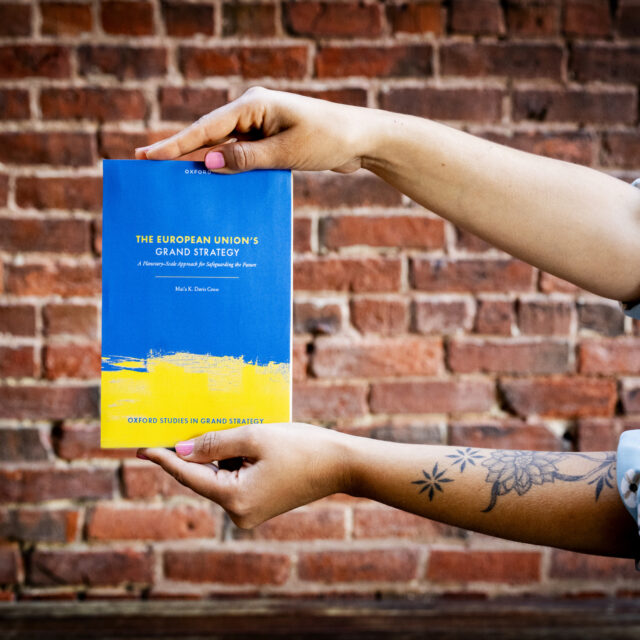
When Northeastern University Professor Mai’a Cross embarked on her latest book about the European Union (EU) and its future, the continent was in the midst of tumult and transformation. Russia had invaded Ukraine and President Vladimir Putin had set about reshaping the European security architecture. “I realized that this was going to present a bit of a challenge in terms of how I pin this down, with the situation on the ground being so fluid,” Cross, dean’s professor of political science, international affairs and diplomacy, told Northeastern Global News.
But the changing circumstances did little to deter the visionary professor, who has written extensively about international cooperation and diplomacy through the European lens. If anything, they further underscored the thesis that would emerge in her book: that the EU’s long-term commitments in the domains of environmental protection, scientific research and democracy could help secure humanity’s survival and flourishing for generations to come. In her latest ambitious, interdisciplinary work “The European Union’s Grand Strategy: A Planetary-Scale Approach for Safeguarding the Future,” published this month by Oxford University Press, Cross lays out a long-term vision for how the EU can help protect humanity’s future while navigating the numerous and evolving existential threats — from nuclear annihilation and runaway artificial intelligence systems, to climate catastrophe and the erosion of democracy.