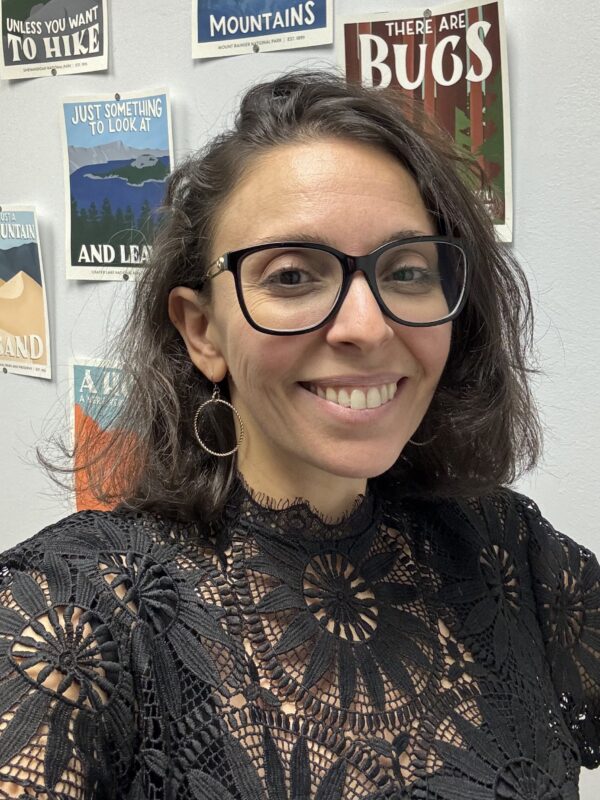
Associate Teaching Professor
Diana Epelbaum, Ph.D., is Associate Teaching Professor in English and Coordinator of the Writing Program at NU-NYC. Her teaching and scholarship are interdisciplinary, bridging Writing and Rhetoric, Eighteen-Century Cultures of Transatlantic Science, and Early American Literature. She is a lifelong educator trained in best practices in writing, reading, and thinking pedagogies. Over the last decade, Diana’s courses have focused on equity, student agency, and writing transfer through metacognition, and she is currently at work on a teaching book that explores the intersection of classroom metacognitive practice with the science of learning. Diana has frequently trained faculty across the curriculum in writing pedagogy and classroom metacognition.
- Faculty Resource Network Convener, New York University Summers 2021-2023
- Scholars’ Workshop Fellowship, Omohundro Institute for Early American Studies (2020)
- Millennium Dissertation Year Fellowship, Graduate Center, CUNY (2015-2016)
- The New York Times Teachers Who Make a Difference Award, New York Times (2009)
- Epelbaum, Diana. “Design, Pedagogy, and Pandemic Teaching Tools in an Interdisciplinary History of Science Course.” Teaching the 18th Century, edited by Kate Parker and Miriam Wallace, Bucknell U.P., 2023, pp. 114-134.
- Epelbaum, Diana. “‘Little Atlas’: Global Travel and Local Preservation in Maria Sibylla Merian’s The Metamorphosis of the Insects of Surinam.” Transatlantic Eighteenth-Century Women Travelers, edited by Misty Krueger, Bucknell U.P., 2021, pp. 23-47.
- Epelbaum, Diana. “Knowing Emotion: College Initiation and Self-Confrontation in the ‘Meta’ Writing Classroom.” Preserving Emotion in Student Writing, edited by Craig Wynne, Peter Lang, 2020, pp. 57-84.
-
Education
Ph.D. in English, The Graduate Center--City University of New York (2016)
-
Address
Nugent 151
-
Office Hours
Tuesdays & Fridays, 12:00-1:15 p.m. & by Appointment (Fall 2026)

First-Year Writing
ENGW 1111
Designed for students to study and practice writing in a workshop setting. Students read a range of texts in order to describe and evaluate the choices writers make and apply that knowledge to their own writing and explore how writing functions in a range of academic, professional, and public contexts. Offers students an opportunity to learn how to conduct research using primary and secondary sources; how to write for various purposes and audiences in multiple genres and media; and how to give and receive feedback, to revise their work, and to reflect on their growth as writers.