Skip to content
Apply
Stories

Professor develops ‘emerald tutu’ of floating wetlands to protect Boston from floods

People in this story

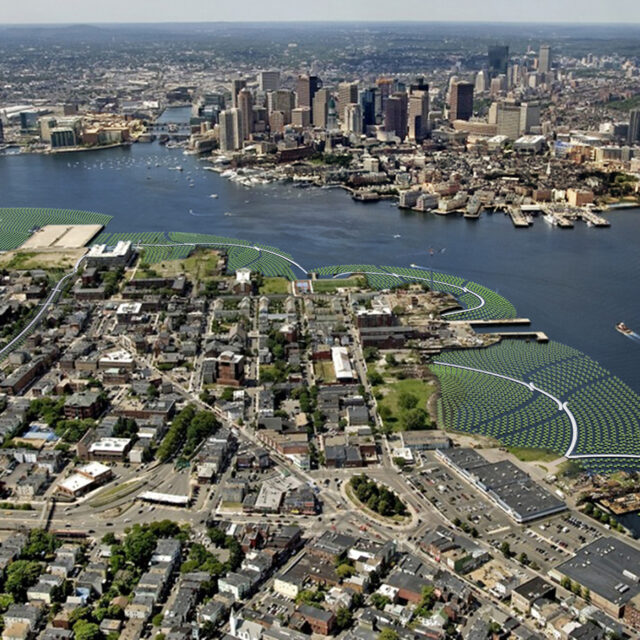
People have heard of Boston’s famed “Emerald Necklace” with its network of parks and green spaces. Northeastern University assistant professor Julia Hopkins hopes that Boston soon will be known for the “Emerald Tutu,” a system of interconnected circular mats of floating vegetation that can be arranged in rings and semicircles to protect urban coasts from sea level rise and intensified storms. Like land-based parks, the Emerald Tutu is designed to feature walkways that get people out in nature—in this case out on the shallow waters of coastal shorelines.

But in addition to being aesthetically pleasing and recreational, the Emerald Tutu would absorb wave energy and help ameliorate the flooding that increasingly threatens to inundate Boston and other coastal cities. “It functions as a marsh without being a marsh,” says Hopkins, who specializes in civil and environmental engineering and is lead scientist for the Emerald Tutu startup. 

Continue reading at News@Northeastern.

More Stories

FILE - Elon Musk arrives to speak at an indoor Presidential Inauguration parade event in Washington, Jan. 20, 2025. (AP Photo/Matt Rourke, File)

What do campaign ads buy you in 2026? It may not be much, experts say.

10.29.2026
01/10/24 - BURLINGTON, MA. - Stock photography of the Colosseum which is operated by the Institute for the Wireless Internet of Things (W-IoT) at Northeastern University, and housed at the Northeastern Innovation Campus in Burlington, Massachusetts on Jan. 10, 2024. The Colosseum at is the world's largest RF emulator with 256 programmable software radios which enables academic, government, and industry researchers to perform scalable and repeatable experimentation in wireless systems in a large-scale emulation environment. Photo by Matthew Modoono/Northeastern University

Democrats, Republicans support government intervention to train workforce on AI tools, Northeastern University survey finds

10.26.2026
10/31/17 - BOSTON, MA. - Stock images of pumpkins on Halloween on Oct. 31, 2017. Photo by Adam Glanzman/Northeastern University

Halloween originated in Scotland 2,000 years ago – so how did it become so big in America? Northeastern historians explain

10.29.26
Northeastern Global News