
Skip to content
Apply
Stories

Russia-Ukraine, Israel-Hamas: Can international law stand up to global conflict?

People in this story

President of Serbia Aleksandar Vui speaks during a United Nations (UN) General Assembly meeting to vote on the creation of an International day to commemorate the Srebrenica genocide at UN headquarters in New York on May 23, 2024. (Photo by ANGELA WEISS / AFP) (Photo by ANGELA WEISS/AFP via Getty Images)

With protracted wars going on in Europe and the Middle East, the international legal system — and the liberal international order, itself — is being tested like never before. Those wars have come at significant cost in terms of civilian casualties, a fact that has led some to question the efficacy of international humanitarian law, a subset of international law that concerns the protection of civilians during armed conflict. 

In a recent issue of Foreign Affairs, one observer argues that the so-called laws of war have “broken down” as civilian deaths in Gaza climb to as high as 35,000, according to some estimates. In Ukraine, more than 10,000 civilians have been killed in Russia’s ongoing war, according to Oxfam International.

In a world system with a shared set of rules for how wars must be conducted, wherever the atrocities of war play out, the specter of accountability looms. But accountability under the international system “is a long process,” says Mai’a Cross, dean’s professor of political science, international affairs and diplomacy, and director of the Center for International Affairs and World Cultures at Northeastern University.

Continue reading at Northeastern Global News.

More Stories

Rear view of two multiracial police officers patrolling a community on foot. They are standing at a street corner looking toward an empty intersection. The policewoman is mixed race, African-American, Asian and Hispanic, in her 40s. Her partner is a young Hispanic man in his 20s.

Police recruits learn a lot from their field training officers, including use of force

03.04.2026
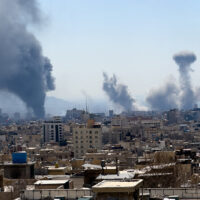
Plumes of smoke rise following reported explosions in Tehran on March 1, 2026, after Iran's supreme leader, Ayatollah Ali Khamenei, was killed a day earlier in a large U.S. and Israeli attack, prompting a new wave of retaliatory missile strikes from Iran. (Photo by Mahsa / Middle East Images / AFP via Getty Images)

The US says its war with Iran could last weeks. But what if Congress intervenes?

03.03.2026
Sustainable green rooftop architecture in eco-friendly modern urban cityscape

Making green space ‘part of the game’: How considering urban forestry at multiple scales can improve city planning

03.05.26
Northeastern Global News