
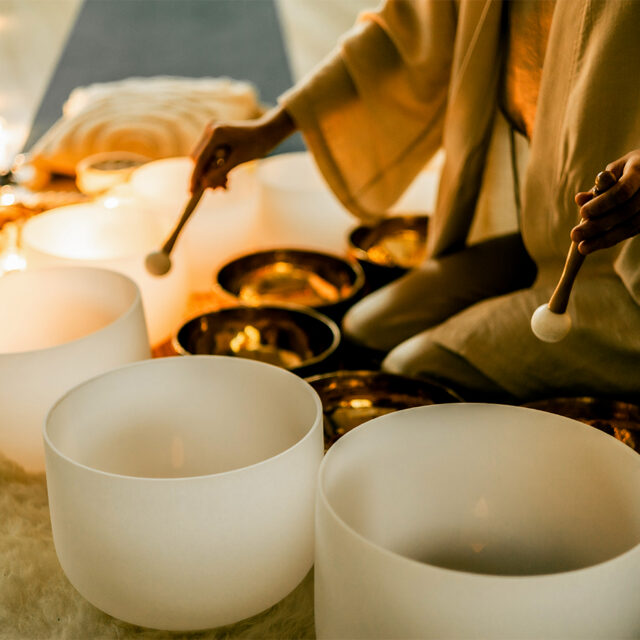
It’s Mental Health Awareness Week at Northeastern, which means NU London has a range of events for students to get involved. One of these in particular piqued my interest: A sound bath, taking place at Chapter Spitalfields, NU London’s accommodation space. I’d never heard of a sound bath before, so I went along to experience it firsthand. So, what is a sound bath? Well, it doesn’t involve an actual bath, nor is there any water. It’s an immersive experience where you’re exposed to deep sound vibrations to help you relax and feel rejuvenated. The vibrations come from “singing bowls”, which are simply bowl-shaped instruments made of metal and glass. The practitioner can either strike the bowl or rub the rim to get a sustained vibration – much like how I like to make unnecessary noise at the dinner by rubbing the rim of my wine glass.
According to Elizabeth Bucar, a professor at Northeastern University’s Department of Philosophy and Religion, sound baths are gaining popularity as a spiritual wellness practice – but the science of how exactly they work on the human body is still at an early stage. “There are scientific theories about why sound baths have these effects,” she explains in her new book Beyond Wellness. “Some posit that sound alters brainwave states and that sound baths induce states associated with greater levels of relaxation. Others suggest that a sound bath stimulates the vagus nerve to produce an increased feeling of well-being. Underlying all these theories is some version of the idea that humans have an internal rhythm that vibrations can alter, thereby improving us,” according to Bucar.