
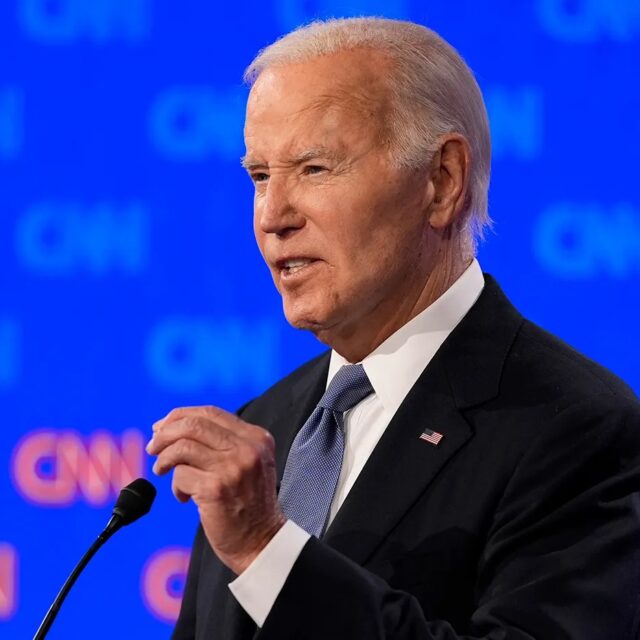
President Joe Biden’s performance during the first presidential debate has been widely panned, with critics and even those within his own party calling for him to step aside. But the question remained: Would Biden’s shaky performance against former President Donald Trump result in a noticeable dip in the polls for the president? According to a new report from the Northeastern University-led data project CHIP50, the answer is no. Led by David Lazer, university distinguished professor of political science and computer science at Northeastern, the report indicates that the debate had little if any impact on people’s voting preference. Lazer hopes the report helps illustrate the dangers of making a mountain out of a molehill when it comes to the media interpreting data.
“Even the New York Times, which is usually better about this, talked about a very tiny shift that was totally insignificant statistically like it was evidence that it was a shift toward Trump after the debate,” Lazer says. “My hope is that reporters look at this and say, ‘Maybe we need to be careful in overinterpreting noise as actual signal.’” Seeing the dominant narrative coming out of the debate, Lazer and the team at CHIP50 decided to test the hypothesis that Biden had lost ground in public opinion after the debate. Notably, Lazer says, they didn’t survey two different cross-sectional groups of people before and after the debate like most polls. Instead, the team was able to survey the same group of respondents from a survey conducted before the debate.