Skip to content
Apply
Stories

Can the US play peacekeeper in the Israel-Hamas war?

People in this story

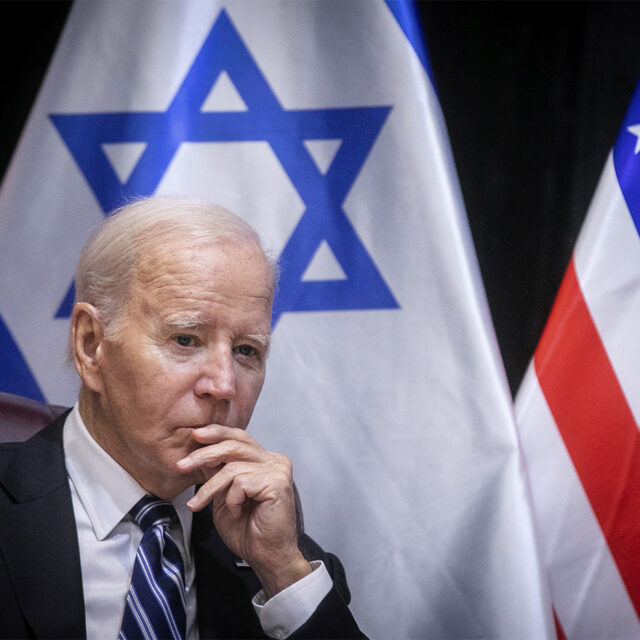
U.S. President Joe Biden pauses during a meeting with Israeli Prime Minister Benjamin Netanyahu to discuss the war between Israel and Hamas, in Tel Aviv, Israel.

On Wednesday, President Joe Biden announced that the U.S. will be sending $100 million in humanitarian support to help “1 million displaced and conflict-affected Palestinians.” At the same time, Israel has asked the U.S. for $10 billion in emergency military support, which Biden is reportedly asking Congress for as part of a “major foreign policy aid package” that would also include the support for Gaza and the West Bank.

Many observers and social media users on both sides of the conflict were quick to suggest that the separate aid packages may only serve cross-purposes, as Israel’s bombing campaign has resulted in civilian deaths. Additionally, others note that there are no guarantees that the humanitarian aid won’t end up in the hands of Hamas, the militant group that carried out an attack on Israeli civilians on Oct. 7 that sparked the war.

With aid potentially heading to both Israelis and Palestinians, can the U.S. play peacekeeper, or will its actions only further fan the flames? It is a complicated dynamic to unpack — one that’s enveloped in a fog of war that’s replete with disinformation, experts note.

Continue reading at Northeastern Global News.

More Stories

FILE - Elon Musk arrives to speak at an indoor Presidential Inauguration parade event in Washington, Jan. 20, 2025. (AP Photo/Matt Rourke, File)

What do campaign ads buy you in 2026? It may not be much, experts say.

10.29.2026
01/10/24 - BURLINGTON, MA. - Stock photography of the Colosseum which is operated by the Institute for the Wireless Internet of Things (W-IoT) at Northeastern University, and housed at the Northeastern Innovation Campus in Burlington, Massachusetts on Jan. 10, 2024. The Colosseum at is the world's largest RF emulator with 256 programmable software radios which enables academic, government, and industry researchers to perform scalable and repeatable experimentation in wireless systems in a large-scale emulation environment. Photo by Matthew Modoono/Northeastern University

Democrats, Republicans support government intervention to train workforce on AI tools, Northeastern University survey finds

10.26.2026
10/31/17 - BOSTON, MA. - Stock images of pumpkins on Halloween on Oct. 31, 2017. Photo by Adam Glanzman/Northeastern University

Halloween originated in Scotland 2,000 years ago – so how did it become so big in America? Northeastern historians explain

10.29.26
Northeastern Global News