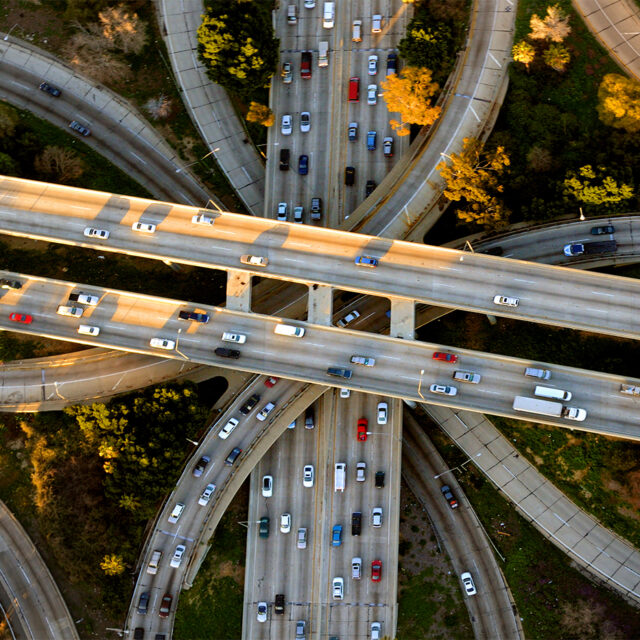
When singer-songwriter Joni Mitchell railed against environmental destruction in her 1970 song “Big Yellow Taxi,” she cautioned against paving paradise and putting up a parking lot. But she might have been better off warning about highways. U.S. cities are rapidly becoming urban heat islands, where these cities are significantly warmer than their surrounding area. Vast expanses of asphalt and concrete trap heat, while large, densely packed buildings disrupt wind flow and intensify the effect. But beyond parking lots and skyscrapers, recent research points to highways as another cause behind America’s urban heat islands.
By studying satellite-based temperature data before and after 11 major highway expansion projects in the San Francisco Bay Area, researchers found all the projects had “significant and measurable” impacts on the urban heat island effect, said Serena Alexander, an associate professor of public policy, urban affairs and civil and environmental engineering at Northeastern University. These highway projects, which involved everything from adding lanes to installing guardrails, accounted for 70-88% of the intensifying heat disparity researchers found through their analysis.