
Skip to content
Apply
Stories

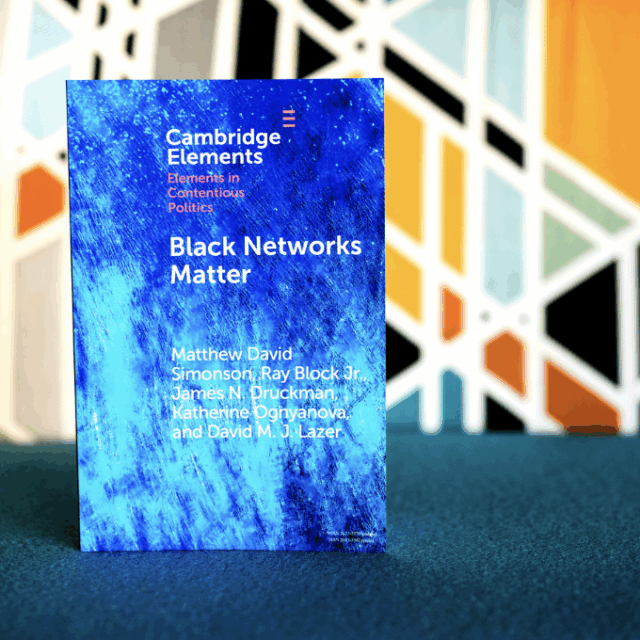
New book describes how Black Americans used the power of networks and allies to organize largest protests in nation’s history

People in this story

In May 2020, the video of George Floyd’s death at the hands of a Minneapolis police officer sparked an uptick in protests by the Black Lives Matter movement. What turned the rallies into what is believed to be the largest mass mobilization in the nation’s history later that summer was the way Black Americans reached out on social media to share their stories of encounters with racism, Northeastern University researchers say.

“Black Networks Matter,” a new book co-authored by Northeastern professor David Lazer, describes how a social justice movement used the power of relatively new technology and networks to motivate more than 10 million people to rally and demand justice for Black victims of racism and police killings. “The scale (of the protests) clearly has a lot to do with social media and the role that social media played in mobilizing people,” says Lazer, whose research relies on survey data from 5,000 protesters as well as 100,000 non-protesters.

Most of the protesters were not Black, a unique development in civil rights demonstrations, says Lazer, an expert in network science and university distinguished professor of political science and computer sciences. “We found that interracial ties between Blacks and non-Blacks were really crucial in mobilizing non-Black participation,” he says. “The diversity of the protestors is in part driven by those cross racial ties.

Read more at Northeastern Global News.

More Stories

08/14/26 - BOSTON, MA. - Ayla DiBattista, who studies international affairs with minors in economics and cultural anthropology, poses for photos on Aug. 14, 2026. DiBattista recently completed co-op with CANVAS, a Serbian organization that promotes pro-democracy activism. She helped build an AI to help activists worldwide. Photo by Matthew Modoono/Northeastern University

On co-op in Serbia, she helped build an AI to give activists worldwide a leg up

09.04.2026
A Flock LPR automatic license plate reader installed to monitor traffic is seen on August 13, 2026 in Arlington, Virginia. Flock has come under fire by critics who accuse the company of mass surveillance of Americans and incidents where law enforcement has abused the system for personal reasons. (Photo by Samuel Corum/Sipa USA)(Sipa via AP Images)

What’s behind the Flock camera controversy?

09.01.2026
As seen from the New Jersey Turnpike near Kearny, N.J., smoke billows from the twin towers of the World Trade Center in New York after airplanes crashed into both towers Tuesday, Sept.11, 2001. (AP Photo/Gene Boyars)

 Incoming Northeastern freshmen weren’t born yet, as nation marks 9/11’s 25th anniversary

09.11.26
Northeastern Global News