
This project is supported by the Robert H.N. Ho Family Foundation Global.

How should Buddhist communities understand and respond to abuses of power? What new forms of suffering are emerging through artificial intelligence, algorithms, and social media? What sorts of entities – for example, plants or AI – are capable of suffering and liberation from it? These were some of the questions asked at the Buddhist Ethics Symposium in June 2026.
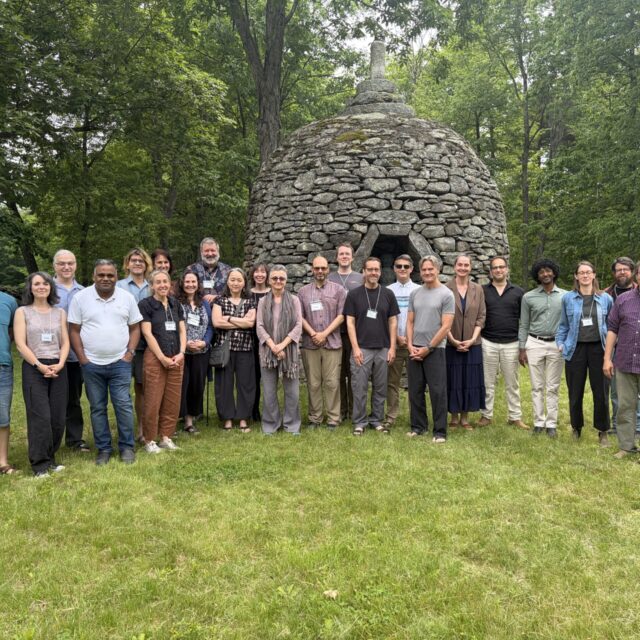
The Buddhist Ethics Symposium has been held every two years (except 2020) since 2016. This year it was held at the Barre Center for Buddhist Studies in western Massachusetts, and administered by Northeastern’s Ethics Institute. A generous grant from the Robert H.N. Ho Family Foundation Global covered travel funding for many participants, and support for project management and logistics.
Unlike many academic conferences, the symposium does not center formal paper presentations. Facilitators share a small number of readings in advance, introduce a theme, and invite participants to explore questions together. Conversations are rich, as participants come from a broad range of academic disciplines related to Buddhist Studies, including philosophy, ethnography and anthropology, history, material culture and art history, gender studies, philology and textual studies, and cultural studies. They also study Buddhism across a broad range of and times, from classical India through medieval Japan and Tibet to the contemporary United States.