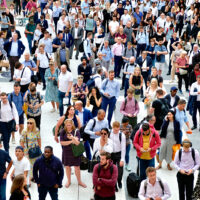

What do you see when hundreds and thousands of tiny dots are positioned together? Painter George Seurat saw a Sunday in a park in the middle of the Seine river. Northeastern University professor Daniel O’Brien sees a city. “We live at multiple geographic scales at the same time — your property, your street, and as you move up you’ve got the neighborhood, the whole city and the region — and that’s a lot like the way a pointillistic painting is organized,” explains O’Brien, a professor in the School of Public Policy and Urban Affairs and the School of Criminology and Criminal Justice.
“It’s dots that come together to form objects and those objects are organized to form the full image,” he says. It’s kind of a metaphor, O’Brien says. “Zooming in or out from a thing are all essential to understanding the full picture,” he continues. O’Brien is the author of “The Pointillistic City,” a new book from MIT Press. He is also “a big data guy” and — as director of the Boston Area Research Initiative — a leader in the field of urban informatics, which uses large data sets to both learn about and better serve communities.