Program of Learning
The Program of Learning is a 29-week training for interpreters who want to build skills for working in situations with legal implications. The Program is currently in development by a curriculum team of experienced subject matter experts, led by an instructional designer. It brings together online modules, small-group reflective practice sessions, and applied learning in your own community, with an experienced supervising partner. This is not courtroom training. It focuses on the everyday places where legal issues come up for Deaf and DeafBlind people, like benefits offices, VR meetings, health care decisions, and probate matters.
Who it’s for
Deaf, Coda, and hearing interpreters are welcome to apply for the following roles:
Trainees are interpreters with about three to five years of experience and a state or national credential is preferred. Work experience in legal or quasi-legal settings is not required.
Supervising partners are experienced interpreters with at least seven years in the field, national certification, and experience in situations with legal implications. Each supervising partner completes their own training to prepare for mentoring two trainees during applied learning.
How it works
The Program has three parts:
Module content
Online coursework you complete on your own schedule. Supervising partners take one module that prepares them to work with trainees. Trainees take one required module showing how different areas of law connect, plus three topic modules of their choice.
Reflective practice
Live Zoom sessions in small groups of five or fewer, led by an experienced facilitator. Trainees and supervising partners meet in separate groups.
Applied learning
Supervised practice in situations with legal implications in the participants’ home regions, alongside the coursework. We’ll work with our partners to help connect trainees and supervising partners with assignments.
Each supervising partner is paired with two trainees. Trainees complete 48 hours of hands-on work, and supervising partners provide at least 20 hours of mentoring to each trainee, with feedback and a debrief after each experience.
Time commitment
Trainees
- 48 hours of online module content
- 12 hours of reflective practice
- 48 hours of applied learning
Supervising Partners
- 12 hours of online module content
- 6 hours of reflective practice
- At least 40 hours mentoring (20 hours with each of two trainees)
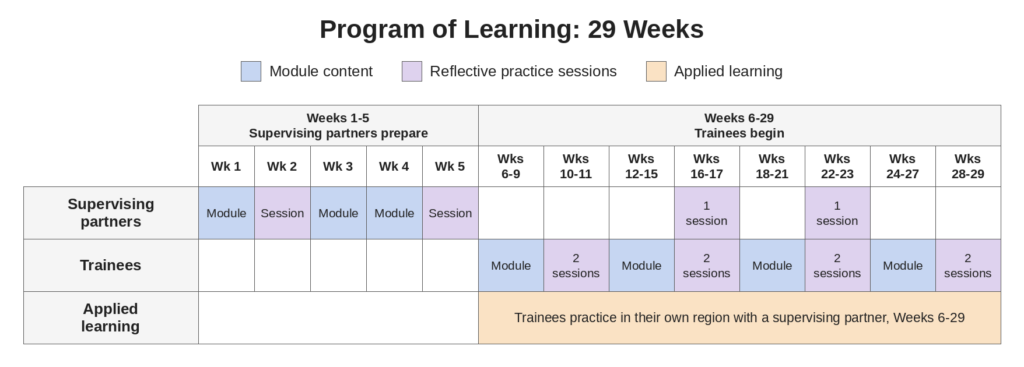
Program Timeline
Weeks 1 to 5: Supervising partners complete module content and reflective practice sessions.
Weeks 6 to 29: Applied learning runs throughout, while trainees alternate between module content and reflective practice sessions. Supervising partners also meet for a reflective practice session twice during weeks 6 to 29.
Regional Cohorts
The program will run as four regional cohorts, one per year from 2028-2031. Each cohort includes 20 trainees and 10 supervising partners.
Cohort 1 will draw from the Northeast. Cohorts for other regions will follow.
Note- Regions shown on the map are proposed and subject to change.

What you’ll get
- RID CEUs (specifics TBD).
- Trainees receive mentorship from an experienced supervising partner.
- Supervising partners receive training in how to facilitate reflective practice sessions with their trainees during applied learning.
- A network of colleagues doing this work in your region.
- A high quality training at no cost to you.
Questions
What topics will the modules cover? Topics will cover areas where deaf adults and elders often face legal issues in everyday life, such as public benefits, disability rights, health care, probate and family matters, and employment, education, and vocational rehabilitation. Our curriculum development team is working now to shape the final topics and content.
Do I need legal experience to be a trainee? No. The program is designed to build that experience.
Is this courtroom interpreting training? No. The program focuses on situations with legal implications outside the courtroom. It does build a strong foundation if you want to pursue courtroom work or legal certification later.
Can Deaf interpreters apply? Yes, Deaf interpreters are strongly encouraged to apply for both trainee and supervising partner roles.
When can I apply? Application details are not set yet. Join the mailing list and we’ll let you know as soon as plans are finalized.
What if I’m not in the Northeast? Join the mailing list. Cohorts for other regions will follow.
How is this different from the self-directed modules? The Program of Learning is a full cohort experience with reflective practice and supervised applied learning. The self-directed modules are online courses anyone can take at their own pace.
How much does it cost to participate? There is no cost to participate.