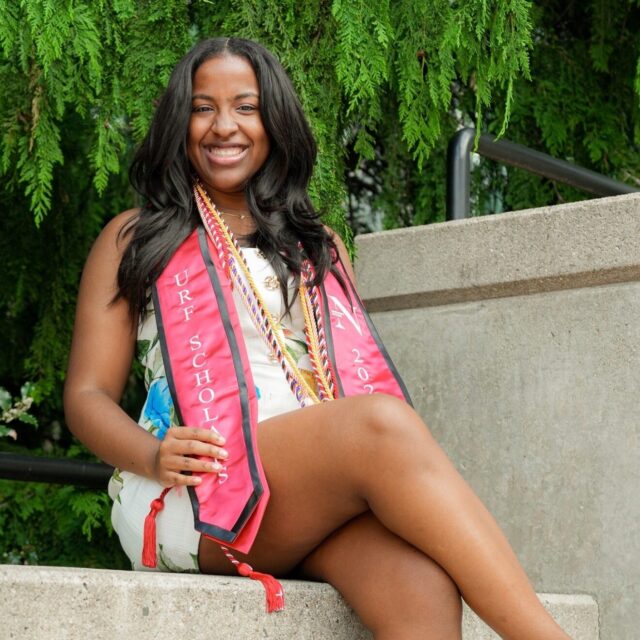
Keneya Onuaguluchi graduated from Northeastern in May 2025 with a BA in History, Culture, Law. During her time at CSSH, she was involved in research with several professors focused on the criminal justice system and reforms that could benefit it. She ended her time in Boston as the undergraduate student speaker for CSSH’s College Celebration. Keneya will be entering UCLA this fall as a distinguish
What was your path to Northeastern?
I’m from California originally, so it wasn’t on my radar until a Northeastern advisor came and gave a talk at my school, where they talked about the honors program, co-op, and experiential learning opportunities. After I applied and was accepted, I decided to dive in and learn about research opportunities, like RISE, the Office of Undergraduate Research and Fellowships (URF), co-ops, and studying abroad. Northeastern gave me the opportunity to be in a big school but really have the small-school feel. In the honors program, the classes are so small, and CSSH is also small. So it’s good to get that one-on-one attention and not feel drowned out by the big school.
What drove you to choose a major in History, Culture, and Law?
I specifically chose History, Culture, and Law because it does a really good job of exploring the intersections of race, gender, and socioeconomic background in the law. As someone who wants to be a civil rights attorney, these classes were a really good opportunity [to] look into how identity impacts how people are treated in the criminal and judicial system. It was great to explore that before law school.
Can you tell me more about the experiential learning opportunities you pursued at CSSH?
I did a summer study abroad at the London School of Economics. It was probably the highlight of my college experience! I met some really good friends and got to travel, and it was amazing to push myself. In Boston, I [had] a lot of research opportunities with Professor Patrice Collins from criminal justice. We did tons of research, with funding from URF, and they were really supportive. That experiential opportunity led me to get more hands-on with the criminal justice system. I ended up working with the Boston Office of Returning Citizens. They did a reentry summit one year, where people recently released from jail were able to attend an event to connect with resources in the area. It was great to talk to people about their needs and what the city of Boston can do for them. I really got to combine my research with the real world!
Seeing how a lack of resources can land people back into the cycle of incarceration was the most influential part for me. If you don’t have housing, food, and a job, you tend to go back to the lifestyle you’re used to, and that lifestyle tends to lead you back to the same circumstances. So it’s really important that the city pours money into those resources for reentry to prevent people from going back into the criminal system.
You’ve been very involved during your time here through various roles, such as student ambassador for Northeastern and with the Transformational Prison Project. What drove you to pursue these roles?
They’re great ways to get involved in the legal system. With the Transformational Prison Project, I was drafting policy and meeting legislatures. And being a student ambassador was important to me because I wanted to talk to students and ensure that their identities are being supported. I think Northeastern does an amazing job with affinity spaces and affirming people that they will be safe and protected.
What has been your proudest moment at Northeastern?
I would have to say giving the graduation speech was a really proud moment. When I got the invite, I was very nervous to take it, but I wanted to push myself and take on the challenge. It also felt like the culmination of a lot of years of hard work. My family was able to be there, so it was so surreal to reflect on my time at Northeastern in front of so many people. I’m so proud of pushing myself out of my box.
What got you through the challenging times while pursuing your degree?
I was definitely blessed to have a great support system of family, friends, and professors, so that was great to lean on. I also played club basketball, which was a wonderful outlet for stress. I met some of my closest friends there!
What is the biggest life lesson you’ve learned during your time at CSSH?
I found my voice a lot while being at Northeastern. I’m someone [who’s] naturally more reserved, so I started understanding that there’s lots of power behind words. Speaking up, even when it’s uncomfortable, has allowed me to step into who I am. Your voice can open up so many doors in ways that silence can’t. So even when I’m feeling shy or nervous, I still try to take up space with my voice and stand up for what I believe in.
With a degree in hand, what are your future plans?
I see myself continuing the public interest work I did at Northeastern. At UCLA, they have the critical race program, where they cover things like mass incarceration, wrongful conviction, and death penalty appeals. I’m really interested in wrongful convictions and police brutality cases. So I’m excited to focus on my academic skills and knowledge that I need, while also networking with organizations in L.A.
What advice would you give incoming undergraduate students?
I would say that you belong in this space. A lot of times, it’s easy to get imposter syndrome, but I think that no one gets anywhere by accident, and every step you took led you to this place. And as a result, you deserve to take up space and focus on your growth.
Is there anything else you’d like to add?
A few shoutouts to teachers like Professor Patrice Collins: I mentioned her before, but her class race crime and justice was super great. Professor Layla Brown teaches a lot of classes focusing on the African diaspora and Afro Latinx identity, and the work that she’s doing is really important. Professor Megan Denver is wonderful in riminal justice. And finally, the Civil Rights and Restorative Justice Project: the work that they do helped me get where I am.