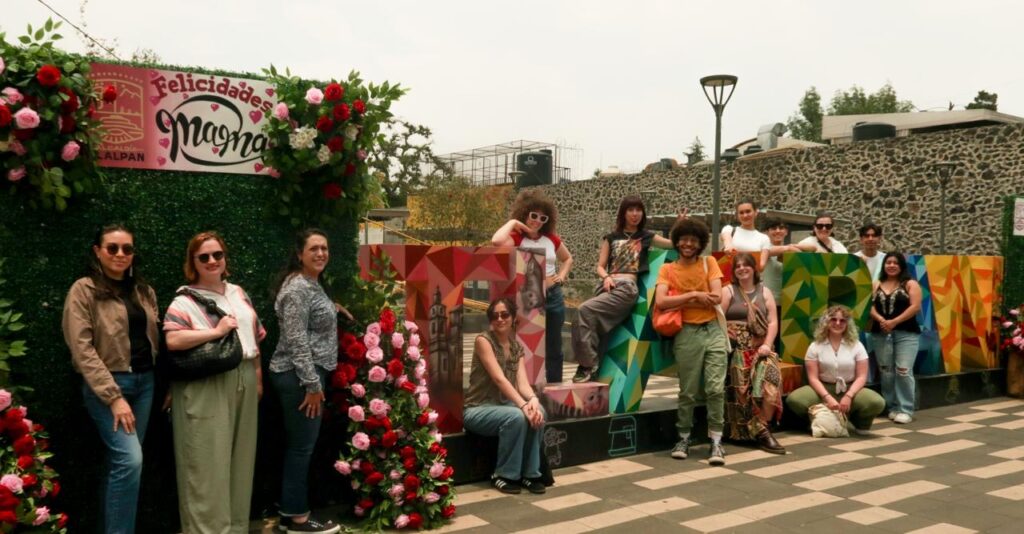
Eduardo Mitzi ‘28 is an Industrial Engineering major; Julia Galang ‘25 studies Graphic Design; and Amanda Coniglio ‘27 is a Human Services and International Affairs student. What do they all have in common?
All three students are minoring in the Latinx, Latin American, and Caribbean Studies Program (LLACS), which led to their decision to travel to Mexico City for the Mexico City Gender and Migration Dialogue of Civilizations. The Dialogue, led by Nicole Guidotti-Hernández, Professor of English and Director of LLACS, exposes students to the relationship between gender, migration, and medical anthropological research methods. Each student arrived in Mexico City with a different perspective and left with an expanded worldview and distinct takeaways.
They enrolled in the Dialogue for different reasons. Eduardo was already involved in the Latinx Student Cultural Center, and when Professor Guidotti-Hernández reached out to announce the program, he knew he would be interested in topics like medical anthropology and transnational activism. Julia took a class with Professor Guidotti-Hernández, and when she heard about how many requirements it filled, she decided to step out of her comfort zone. Amanda was encouraged to apply after writing a report on the migration of women from Latin America to the U.S. in one of Professor Guidotti-Hernández’s courses.
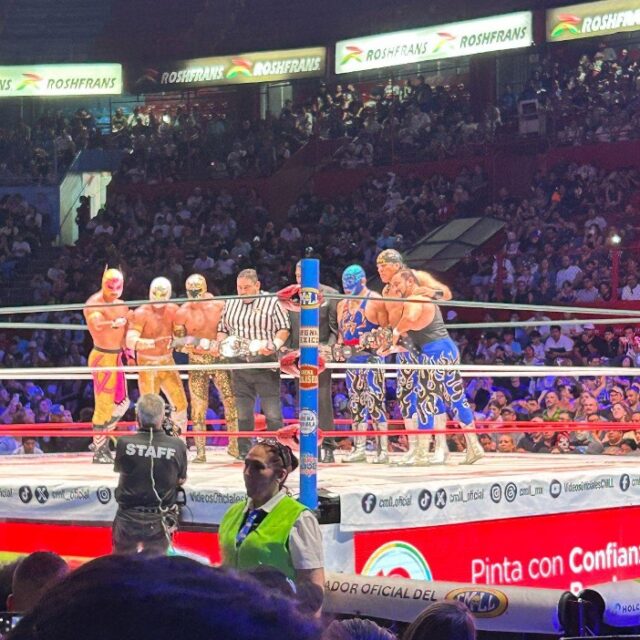
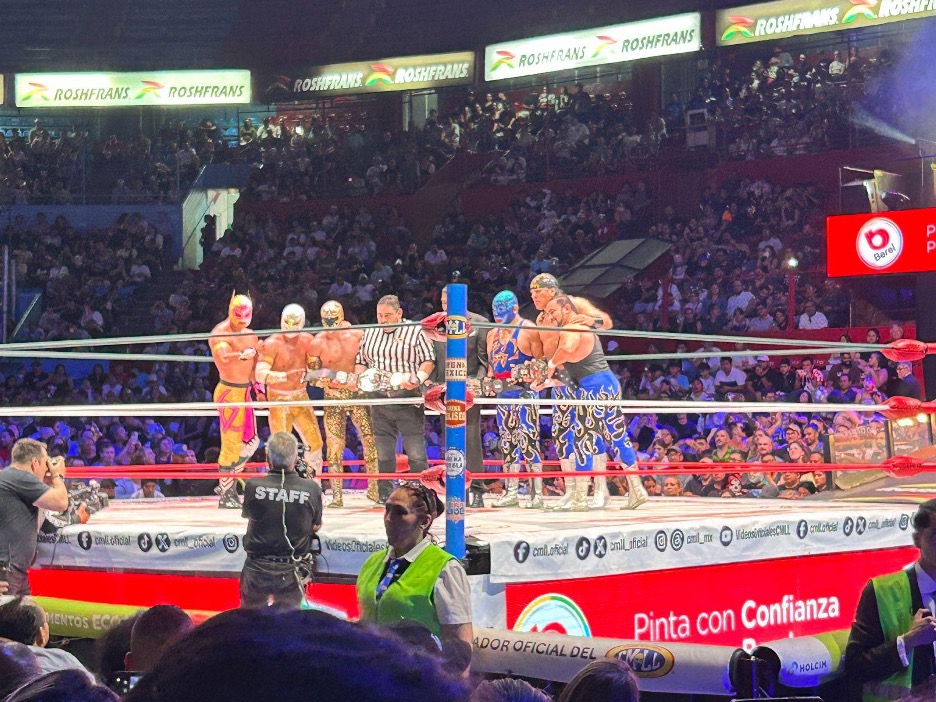
Throughout the Dialogue, the group participated in excursions including a trip to Lucha Libre, a popular Mexican wrestling event. “When we went, the atmosphere, the crowd, and the emotion was so exciting,” Eduardo said. These activities complemented their studies and enabled them to apply abstract concepts to real-world examples. Amanda noted the comparison, connecting course concepts to “gender and sexuality and their expression within the show.”
When asked about their key takeaways from the trip, an underlying theme emerged– connections between the new experiences and prior learning. Julia saw common threads between current events in the U.S. and historical moments in Mexico. “We were able to see how they were impacted by colonization and forced migration, and how that has impacted the people in the area,” she said. She also realized the importance of information organization, adding that “history can be forgotten if we don’t have resources like archives.”
Amanda focused on the connections within Mexico through the lens of medical anthropology. Her coursework helped her discuss how “social issues are involved in the distribution of natural remedy-based practices,” comparing physical health to societal strength.
Eduardo toppled some of his preconceptions during the Dialogue. Getting an inside look at how the city moved and how the citizens lived helped him “learn that some of the perceptions that we have can be accurate, but they can also be really incorrect.” He spoke on how his perspective of Mexico was exclusively U.S. based before he travelled to the country, and he now has a wider view of its unique culture.
Moving forward, the students all plan on applying the knowledge they gained in Mexico City in different ways. Eduardo’s engineering background taught him that “there’s one correct answer to a problem,” but after his experiences in the Dialogue, he intends to look for more than one solution and examine the varying degrees of truth in each.
Julia’s experience led her to accept her current co-op with the archives at Northeastern’s Oakland Campus. After seeing the many ways in which information can be distorted or altered, she decided to plunge into the world of archiving.
In the future, Amanda hopes to use her combined knowledge from coursework in Human Services and her LLACS minor, and her Dialogue experience to dive deeper into the world of nonprofit organizations.
Eduardo, Julia, and Amanda were strangers before they travelled over two thousand miles together and became collaborators in learning and life. Each pushed through their own barriers by connecting with each other and the culture of Mexico. The Mexico City Gender and Migration Dialogue of Civilizations pressed this group to look at problems from all angles, stay curious and aware of the differences and similarities between the U.S. and Mexico, and commit to uncovering its full history, which will undoubtedly assist them in their academic and professional careers.