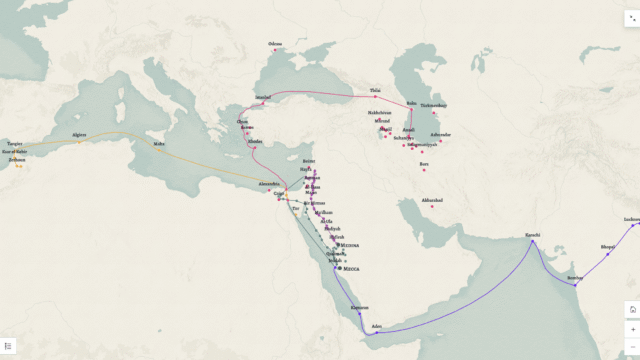
The NULab for Digital Humanities and Computational Social Science hosted its ninth annual spring conference on May 1, 2026. The conference theme was “Collective Persistence” and the event, held virtually, brought together Northeastern faculty, staff, students, and collaborators from across the university’s global network in Boston, Oakland, and London for a rich day of interdisciplinary exchange. Presentations spanned topics that include the ethics of AI in the classroom, decolonial archival practice, network analysis of Civil War pension claims, dialogical AI systems for addressing wicked problems, the visual culture of empire, and community-centered environmental modeling.
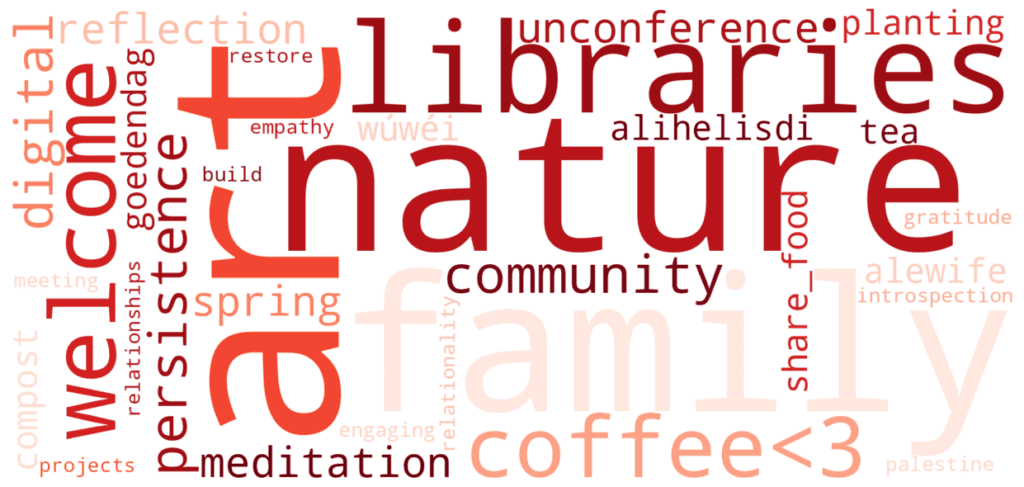
The day began with an informal “coffee hour” in which participants shared introductions and collaborated on a word cloud with their answers to the question “How are you managing to persist right now?” Following this, the conference opened with remarks from Ellen Cushman, NULab Co-Director, Cherokee Nation Citizen, and Dean’s Professor of Civic Sustainability. Cushman framed the day’s theme of collective persistence and reflected on what it means to unsettle and to endure collectively. Welcome remarks were then delivered by Kellee Tsai, Dean of the College of Social Sciences and Humanities, and Dan Cohen, Dean of the Library, Vice Provost for Information Collaboration, and Professor of History, who highlighted the NULab’s role as an incubator for innovative interdisciplinary research and celebrated its continued success in bringing together scholars across the humanities, social sciences, and computing.
Panel 1: Lightning Talks
Moderated by Federica Imbriale (Philosophy, Northeastern University London), the opening panel of lightning talks brought together a range of presentations on digital humanities and computational social science. Sara Morrell (Political Science, College of Social Sciences and Humanities) began the session with a talk entitled “Grounding Classroom AI Policy in Ethics: A Student-Centered Dialogic Approach,” which shared an approach to teaching AI ethics through a workshop in which students collaborate to draw a flowchart that clarifies shared understandings of ethical priorities regarding AI and then use these to determine appropriate AI uses in their classes. Morrell partnered on this project with Professor Ellen Cushman as part of Morrell’s role as the CSS Research and Teaching Coordinator at the NULab’s Digital Integration Teaching Initiative. More on the project is available at a blog post Morrell has authored, including a link to a version of the paper Morrell will be presenting at the 2026 American Political Science Association conference. The second presentation was “The Problem of Induction and NFL Theorems” by Maria Federica Norelli (Philosophy, Northeastern University London). In this talk, Norelli linked computation and philosophy, discussing the implications of Hume’s problem of induction—which asks why we should expect the future to resemble the past—for machine learning. As Norelli observed, machine learning systems rely on induction because they generalize from finite data to unseen cases—they make assumptions about the world in order to operate. To help resolve this issue, Norelli argued that machine learning may be justified conditionally, if not universally.
The third presentation, “Persistence as Praxis (An-Other Subaltern Archive of the Nigerian/Biafran War)” by ThankGod Ahumibe (English, College of Social Sciences and Humanities) outlined an approach Ahumibe has developed for a decolonial archive of the Nigerian/Biafran Civil War. This archive, which Ahumibe hopes to build in his upcoming PhD studies at the University of Colorado Boulder, would serve communities first, scholarship second. The archive would be developed through participatory design, with an offline-first approach that would be accessible even in areas where internet or other technological access is limited. Ahumibe closed his talk by connecting with the conference theme of collective persistence: “Ultimately, this archive does not presume to start the work of persistence (these communities started it long ago) but to give it a digital home, a wider audience, and a kind of protection against further erasure.” Continuing with the theme of decolonial archiving, the final presentation in this panel was “Race, Gender, and the Visual Culture of Domestic Labor: An Interactive Digital Archive of Tradecards and Postcards from the age of New Imperialism” by Joydeep Mitra (Computer Science, Khoury College of Computer Science) and Satya Shikha Chakraborty (History, The College of New Jersey). The project that Mitra and Chakraborty presented is a collaboration between the researchers and their students to develop a digital archive of trade cards and postcards from the 1870s to the 1940s. Chakraborty and Mitra argue that mass-produced ephemera like postcards and trade cards were “important ‘tools’ of empire” that “perpetuated harmful stereotypes and upheld the domestic and political hierarchies of race, gender, and labor.” Their paper shared some of the ways that the project has used Value Sensitive Design (VSD) to inform their technical development process. These presentations, from a range of disciplines, showcased the diverse ways that computational and digital methods can help memories, communities, and learning opportunities persist, even in very challenging environments.
Poster Session:
Following the lightning talks was an informal poster session in which participants were invited to learn more about computational and digital projects at Northeastern. In breakout rooms, presenters shared brief introductions to their topics and then engaged in discussion with participants. Colleen Nugent McLean (Centers for Digital Scholarship Coordinator, Northeastern University) shared her poster “Digital Humanities Now: Aggregating DH Scholarship”, offering a glimpse into the development of the recently re-launched Digital Humanities Now project, which “highlights and distributes informally published digital humanities scholarship and resources from the open web.” Emily Allen (Digital Projects Librarian, Northeastern University) shared “Establishing inclusive and reparative description practices,” in which she discussed recent efforts from the Northeastern University Library to develop more inclusive practices for cataloging archival items. These efforts are continuing, and those interested can learn more by viewing this recording from a spring 2026 workshop on the topic. Finally, Gordon Henry (Humanities Center and English, College of Social Sciences and Humanities) and Jae Messersmith (Digital Archive of Indigenous Language Persistence (DAILP) Coordinator, Northeastern University) presented “Syntax in Anishinaabemowin,” sharing work from the DAILP project on performing linguistic analysis on the Anishinaabemowin language. These poster sessions offered presenters and participants the opportunity to share and receive feedback, to make connections, and to begin planning further collaborations.
Panel 2: Research Talks
Moderated by Professor Moira Zellner (NULab Co-Director; Public Policy and Urban Affairs, College of Social Social Sciences and Humanities), the research talks featured presentations by Phileas Dazeley-Gaist, Halima Haruna, Jeremy Sorgen, and Tayte Adderley. Dazeley-Gaist (Mathematica Research) presented a paper, “Dialogical AI for Human Ecology”, on conversation among multiple AI agents, with an eye towards more responsible integration of AI into society and understanding how to promote cooperation. Haruna (History, College of Social Sciences and Humanities) presented her work “Pension Claims to Networks: Logics of African American Women’s Civil War Pensions Claims.” Haruna’s project, which has been supported by a NULab seedling grant, integrates close reading of post-Civil War pension claims brought by African American women with network analysis, revealing historical and geographic dynamics. In the future, she plans to examine the role of age and further develop her network analysis, to include interactive elements and historical interpretation. Sorgen (Business & Public Policy and Urban Affairs, Northeastern University Oakland) and Adderley (Public Policy and Urban Affairs, Northeastern University) presented work done in collaboration with scholars at Northeastern, tribal elders, and other community partners, titled the “Clear Lake Project.” This project, also supported by a seedling grant, is building a model that will show the dynamic interplay of social, ecological, and economic systems surrounding the lake with the goal of supporting the lake’s ecology and dwindling Clear Lake hitch population by enabling stakeholder communication and cooperation. Discussion focused on the technical attributes of these analyses, as well as potential future research directions.
Closing Remarks:
Moira Zellner closed the conference with thanks to the day’s presenters, moderators, and attendees. The formal closing was followed by an informal networking session that drew connections across the day’s presentations, with participants identifying opportunities for collaboration and reflecting on the shared questions that had emerged throughout the day. Conversations ranged across the ethics and limits of AI systems, the design of community-centered archives, the possibilities of participatory modeling, and the recovery of histories that have been suppressed or overlooked, with attendees finding common ground across disciplines and institutional contexts.
Zellner encouraged everyone to carry the energy of the day forward and to stay in touch with one another, continuing to explore the collaborations and opportunities the conference had surfaced. It was a fitting conclusion to a day that so vividly demonstrated what it looks like when a community commits to doing the work of persistence together.