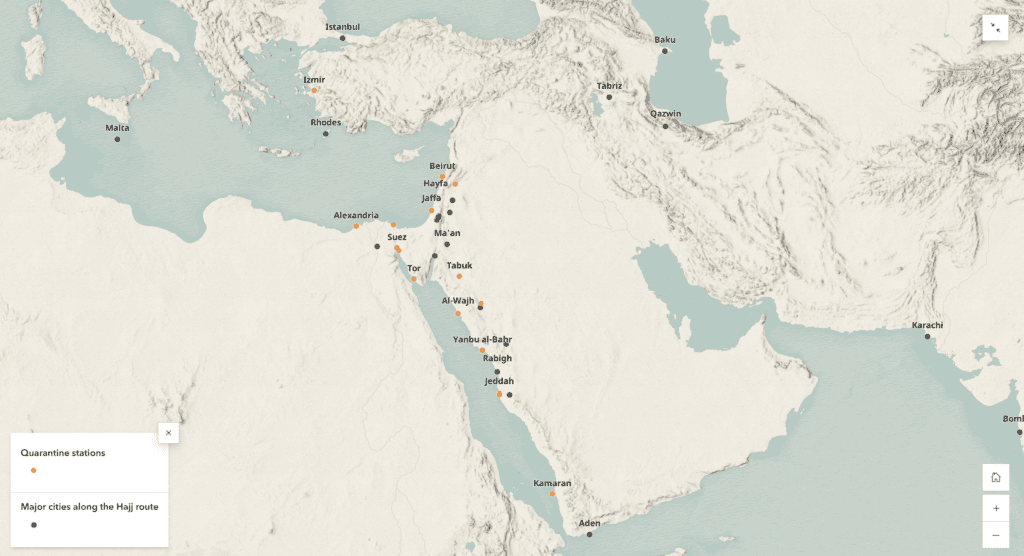
A Muslim pilgrim traveling to Mecca in the late nineteenth and early twentieth centuries had to consider several things that pilgrims traveling in earlier or later periods did not need to. For example, they needed to quarantine for several days or weeks. Besides the COVID-19 pandemic, the Saudi state has largely dealt with Hajj’s potential of spreading disease by mandating vaccinations. And before the advent of steamships and railways in the nineteenth century, it took so long to travel between the average pilgrim’s hometown and Mecca that any disease caught in Mecca would have little chance of spreading back home. But in the late nineteenth and early twentieth centuries, there were no widely used or approved vaccines for cholera, the biggest epidemic disease at the time.[1] And pilgrims could travel between Mecca and their hometowns in increasingly shorter periods, confined in the often crowded and stuffy cars and cabins of trains and steamships. The solution for this, as decided by the British, French, and Ottoman empires in a series of international sanitary conferences in the nineteenth century, were quarantine stations, which would be built at major Hajj transit locations, and would be required for pilgrims to visit.[2]
Quarantining was just one of the unique considerations of Hajj pilgrims in the last decades of the Ottoman Empire, 1880s-1910s. My project as a NULab/DITI Research Fellow for the 2025-2026 academic year is an interactive webpage with maps, charts, and other media that traces the experiences of Muslim pilgrims in this turbulent period. It is somewhat of a continuation of my project in the 2024-2025 academic year, in which I collected data specifically on Egyptian pilgrims. This year, thanks in part to a NULab Seedling Grant, I was able to expand and diversify my primary sources (travel accounts written by pilgrims in the period) to include writings by pilgrims from Morocco, Istanbul, Persia, and India, written in Arabic, Ottoman Turkish, and English. These sources do not represent all Hajj trajectories: for example, they exclude East and Southeast Asia, the Balkans, West Africa, and East Africa, even though many pilgrims came from there and elsewhere. This is partly due to my constraints in terms of time, physical access to these sources, and language.
I have additionally chosen to only use travel accounts written by Muslims, avoiding the several European-language ones by (self-identifying) non-Muslims.[3] Although these European accounts are useful for revealing details about the Hajj, European perceptions of Islam and the “Orient,” and Orientalist literature, they were ultimately not written from the perspective of Muslim pilgrims. As this project is concerned with Muslim pilgrims’ experiences, especially regarding imperialism and biopolitics, I intentionally excluded these accounts.
The webpage introduces various narratives of pilgrims’ journeys to Mecca, rather than focusing on the Hajj in Mecca. It is therefore centered on pilgrims’ experiences and structured around the phases of their journeys. Starting with an introduction to the Hajj and temporal and spatial context, it begins with pilgrims leaving their homes, follows them as they board trains and steamships, then as they rent camels to reach Mecca, and finally as they retrace their footsteps to head home—before quarantining, of course. Although it is still in progress, the draft webpage can be viewed at this link.

I hope that this webpage can be a starting point for exploring and teaching various dimensions of the Hajj in this period through the eyes of the pilgrims who experienced them. I wanted to make the history of the Hajj in this period accessible to audiences inside and outside of academia, at various stages of learning and familiarity. As a complement to traditional reading materials and lectures, this webpage follows in the footsteps of other digital humanities projects about the Hajj and Middle Eastern history.[4]
The history of the Hajj can be used to explore many dimensions of Ottoman Empire, Middle Eastern history, steam-age technology, and imperialism in a way that intentionally avoids top-down perspectives. Take the 1912 journey of the Egyptian school headmaster Muhammad Hasan Ghali for example.[5] Through his travel writings, we learn that Egyptian pilgrims could now more easily avoid the official, state-sponsored caravans and instead take advantage of the many steamship and railway routes to design their own itineraries. Ghali did this to visit Jerusalem as part of his journey to the Hijaz–something the Egyptian caravan did not do. We also learn that even though Egypt was under British rule at the time, Ghali was still loyal to the Ottoman sultan, praising him for his many pan-Islamic infrastructural projects. Ghali even used the proceeds of his book, published in World War I under British rule, to aid the Ottoman navy–a British enemy. We learn from many other pilgrim accounts that quarantine was often a requirement – and that this caused pilgrims much anxiety, as they had to pay extra fees, spend longer periods of time than expected (and hence potentially miss the annual pilgrimage dates), and be subjected to biopolitics as they were forced to be fumigated and temporarily exchange their clothes for quarantine uniforms. Although many knew that they would need to quarantine, the requirements changed from year to year and location to location, so pilgrims were often surprised with longer quarantine station visits than planned.
Through this webpage, we can explore the ways individual pilgrims encountered empire, public health, technology, religion, and spirituality. This period especially allows us to consider the realities of empire in a context largely without nation-states, and completely different definitions of borders and citizenship. I hope to elaborate on these themes in the final version of the webpage.
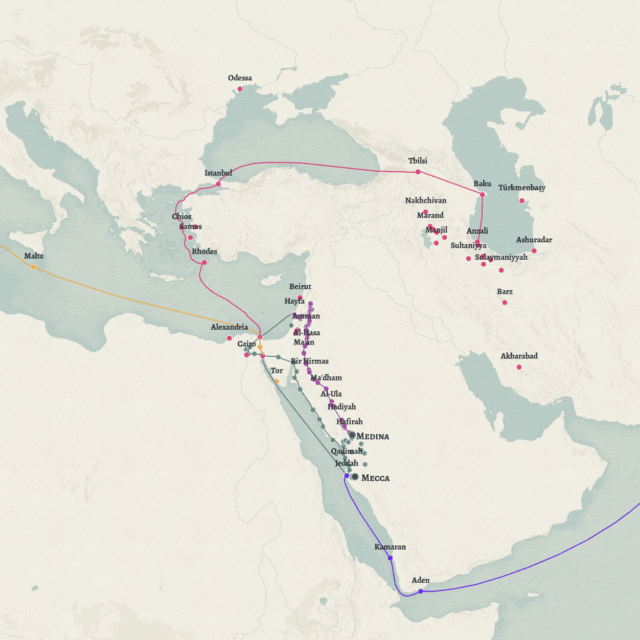
I also hope to emphasize the multi-directionality of Hajj journeys. Today, the Hajj journey usually consists of a visit to Mecca and the holy city nearest to it, Medina. But as I have shown in my blogpost last year, the Hajj was once a journey with multiple destinations, beyond just Mecca and Medina, and it was so for centuries. In the late nineteenth and early twentieth centuries, pilgrims often visited other spiritually important sites and cities in the Levant, Persia, Egypt, Anatolia, Arabia, and beyond, including cities like Jerusalem, Hebron, Najaf, Damascus, and Cairo, as well as more rural sites with significant tombs. Paradoxically, today, in the age of air travel, Hajj itineraries do not include as many side-visits. There are several reasons for this, among them being the development of nation-state borders (and the modern visa and passport requirements that accompany them), changing ideological and spiritual trends among Muslims, war, and the imperialist settler-colonial project of Zionism that puts several holy sites in the Levant off-limits to many.
As I read through the pilgrim accounts for data collection, I made note of the places pilgrims stopped at and the reasons for doing so: visiting a tomb in Hebron, praying at a famous mosque in Tabuk, quarantining at Tor, or resting at a travel lodge in Jeddah. Each location that appears on the map includes a list of amenities it offers, as described by the pilgrims who visited it: hospitals, coffeehouses, quarantine stations, consulates, train stations, and wells among others. I recorded these in a public-facing database, although it is still a work-in-progress. Understanding pilgrims’ reasons for visiting these places allows us to begin seeing connections between them, depicting the Hajj as a global network rather than a two-directional journey between home and the Hijaz. I hope that this will allow us to identify patterns such as increases or decreases in pilgrims’ visits to these places, especially as certain places were selected over others for steamship ports, train stations, and quarantine stations.
I hope that it will also allow us to situate the story within its historical context, acknowledging that although our perspectives are rooted in our twenty-first-century moment, we should avoid a sense of presentism. This is one reason why it was important for me to choose a base map without contemporary nation-state borders, as these borders were constructed after the period in question.
While developing this project in the 2025-2026 academic year, the Middle East has been subject to unjust imperialist violence by the US, Israel, and their allies. As an Arab and Muslim historian living in the heart of the empire, I cannot disconnect my historical research from the present context. I started my PhD in the fall of 2023, right before the acceleration of the US-funded Israeli genocide of Palestinians in Gaza. Under both the Biden and Trump administrations, I was told by US leaders, policymakers, journalists, and academics that these actions were justified, because an entire population needed to be purged of “terrorism,” even its children and healthcare workers. The US government forcibly uses the taxes from my salary as a PhD student to fund illegal wars and genocide. This is only escalating in the recently instigated US and Israeli war on Iran.
This year’s Hajj takes place in late May 2026, a few weeks after this blogpost’s publication. It is anyone’s guess how the Hajj, one of the world’s largest peaceful gatherings, will be affected by the current illegal war. Major airports used for Hajj travel have severely limited flights. This is in addition to Israel’s decades-long travel restrictions on Palestinians. Israel already prevented Palestinian Muslims from praying at Al-Aqsa Mosque in Jerusalem during Ramadan, and for the first time in fifty-nine years, Eid al-Fitr prayer was not performed at Al-Aqsa due to Israeli settler aggression.
Part of my hope in creating this webpage is to show that this type of “conflict” in the Middle East is not inherent and nor was it inevitable, and to show a perspective on the Middle East that, although not removed from violence and imperialism, is not centered on it. There is beauty in the Hajj, in the way it unites while celebrating diversity, and persists throughout eras of turbulence. If there is anything the late-nineteenth-century Hajj can teach us, it is that the Hajj, which has been performed for over fourteen centuries, will continue to be performed and adapted to changing political, social, environmental, and technological realities. In our current moment, the question is how it will be affected by the racist, capitalist logic of empire, perpetuated by Zionist Israelis, Americans, and their allies in the Middle East and elsewhere.
Acknowledgments:
I developed this project as a Research Fellow for the NULab/Digital Integration and Teaching Initiative in 2025-2026. It was generously supported by a NULab Seedling Grant, and I thank Sean Rogers and Sarah Connell for coordinating it. I thank Bahare Sanaie-Movahed for her expert GIS advice and mentorship throughout this project. I am grateful to the 2025-2026 NULab/DITI team of faculty, staff, and students for their support and feedback on this blog post. Thanks also to my advisor, Ilham Khuri-Makdisi, who directed me to important sources and is a wonderful source of encouragement. All mistakes and views here are my own.
References
[1] Anna Lena Lopez et al., “Killed Oral Cholera Vaccines: History, Development and Implementation Challenges,” Therapeutic Advances in Vaccines 2, no. 5 (2014): 123–36, https://doi.org/10.1177/2051013614537819.
[2] Michael Christopher Low, Imperial Mecca: Ottoman Arabia and the Indian Ocean Hajj (Columbia University Press, 2020); Birsen Bulmuş, Plague, Quarantines and Geopolitics in the Ottoman Empire (Edinburgh University Press, 2012).
[3] Richard Francis Burton, Personal Narrative of a Pilgrimage to Al-Madinah & Meccah — Volume 1 (1853), https://www.gutenberg.org/ebooks/4657; Harry St John Bridger Philby, The Heart of Arabia, a Record of Travel and Exploration, vol. 1 (London, Constable, 1922), http://archive.org/details/heartofarabiarec01philuoft; John F. Keane, Six Months in Meccah: An Account of the Mohammedan Pilgrimage to Meccah. Recently Accomplished by an Englishman Professing Mohammedanism (Tinsley Brothers, 1881), https://catalog.hathitrust.org/Record/100729752; C. (Christiaan) Snouck Hurgronje, Mekka (Haag : Nijhoff, 1888), http://archive.org/details/mekka12snou.
[4] Kynn, Tyler and Gasdia, Russ. The Hajj Trail: A Journey Along the Darb al-Hajj. https://www.hajjtrail.com, Azimli, Musa Kazım. “Digital Humanities in Ottoman and Middle Eastern Studies: An Overview of Recent Developments.” (2022) https://storymaps.arcgis.com/stories/3cc60a36f2fb43cf8389b9b8ef0dc8df, Kynn, Tyler. Seyahat: A Journey to Mecca. Seyahat Interactive. Switch. 2024. https://store.steampowered.com/app/3306180/Seyahat_A_Journey_to_Mecca/
[5] Ghali, Muhammad Hasan. “Dalīl al-wuṣūl ilā ziyārat al-rasūl.” 1914. Bibliothèque nationale de France. https://gallica.bnf.fr/ark:/12148/bpt6k91059689/f1.item.