Sari Altschuler

Associate Professor of English; Founding Director, Health, Humanities, and Society Program
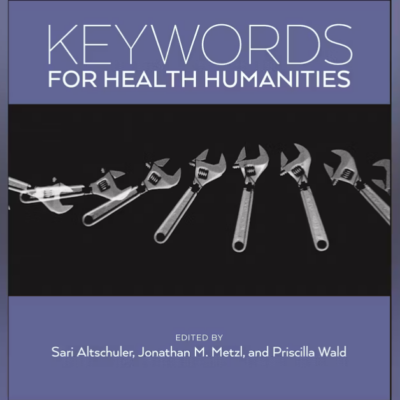
Sari Altschuler’s research focuses primarily on American literature and culture before 1865, disability studies, and the health humanities, broadly understood. She is the author of The Medical Imagination: Literature and Health in the Early United States (Penn Press, 2018) and Before Disability: A History of American Citizenship (Penn Press, forthcoming 2026) as well as co-editor of Keywords for Health Humanities (NYU, 2023) with Jonathan Metzl and Priscilla Wald and Health Humanities: An Introduction (under contract with NYU) with Corinna Treitel. Her work has appeared in leading journals, including Early American Literature, Nineteenth-Century Literature, American Literature, American Literary History, PMLA, and the medical journal The Lancet. She serves on the advisory board of American Quarterly and the editorial boards of Early American Literature and American Literature. Her research has received awards from the Society of Early Americanists, the Society for the Historians of the Early American Republic, the Disability History Association, and the Library Company of Philadelphia and long-term funding from the McNeil Center for Early American Studies, the American Antiquarian Society, the Andrew W. Mellon Foundation, and the Wellesley College Newhouse Center for the Humanities. She was an assistant professor of English and core faculty member of the Center for the Study of Human Health at Emory University before joining the Northeastern faculty. During the 2019-2020 academic year, she was on leave as a faculty fellow at the Wellesley College Newhouse Center for the Humanities and an invited professor at Université de Paris – Paris Diderot.
Currently she directs Touch This Page! Making Sense of the Ways We Read, an award-winning multi-site and online exhibition about the multi-sensory experiences of reading with David Weimer, and chairs the Critical Health Humanities seminar at Harvard’s Mahindra Humanities Center with Amy Boesky and David Jones.
- Hennig Cohen Prize, The Melville Society (awarded 2025)
- Co-PI – National Endowment for the Humanities, Humanities Connection Implementation Grant with Christopher M. Parsons (2022 – 2025)
- Co-PI International Emerging Actions Grant, Centre National de la Recherche Scientifique (France) with Sophie Vasset (Université de Paris) (2022 – 2024)
- Co-PI – National Endowment for the Humanities, Humanities Connection Planning Grant
with Christopher M. Parsons (2020 – 2021) - 1921 Prize for Best Essay in American Literature, The American Literature Society (2020)
- Public Disability History Award – Disability History Association (2020)
- Biennial Innovation Award – Library Company of Philadelphia (2019)
- Invited Professor – Université Paris Diderot (Spring 2020)
- Faculty Fellow, Newhouse Center for the Humanities – Wellesley College (2019 – 2020)
- Andrew W. Mellon Fellowship in Humanistic Inquiry (2015 – 2017)
- The John B. Hench Post-Dissertation Fellowship at the American Antiquarian Society (2013 – 2014)
- Society of Early Americanists Essay Prize (2014)
- Zuckerman Prize in American Studies (Runner-up) (2014)
- Society for Historians of the Early American Republic (SHEAR) Dissertation Prize (2013)
- The Barra Dissertation Fellowship at the McNeil Center for Early American Studies, University of Pennsylvania (2011 – 2012)
- Consortium for the History of Science, Technology, and Medicine Dissertation Writing Fellowship (2011 – 2012) (declined)
Book
- Sari Altschuler, Jonathan M. Metzl, and Priscilla Wald, eds. Keywords for Health Humanities. NYU Press, 2023.
- The Medical Imagination: Literature and Health in the Early United States. Philadelphia: University of Pennsylvania Press (February 2018).
Edited Volumes
- “Covid-19” A forum in American Literature, edited with Priscilla Wald 92.4 (December 2020).
- “Early American Disability Studies.” Special Issue of Early American Literature, guest edited with Cristobal Silva 52.1 (Spring 2017).
- “The Republics of Benjamin Rush.” Special Issue of Early American Studies, guest edited with Christopher Bilodeau 15.2 (Spring 2017).
Digital Humanities Project
- “Touch This Page! Making Sense of the Ways We Read.” A collaboration between Northeastern University, Harvard University, and the Perkins School for the Blind. Co-directed with David Weimer. Co-PI with Daniel Cohen, Waleed Meleis, and David Weimer Touchthispage.com
Journal Articles and Essays
- “Babo’s ‘Mute’-ny: Deaf Rights and Black Testimony in Antebellum America” PMLA (forthcoming).
- “Disability.” Invited contribution for “What’s in a Name?” forum on scholarly language edited by Jessica Choppin Roney and Nora Slonimsky for the Journal of the Early Republic (forthcoming, expected 2023).
- “Wave/Forest Fire.” Invited contribution for “2020 Keywords” forum edited by Samantha Pinto and Jennifer Nash in Theory & Event (January 2022): 187-192.
- “After the Outbreak: Narrative, Infrastructure, and Pandemic Time,” Resilience in a joint special issue of American Literature and Resilience: A Journal of the Environmental Humanities on “The Infrastructure of Emergency” 8.3 (Fall 2021): 126-155.
- “Humanities in a Time of Crisis: The Humanities Coronavirus Syllabus.” Co-authored with Elizabeth Maddock
Dillon. ISLE: Interdisciplinary Studies for Literature and Environment. 27.4 (Autumn 2020): 836-58. - “Covid-19 and the Language of Racism.” Coauthored with Priscilla Wald. Signs: Journal of Women in
Culture and Society. (available online fall 2020, in print fall 2021). - “Texturing Digital Humanities: A Manifesto.” Coauthored with David Weimer. PMLA 135.1 (January 2020): 74-91.
- “Touching The Scarlet Letter: What Disability History Can Teach Us about Literature.” American Literature (March 2020): 91-122.
- “The Gothic Origins of Global Health.” American Literature 89.3 (September 2017): 557-90.
- “Early American Disability Studies.” Coauthored with Cristobal Silva. Early American Literature 52.1 (Spring 2017): 1-27.
- “Ecce Homo! The Figure of Benjamin Rush.” Coauthored with Christopher Bilodeau. Early American Studies 15.2 (Spring 2017): 233-51.
- “The Medical Imagination.” The Lancet 388 (November 2016): 2230-31.
- “From Empathy to Epistemology: Robert Montgomery Bird and the Future of the Medical Humanities.” American Literary History 28.1 (Spring 2016): 1-26.
- “‘Picture It All, Darley’: Race Politics and the Media History of George Lippard’s The Quaker City.” Nineteenth-Century Literature 70.1 (June 2015): 65-101.
- “‘Ain’t One Limb Enough?’: Historicizing Disability in the American Novel.” American Literature 86.2 (June 2014): 245-274.
- “Playbill for George Lippard’s The Quaker City.” Coauthored with Aaron Tobiason. PMLA 129.2 (March 2014): 267-273.
- “From Blood Vessels to Global Networks of Exchange: The Physiology of Benjamin Rush’s Early Republic.” Journal of the Early Republic 32.2 (Summer 2012): 207-231.
- “‘He That Hath an Ear to Hear’: Deaf America and the Second Great Awakening.” Disability Studies Quarterly 31.1 (Winter 2011). [34 pages]
Teaching and Review Essays
- “Health (and the) Humanities in Early America.” Early American Literature 90.1 (Spring 2018).
- “Medicine, Disability, and Early American Literature” in The Blackwell Companion to American Literature (Volume 1: to 1820). Ed. Susan Belasco, Theresa Strouth Gaul, Linck Johnson, and Michael Soto. West Sussex, UK: Wiley-Blackwell (Spring 2018).
- “Reading Disability in Hawthorne: Enabling Student Analyses of The Scarlet Letter” in Nathaniel Hawthorne in the College Classroom, Ed. Christopher Diller and Samuel Coale. Norwalk, CT: AMS Press, 2016, pp. 235-47.
-
Education
PhD, 2012, City University of New York
-
Contact
-
Address
450 Renaissance Park
360 Huntington Avenue
Boston, MA 02115 -
Office Hours
9:10-10:10 am M, 4:30-5:30 pm W