


By: Claire Lavarreda
The NULab for Digital Humanities and Computational Social Science hosted its 10th annual Speed Data-ing event on December 10, 2025! Participants in this exciting milestone included Ayah Aboelela, Ph.D. candidate in World History; Danielle Duran, Ph.D. candidate in Sociology; Cassie MacMillan, Professor of Sociology and Criminology and Criminal Justice; Mel Williams, Ph.D. student in English; and Priya M. Shimpi Driscoll, Professor of Early Childhood Education & Associate Dean of Research, Scholarship, and Social Impact. Many of this diverse set of projects have been supported by the NULab’s Seedling, Community Collaboration, and Travel grant program.
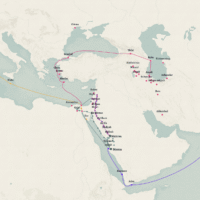
Ayah Aboelela began the hour, presenting her project titled “Mapping the Late Ottoman Hajj: A Global and Digital History.” Through careful analysis of pilgrim accounts—including those documented by Muhammad Sadiq Pasha (who traveled in 1894), Ibrahim Rifat Pasha (1901), Hadji Khan (1902), Abdurresid Ibrahim (1911), Muhammad Hasan Ghali (1912) and Richard Burton (1857)—Aboelela decenters European accounts and documents places pilgrims stopped. The project utilizes AirTable to compile data and ArcGIS for visualization, with the goal of continuing to map and explore connections across locations like coffee shops, quarantine stations, and holy sites. Though there have been several challenges, including the forceful renaming of places by Israeli occupation (making them difficult to find by their original names), Aboelela has successfully mapped and layered four pilgrimage routes.
The next project was presented by Danielle Duran, titled “Framing Taste: Digital Food Policy Archive & Food Stories Project.” Duran’s dissertation is focused on food studies, employing comparative historical analysis to examine political and cultural food discourse on “appropriate” food items for SNAP program participants. Duran argues that food goes beyond the act of consumption—it actually has deep relationships across social, political, economic, and environmental contexts. The digital component of her project traces key SNAP policy periods, including the Food Stamp Plan of 1939, the Food Stamp Act of 1964, the Food Stamp Act of 1977, the Food, Conservation, and Energy Act of 2008, and present federal and state policies. Duran’s research has revealed that there is a hyperfixation on SNAP participants consuming sweetened beverages, prepared desserts, salty snacks, and candy, despite non-SNAP users demonstrating similar patterns of consumption. A close reading of congressional records indicates that SNAP participants’ food choices are portrayed as being linked to morality, with the social position of SNAP participants suggesting an inability to consume “legitimately,” not practicing good “citizenship,” and behaving in ways that are antagonistic to the “taxpayer.”
Continuing on the thread of social status, Cassie McMillan then presented “‘A Bunch of Degenerates:’ An Exploration of Online Discourse About Problematic Sports Betting Through Social Network Analysis.” McMillan’s project focuses on the ways in which Reddit users discuss problematic sports betting, responding to the rapid legalization and spread of online sports betting and Gambling Disorder (GD). The project seeks to determine if recreational, pro-gambling forums normalize risky behavior, or if they help create safety nets to encourage responsible gambling. McMillan and her team combed two subreddits, including r/sportsbetting and r/sportsbook, for key terms like “addict,” “problem,” and “hotline” from 2012–2024. The final sample comprised 7,000 posts and 177 threads, enabling a user-based thread networks visualization. Two themes emerged: supportive posts were increasing over time, while non-supportive posts—such as those disparaging the reality of GD—were decreasing over time. This suggests that recreational forums can encourage risky behaviors, while also providing support.
Next was Mel Williams and her presentation, “‘A Scientific Association’: New Digital Methods for Understanding the Impacts of Early Women Writers on the Sciences.” Through the use of the Women Writers Project (WWP) Women Writers Online collection, Williams was able to train multiple word embedding models to compare scientist Margaret Cavendish’s (1623–1673) conceptual frameworks against key intellectual traditions within the Royal Society in the late seventeenth century. Williams noted three central questions that guided her project, including 1. How did women writers like Margaret Cavendish contribute to early modern scientific and philosophical discourse? 2. What can digital text analysis reveal about her use of scientific language? And 3. How did early modern scientific and philosophical discourse by women circulate? Williams’ first round of results have shown that Cavendish’s interpretation of key concepts—like the word “experiment”—were more closely linked to imaginative reasoning terms, as opposed to her peers in the Royal Society who saw “experiment” as something that could only be replicated in a laboratory. More broadly, Williams’ work raises questions regarding who shaped scientific discourse and who was privileged in scientific spaces.
The conclusion of the event was led by Priya Mariana Shimpi Driscoll, presenting her long-running project titled “Sociolinguistic Environment and Language Development of Bilingual Children.” Driscoll and her team focus on how children acquire language, noting that standard models are culturally limited. Driscoll discussed a model beyond Joint Attention, in which third-party learning—typically used in Indigenous and non-Western communities—fostered greater attention and learning without overt social cues. Particularly interesting was Driscoll’s discussion on the results of experimental studies in Nashville, TN and Oakland, CA, in which children in Oakland demonstrated that they were learning better than children in Nashville. This advantage was the result of an 88% regular exposure to a second language in Oakland, as opposed to Nashville, where children had minimal or no exposure to an additional language. Driscoll’s studies are ongoing, and highlight how intentional sociocultural practices impact language learning. Each of these projects contributed to a rich and fascinating showcase of current research in computational social science and digital humanities. The NULab invites you to explore these initiatives and others on our showcase of research projects.