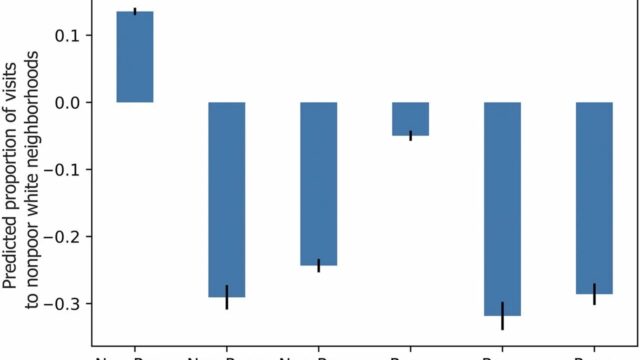
A major expression of social inequality is residential segregation, for example when people of different class backgrounds live in different neighborhoods. Racial segregation is another feature of inequality in American neighborhoods. Do these differences align with how people move about and engage with different areas of the city? What is the relationship between residential social isolation and contact well beyond the confines of where one lives? While researchers have identified consistent patterns in everyday urban mobility, few have systematically examined whether that consistency transcends economic and racial differences. BARI researchers analyzed everyday mobility patterns in the 50 largest U.S. cities and their commuting zones based using over 650 million geo-tagged Twitter posts collected over an 18-month period. We found clear evidence that residents of communities with different racial composition tend not to visit each other’s neighborhoods. Most notably, residents of low-income Black communities rarely visit high-income White communities. Nonetheless, we found diversity in these patterns that could be used to characterize the racial integration (or lack thereof) of each city.
Investigators:
Brian Levy (Harvard University), Nolan Phillips (Harvard University), Robert J. Sampson (Harvard University), Mario Luis Small (Harvard University), Qi Ryan Wang (Northeastern University)* *-Contact: [email protected]
Publications:
- Wang, Q., Phillips, N.E., Small, M.L., Sampson, R.J. 2017. Urban mobility and neighborhood isolation in America’s 50 largest cities. Proceedings of the National Academy of Sciences, 115, 7735-7740.
- Phillips, N.E., Levy, B.L., Sampson, R.J., Small, M.L., Wang, Q. 2019. The Social Integration of American Cities: Network Measures of Connectedness Based on Everyday Mobility Across Neighborhoods. Sociological Methods & Research, 50: 1110-1149.