Experiential Impact Spotlight: Innocentia Ashai
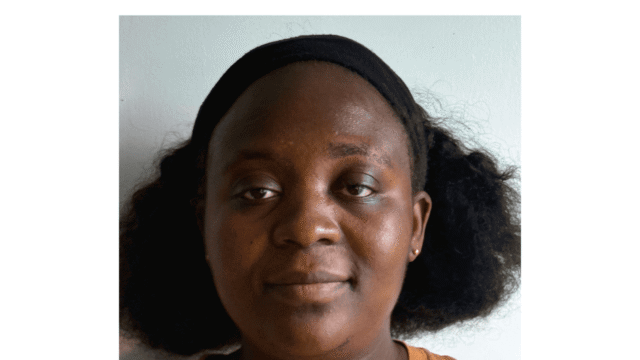
“I have a profound understanding of the relationship between public policy and people’s quality of life because I grew up in Ghana. I have seen personally how policy choices impact communities, whether it was through environmental issues, infrastructure access, or educational chances. These encounters still inspire me to integrate technology, research, and policy to create workable solutions that advance sustainability, equity, and resilient communities.”
Where do you consider your place of origin?
I am originally from Accra, Ghana, where I grew up in a close-knit Ga fishing community.
Which Policy School degree do you have?
I graduated in 2025 with a master’s degree in Master of Arts in International Affairs with a focus on Sustainability and Climate Change Policy.
What drew you to the Policy School?
My job experiences strengthened that curiosity. I became aware of the critical role international organizations play in promoting global collaboration, education, and sustainable development while working with UNESCO. Later, I was able to interact directly with communities and gain a deeper understanding of how policy decisions affect social development, youth empowerment, and educational access through my work with the African Foundation for Educational Success (AFES). All of these encounters strengthened my conviction that evidence-based policymaking supported by research and community involvement is necessary for significant change.
The emphasis on experiential learning at Northeastern’s Policy School drew me in right away. In addition to strengthening my academic background, I was looking for a program that would give me the chance to apply what I had learned to practical policy issues. One of the main reasons I chose Northeastern was the co-op program, which turned out to be one of the most fulfilling aspects of my graduate studies.
How has your personal background shaped your policy interests and passions?
I have a profound understanding of the relationship between public policy and people’s quality of life because I grew up in Ghana. I have seen personally how policy choices impact communities, whether it was through environmental issues, infrastructure access, or educational chances. These encounters still inspire me to integrate technology, research, and policy to create workable solutions that advance sustainability, equity, and resilient communities.
Where did you complete your Policy School co-op?
In Research Data Services (RDS) at Northeastern University.
What kind of support or mentoring did you receive prior to and during your co-op?
My supervisors’ mentoring was one of the things I valued the most. They fostered an atmosphere in which I was at ease raising queries, investigating novel concepts, and assuming responsibility for tasks. Their advice gave me the confidence to make a significant contribution to ongoing initiatives while also motivating me to keep improving my technical and research abilities.
What skills did you build or sharpen during your co-op?
My co-op significantly strengthened both my technical and professional skills. I gained advanced experience using ArcGIS Pro, ArcGIS Online, RStudio, and Visual Studio, while improving my abilities in spatial analysis, data management, historical research, documentation, and project management. I also became more confident communicating technical concepts to interdisciplinary audiences and collaborating on complex research initiatives.
What do you consider the highlight of your co-op experience?
Contributing to the Black Wall Street of Roxbury project was one of my favorite co-op experiences. I assisted in converting historical materials into interactive GIS maps and StoryMaps that highlight and preserve Roxbury’s rich heritage of Black-owned enterprises. It was very satisfying to watch historical data come to life through geographic storytelling since it showed how GIS can help research, preserve history, and meaningfully engage the public. I also had the chance to present this project during the LibCon Week at Northeastern University and eventually won a Grant for this project from Norman B. Leventhal Maps. I am pleased to have contributed to the initiative: Black Wall Street of Roxbury – Leventhal Map & Education Center at the Boston Public Library
What impact did your work make on your host organization, the community, or beyond?
Researchers, educators, students, and community members can use the historical spatial data that I helped arrange, clean, and illustrate. I supported ongoing research and public engagement efforts while helping to preserve significant community histories by creating trustworthy datasets and interactive mapping tools.
How did your co-op experience change you?
This co-op transformed the way I think about the relationship between research and policymaking. It strengthened my confidence as a GIS researcher and showed me how spatial data can be used not only to answer research questions but also to influence planning, preserve community histories, and inform better public policy. The experience reaffirmed my desire to pursue doctoral studies and a career that combines GIS, public policy, and community-engaged research.
If you were talking with a prospective student or potential co-op host, what is the one aspect you would want them to know about the value of experiential learning?
Experiential learning is one of the most valuable parts of a Northeastern education. It gives students the opportunity to apply classroom knowledge to real-world challenges, build professional confidence, and develop skills that simply can’t be learned through coursework alone. For employers, it offers the opportunity to work with motivated students who bring fresh ideas, curiosity, and a genuine desire to make meaningful contributions.
What are you dreaming of for the future? What do you hope to accomplish?
My long-term goal is to pursue a Ph.D. and build a career at the intersection of GIS, public policy, environmental justice, and land governance. I hope to conduct research that helps communities make more informed policy decisions, strengthens climate resilience, preserves local histories, and promotes more equitable and sustainable development. Ultimately, I want my work to bridge the gap between research and policy so that data can be translated into meaningful action.