Experiential Impact Spotlight: Lily Datz
“I think the best thing about experiential learning is that it helps you explore what type of work you do or don’t want to do in the future. Experiential learning through Northeastern provides this opportunity with the safeguard of knowing that you have a strong university system there to help guide you along the way as you explore.”
Where do you consider your place of origin?
I am from Skaneateles, New York, which is a small town in Upstate New York.
Which Policy School degree do you have?
I will graduate in December 2026 with a master’s degree in Urban Planning & Policy
What drew you to the Policy School?
I decided to go back to graduate school while working a full time job in corporate America, so my first priority was finding a program that would support my ability to continue my career at the same time. I was really drawn to Northeastern for this reason, and then I learned more about the Policy School through a conversation with Professor Gavin Shatkin, the director of the Urban Planning and Policy graduate program. Since that initial conversation, Professor Shatkin has become a real mentor during my time at Northeastern!
What policy issues or areas of research are you focused on?
While attending Northeastern for my Master of Science in Urban Planning and Policy, I’ve focused particularly on housing policy and community development. I also have a real passion for finding unique ways to communicate and illustrate urban planning projects to the communities they impact, as the way that many urban planners talk about development projects can often be very technical or un-digestable.
How has your personal background shaped your policy interests and passions?
Growing up, my favorite books were from Richard Scarry, because he illustrated these detailed imaginations of what everyday looked like for different, colorful characters. As I got older, I think this interest in the intersection of people and place evolved into a goal of being able to communicate about how communities develop and exist. I then attended Syracuse University for my undergraduate degree in geography and magazine journalism, which really combined my interests into a unique degree path. I loved writing about how people shaped places and in turn how those places shaped people.
After graduating from undergraduate, I ended up getting a job at a global public relations firm, as I wasn’t sure how I wanted to translate my degree into a job just yet. I quickly realized that I didn’t want my entire job to be focused around public relations and social media, so I decided to take the leap and go back to graduate school to pursue my Master of Science in Urban Planning and Policy. I had always thought that urban planning would be a great career fit for me, because it reflected the real-world implementation of so many of my interests in people and place.
Where did you complete your Policy School co-op?
The Boston Housing Authority.
What kind of support or mentoring did you receive prior to and during your co-op?
Back in the Spring 2025 semester, took the Policy School’s Housing Policy course, which was taught by Nick Kelly, the Chief of Innovation and Economic Opportunity at the BHA. Professor Kelly’s course is what really ignited my interest in housing policy, and it was wonderful to hear about all the different types of projects he was working on at the BHA that went beyond the scope of what I knew about typical housing authorities. I kept in touch with Professor Kelly after that semester, so I was then able to work with him to build my own co-op at the BHA across the Planning, Construction, and Development (PCD) Team and the First Home Program.
What do you consider the highlight of your co-op experience?
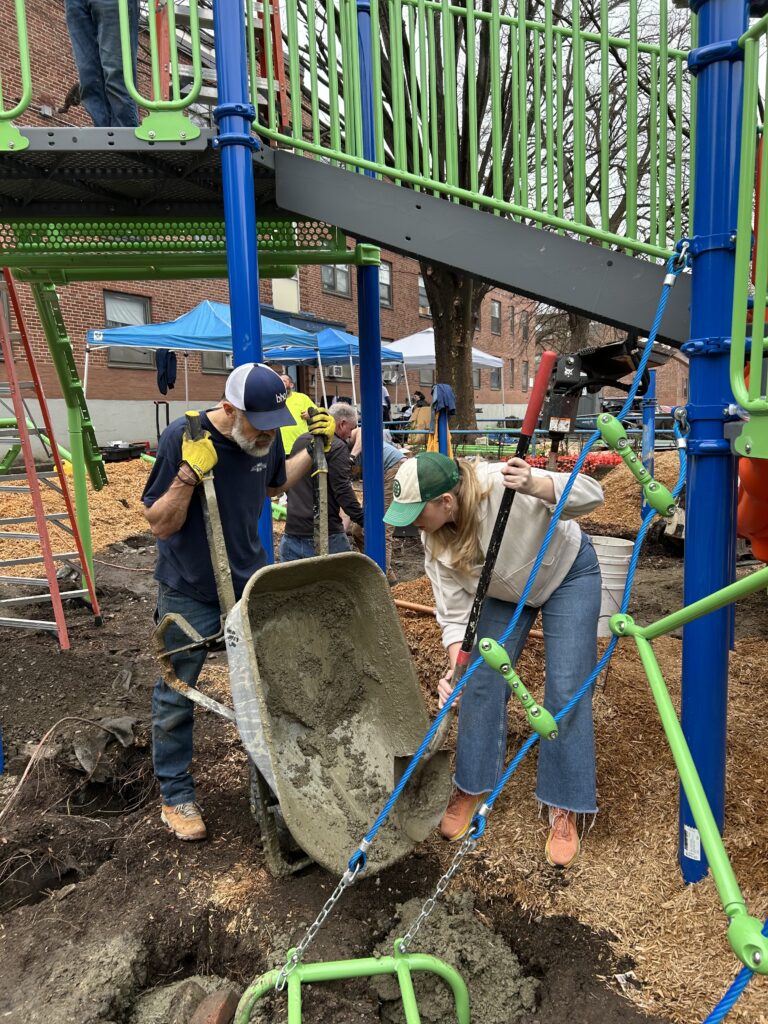
The best project I was able to work on was a community build of a new playground at the BHA’s Bunker Hill public housing site in Charlestown. The BHA received a generous grant from a playground company that allowed us to install two new playgrounds for residents. I worked with one of the BHA’s project managers, Maya Barnes, to organize the community build with volunteers from the BHA, the resident taskforce at Charlestown, and other community partners. It was a long day of hard work building the playground in April, but it was so rewarding to see how thrilled parents and children were with the new playground at the end of the day!
What impact did your work make on your host organization, the community, or beyond?
I was able to attend several resident meetings at various public housing sites throughout the City of Boston where the BHA is starting to work on renovation projects. While I know the work the PCD department does on a day to day is meaningful, because it’s all contributing to the improvement of housing for residents, it was particularly impactful getting to see how residents felt about the work in person. I loved hearing stories about how residents have formed community with their neighbors over time (even multiple decades), so the work our department is doing was helping to ensure that these communities could thrive better in the future with better housing conditions.
I also worked for the BHA’s First Home Program during my co-op. The First Home Program is a partnership with the City of Boston that provides $75,000 in homebuying assistance to eligible residents when purchasing a home in Boston. The funding is a grant, and Section 8 voucher holders are also able to convert their voucher to mortgage payment assistance for up to 15 years, so you can see the incredible opportunity that the program offers for BHA residents. This work was super impactful, as I was able to experience multiple families closing on homes to finally achieve homeownership. Buying a home can be such a catalyst for families to build generational wealth, so it was amazing to work on the team at the BHA that helps make this dream a reality for residents!
How did your co-op experience change you?
My experience at the BHA really helped me learn more about what aspects of the planning and development world I’m most interested in. Working for the PCD team, I was able to touch many projects that were all in different stages, from issuing initial RFPs to pre-development to full on construction. I also was able to work with many different types of partners, from design firms to real estate financing teams to contractors, which expanded my view of what types of roles I could have in the future!
If you were talking with a prospective student or potential co-op host, what is the one aspect you would want them to know about the value of experiential learning?
I think the best thing about experiential learning is that it helps you explore what type of work you do or don’t want to do in the future. I think our culture puts a lot of pressure on students to find the perfect job right after they graduate from school – like there is a societal expectation that you will automatically love your first “real world” job. But it isn’t that simple! In all reality, it’s just as important to learn what you don’t like about a role as it is to learn what you love. Experiential learning through Northeastern provides this opportunity with the safeguard of knowing that you have a strong university system there to help guide you along the way as you explore.
What are you dreaming of for the future? What do you hope to accomplish?
Honestly, my biggest hope for the future is to feel fulfilled by the work I do. For a lot of my life, I’ve been focused on reaching some goals that I set in my head based on what I thought were societal expectations of success. As I’ve gotten older and had more experience working outside of school, I think the real crowning achievement is finding a career that makes you feel fulfilled and more like yourself because it aligns with your values, passions, and views about the world.