Experiential Impact Spotlight: Taiwo Williams
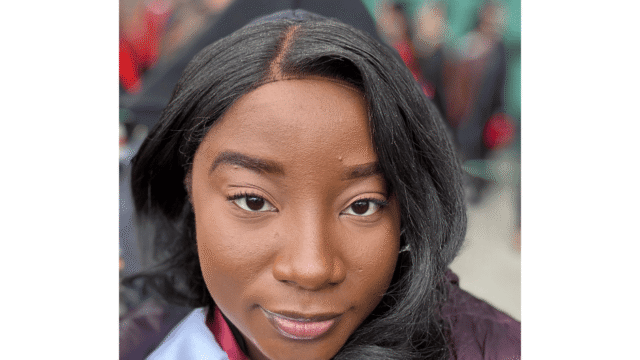
“This experience taught me to be bold. Prior to my co-op, I felt shy and timid, but interacting with voters, whether through calls or in-person conversations, made me much more courageous.”
Where do you consider your place of origin?
I am from Lafiaji, Lagos State, Nigeria.
Which Policy School degree do you have?
I graduated in 2025 with a master’s degree in International Affairs.
What drew you to the Policy School?
I studied International Relations during my undergrad, and as I navigated life outside of school, I realized that a lot of the problems that are yet to be solved in my country, Nigeria, are as a result of poor policy designs or gaps in policy implementation. I discovered that I wanted to play a key role in influencing policy in Nigeria, and that’s what drew me to the Policy School.
What policy issues or areas of research are you focused on?
I focus on policy issues around poverty and inequality. However, I recently developed a strong interest in policy issues around food insecurity and hunger.
How has your personal background shaped your policy interests and passions?
I have always loved being a Nigerian, and I love my country very dearly. However, in 2018, I came across a stark realization. That year, Nigeria had been labelled as the world’s poverty capital, surpassing India at the time. It felt like an irony to me. In school, I was taught about how Nigeria is the ‘Giant of Africa’ and how we had vast economic, natural and military resources. At the time, we had a GDP that stood at $421.7 billion, so how could we be the world’s poverty capital? How could we be so rich on paper, yet, so poor in reality?
Over time, as I experienced life as an adult in Nigeria, I could visibly see the poverty that I once read as a statistic. This paradox fuelled a drive in me to want to understand more about poverty. Down the line, I discovered that there’s a huge inequality gap, and that’s why a lot of people are poor. I have a sustained interest in issues around poverty and inequality because it’s a real problem that cannot be ignored. Poverty affects your ability to reach for the dreams you have. Poverty often determines whether you get to go to school or get to have a decent meal every day. Poverty can confine you to a geography. Poverty exacerbates conflict. I see poverty as a wicked problem that ought to be the policy priority of nations. I have read about it in books, and I have lived amongst it, and that’s why this is a huge passion for me.
Where did you complete your Policy School co-op?
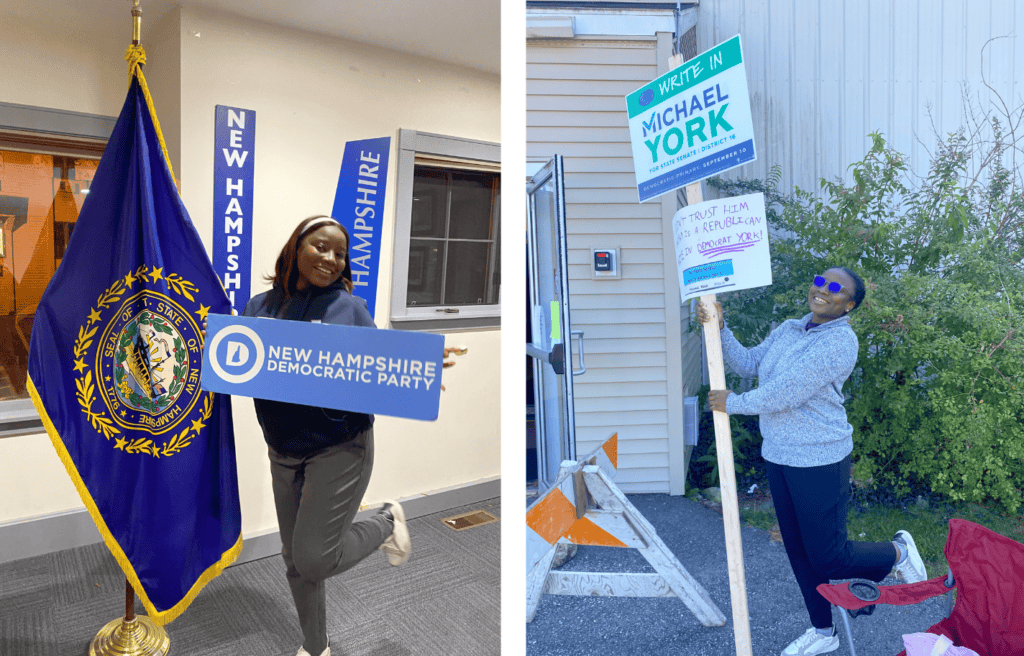
The Blue Lab in Concord, New Hampshire.
What kind of support or mentoring did you receive prior to and during your co-op?
Prior to my co-op, I received mentoring from the CSSH’s co-op team. They organized webinars that provided detailed guidance on how to go about the co-op search and considerations for international students. I was also assigned a co-op advisor.
What skills did you build or sharpen during your co-op your co-op?
The top skill I built during my co-op was advocacy skills. I learnt how to properly communicate issues that I wanted people to care about through verbal and written communication. I also learnt how to canvass!
What do you consider the highlight of your co-op experience?
A cool experience that I had was attending the New Hampshire Democratic Party Convention.
What impact did your work make on your host organization, the community, or beyond?
My work at the Blue Lab contributed to increasing political participation in New Hampshire during the 2024 elections. Through phone banking, grassroots mobilization, and canvassing, we encouraged people to vote in the 2024 elections.
How did your co-op experience change you?
This experience taught me to be bold. Prior to my co-op, I felt shy and timid, but interacting with voters, whether through calls or in-person conversations, made me much more courageous.
If you were talking with a prospective student or potential co-op host, what is the one aspect you would want them to know about the value of experiential learning?
To a prospective student, I would say that a co-op is one of the best ways to find out what you would love to do with your career long term. Whether it’s in a role you have always hoped for or one you never imagined, a lot of clarity comes from ‘doing’. For instance: I never imagined myself canvassing or speaking to people to get them to care about certain issues, but after my co-op experience, I see that as a vital strength that I have today.
What are you dreaming of for the future? What do you hope to accomplish?
I dream of a future where I am knee deep into the world of policy. Whether I am behind the scenes formulating policy or on the field implementing policy; I hope that I would be changing the world, one policy at a time!