PhD Spotlight: Olga Skaredina

Promoting intergenerational equity in environmental decision-making
My PhD research focuses on youth leadership and participation in environmental decision-making, exploring how young people construct agency, articulate intergenerational equity, and reimagine environmental governance. Although young people are often framed as passive beneficiaries, indicators of inclusivity, or even as potential risks, my work positions them as autonomous political actors and co-producers of knowledge. Drawing on over three years of continued engagement with young people in multilateral environmental processes, their perspectives and lived experiences have informed my research design and reinforced my commitment to scholarship that is problem-driven and practice-oriented.
“My research questions have been shaped through my interactions with young people and the ‘aha’ moments that I had during our informal conversations before, during, and after long nights of negotiations.”
Helping young people navigate institutional constraints
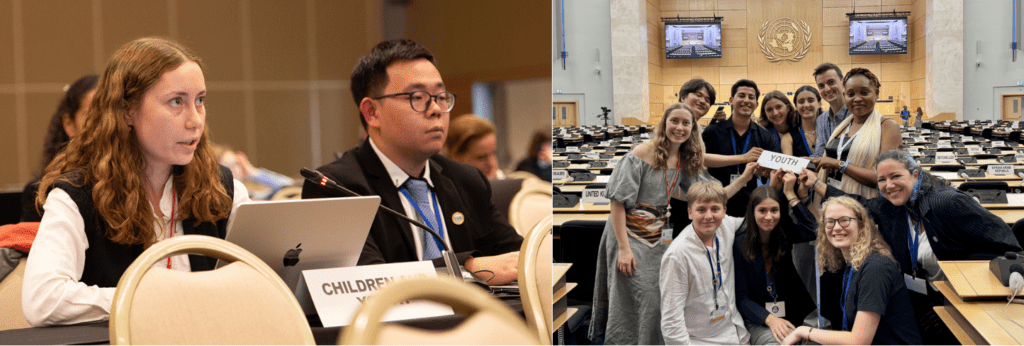
My research questions have been shaped through my interactions with young people and the “aha” moments that I had during our informal conversations before, during, and after long nights of negotiations. In my first year of the PhD, I joined the Children and Youth Major Group (CYMG) to the United Nations Environment Programme as the Science-Policy Thematic Facilitator. In this role, I not only observed but also contributed myself to how young people navigate institutional constraints and work behind the scenes to influence decision-making. I quickly realized that I wanted to bring that embedded, insider perspective into my scholarship and surface the dynamics that are rarely visible to external observers and therefore often absent in academia.
Since then, I have followed negotiations on the Intergovernmental Science-Policy Panel on Chemicals, Waste and Pollution and the Global Plastics Treaty (which became my case studies), supporting youth capacity building, drafting policy positions, and coordinating youth engagement. These experiences have anchored my core values as a researcher – curiosity, open-mindedness, respect, reciprocity, and collaboration – and continue to guide my approach to engaging with communities and bridging research and practice.
Challenging presentist bias
My exposure to the UN system, including my recent internship with the United Nations Environment Programme, has led to collaborations and friendships that I will carry with me throughout my professional and personal life. More importantly, it was through these relationships that the Futures of Intergenerational Equity, Fairness, and Justice research project was born, an initiative that I co-lead with a team of youth advocates from the Global Youth Coalition and that has become a central pillar of my doctoral dissertation.
As I enter the field of foresight as a 2026 Next Generation Foresight Practitioner Fellow at the School of International Futures, I aspire to demonstrate how young people can challenge presentist bias, articulate long-term visions, and meaningfully engage in global governance. Through this work, I hope to further position youth as active co-producers of knowledge, disrupters of power, and visionaries of preferred futures.
Read more about Olga’s work: Linkedin