PhD Student Stephane Labossiere Engages in Rappaport Fellowship Projects
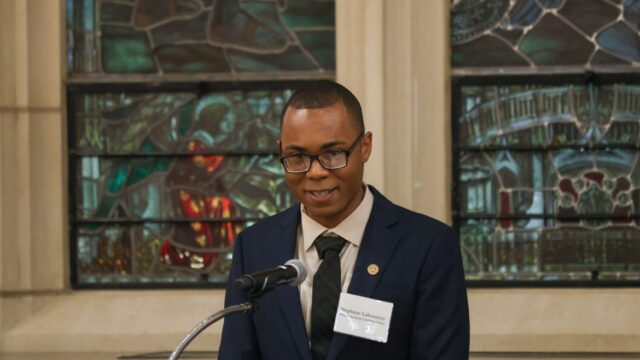
“An important takeaway from my fellowship experience,” says Stephane, “is that, despite the imperfections in our governing systems, there is always an opportunity to leverage creativity and problem-solving skills to improve our communities for everyone. In other words, it is a system we can collaborate with rather than one we need to fight against.”
Policy School PhD student Stephane Labossiere aspires to become a leader in immigration and equity issues, especially for minority communities. In Summer 2025, he took a significant step toward that goal by engaging in a prestigious Harvard Kennedy School Rappaport Public Policy Summer Fellowship. The Fellowship encourages students to apply their skills and passion for good governance to Greater Boston’s public policy challenges.
As a Rappaport Fellow, Stephane worked on several projects through placements at two agencies: the Mayor’s Office for Immigrant Advancement (MOIA) and the Office for Refugees and Immigrants (ORI). His work with ORI is ongoing, and he hopes to secure a major grant to support initiatives that are running out of funding at the state level. Stephane’s two main endeavors consisted of an internal report and a grant he is in the process of co-authoring with MOIA staff members.
Integration and Trust
The internal report documented the experiences, challenges, and successes of a pilot program for shelter transition led by MOIA in partnership with the Boston Rescue Mission (BRM) and other city agencies. It provided insights aimed at strengthening future immigrant integration efforts and outlined how the continuation of the pilot program deepened trust between service providers and migrant communities through Haitian-led mental health, legal aid, and education sessions. Through extensive interviews with staff members and other stakeholders, Stephane highlighted that participants increasingly engaged in self-advocacy, relied on peer-to-peer support networks, and utilized wraparound services when these access points were culturally competent and localized. He also noted, however, that gaps in coordination and case management consistency still hindered optimal outcomes, indicating a need for citywide infrastructure reform in immigrant support.
Drive to Succeed
Stephane’s second major project, which will continue through Fall 2025, focused on a grant proposal for the DRIVE program, led by the Office for Refugees and Immigrants (ORI). This program seeks to address a critical barrier to refugee self-sufficiency: lack of transportation resulting from the absence of a driver’s license. With a sharp reduction in Refugee Cash Assistance (RCA) from 12 to 4 months, newly arrived refugees face increased pressure to secure employment as quickly as possible. The DRIVE Program will equip refugees in Central and Western Massachusetts with the tools, language support, and cultural competencies needed to pass the Massachusetts Learner’s Permit and Road Test. This will enable them to achieve sustainable employment and access educational opportunities.