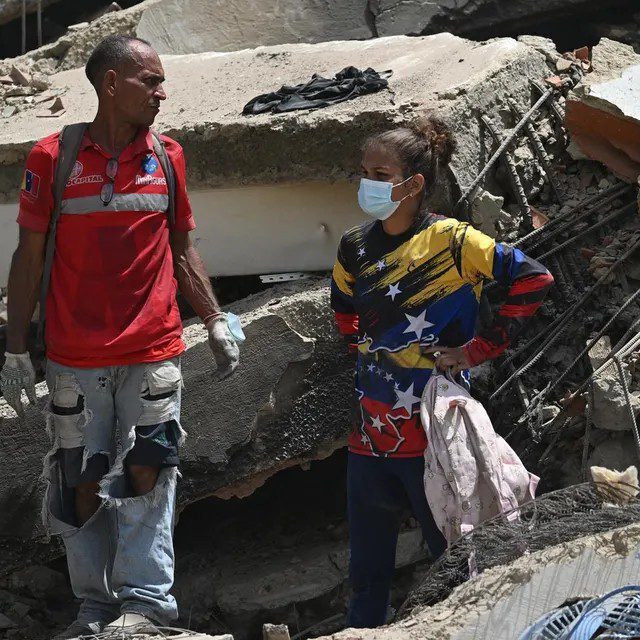
In the hours after two earthquakes tore through northern Venezuela on the evening of June 24, the people pulling survivors from the rubble were, overwhelmingly, the survivors’ own neighbors. In La Guaira—the coastal state that absorbed the worst of the destruction—volunteers who had no specialized equipment heard a baby crying inside a collapsed building and cleared the wreckage with their bare hands until they reached the infant, unharmed. A short distance away, a woman named Amparo del Giudice clawed at a mountain of concrete in search of her son, weeping, because no rescue team had yet arrived. These scenes were not anomalies. For the better part of two days—precisely the window in which the trapped are most likely to be recovered alive—the front line of Venezuela’s response was its own population, working with borrowed tools and privately gathered supplies while the institutions formally charged with disaster relief struggled to arrive in force.
The disaster itself was historic. A magnitude 7.2 tremor struck near San Felipe and was followed thirty-nine seconds later by a magnitude 7.5 quake, the strongest the country has recorded since 1900. By Saturday the official death toll had climbed past 1,400, with thousands injured and tens of thousands reported missing—figures the authorities acknowledged were still rising. What unfolded in the meantime was a population improvising its own search. In La Guaira, families dug through the rubble with bare hands, reporting that the few official teams on site were scarce and poorly equipped, without the heavy machinery needed to lift collapsed slabs. “We did it all by sheer effort,” a resident named Maikel Rincón told the agency EFE after he and his neighbors pulled a seventeen-year-old from a fallen building in the Maripérez district of Caracas. Outside other sites, residents simply shouted what they needed—“We need machines… people!”—while others insisted it was the people themselves looking for a way to lift the concrete.