Where Urban Planning Ethics Meet AI
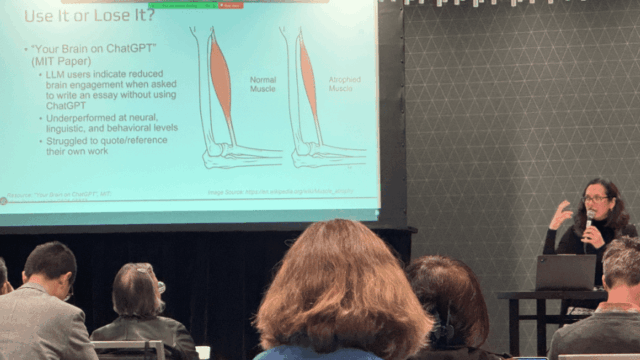
“Broader concepts from moral and political philosophy, such as discourse, pragmatist, and virtue ethics,” says Prof. Moira Zellner, “can be used to surface gaps and questions that merit consideration by the planning field.”
Prof. Moira Zellner presented an Urban Planning AI Workshop at the Association of Collegiate Schools of Planning in Minneapolis on October 23, 2025. The title of her presentation was “Planning Ethics and AI: Moving Beyond a ‘Problems with the Technology’ Framing.”
In this talk, co-authored with Theo Lim (UBC), Kristi Currans (U. of Arizona) and Sarah Williams (MIT), Prof. Zellner discussed ethical issues related to generative artificial intelligence (genAI) modeling and how typical considerations of bias, privacy, equity and inclusion, accountability and transparency, and mis/disinformation often focus on ‘problems with the technology’ that fail to capture broader impacts that are core to the planning field. For example, broadened ethical frameworks can help planners think about how genAI (and any other modeling approach) situated in a planning process alters learning processes and communication, excludes diverse ways of knowing, reduces opportunities for generative conflict, and alters public expectations for the functions of government and deliberative democracy.
She demonstrated how starting with normative planning principles–such as emphases on social learning, participatory processes, justice, sustainability, and resilience–and broader concepts from moral and political philosophy–such as discourse, pragmatist, and virtue ethics– can be used to surface gaps and questions that merit consideration by the planning field. We pair these ethical frameworks with government genAI policies and planning situations, to illustrate how to weigh appropriate roles for genAI in planning contexts that support deliberative democracy.