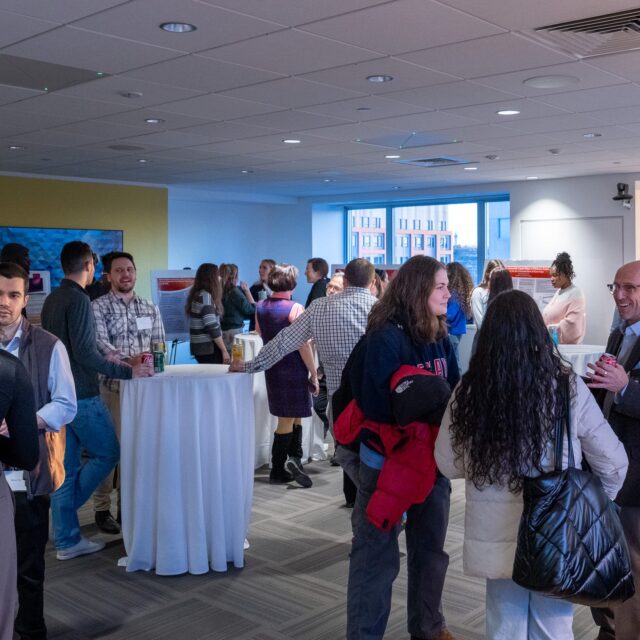
By bringing together faculty and students from all levels, our recent Graduate Research Poster Expo offered a vibrant look at the research shaping our community. Events like these are essential for building scholarly culture, research pathways, mentorship, and future academic goals. They create space for interdisciplinary dialogue and give early-career researchers a platform to share their work.
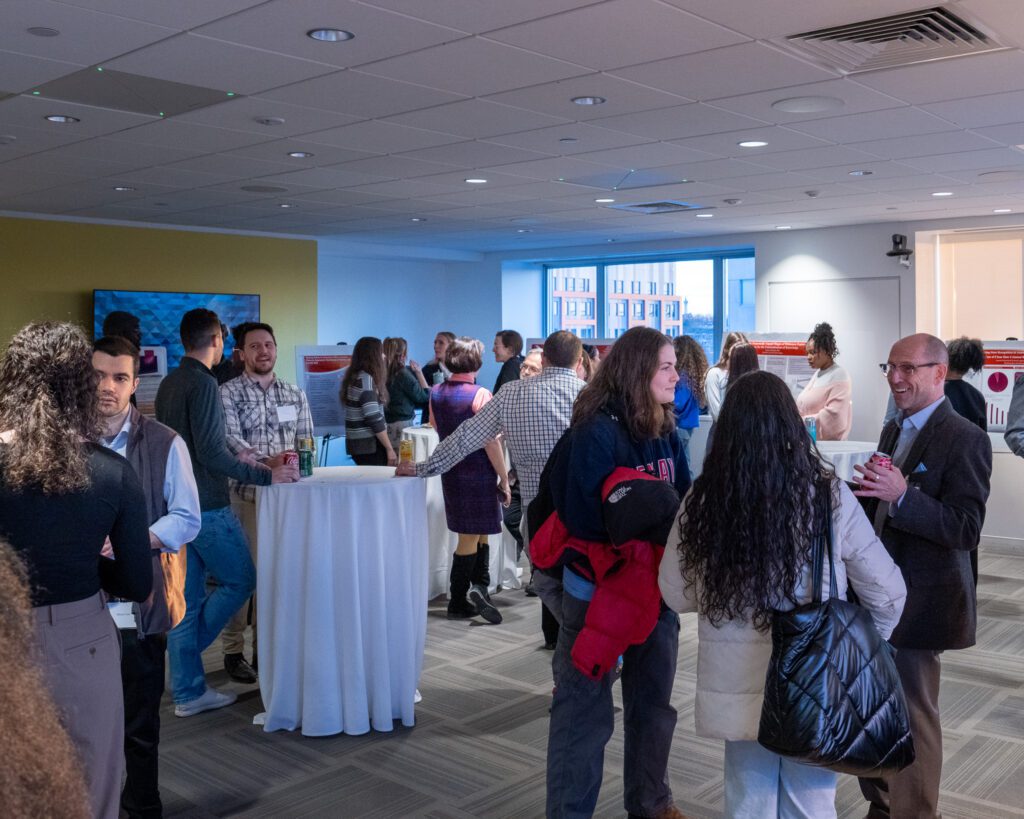
The room hummed with activity as faculty, doctoral students and undergraduate students gathered for an afternoon dedicated to research presentations and scholarly exchange.
Doctoral students showcased posters highlighting their ongoing projects, many of which stem from collaborations on faculty-led research grants. As attendees moved through the space to exchange ideas and explore potential partnerships, the following selections illustrate the diverse range of topics currently addressed within SCCJ.
Policing, Technology, and Public Perception
Public Support for Body-Worn Cameras
Body-worn cameras emerged as a central topic from multiple angles.
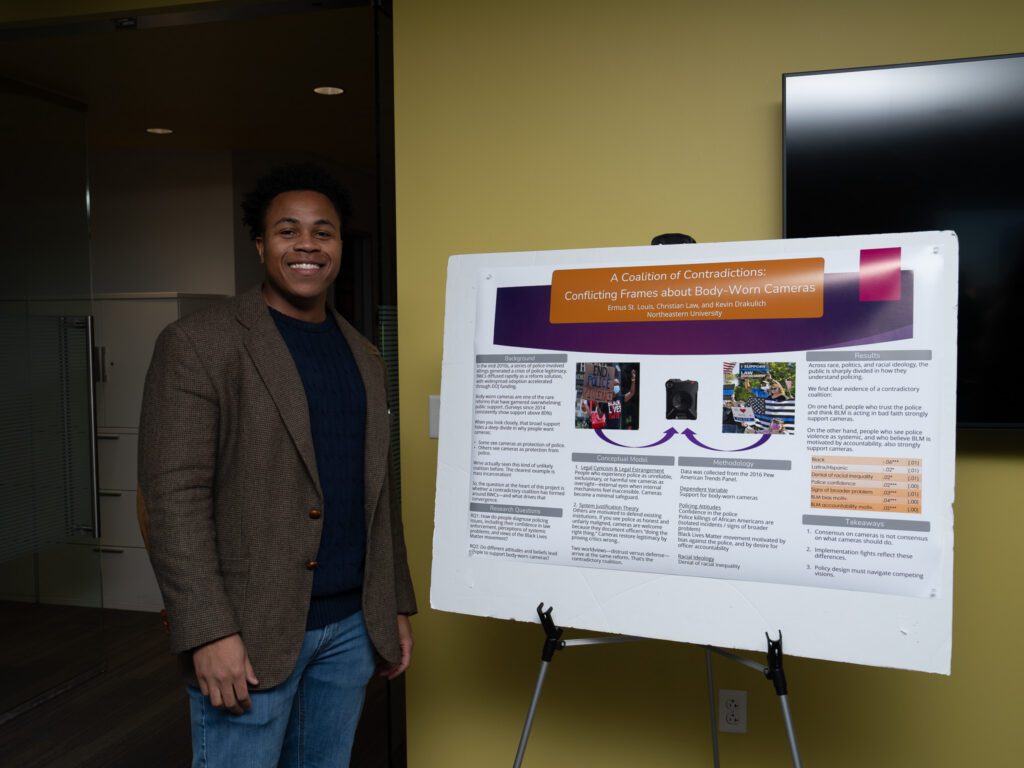
Christian Law presents “A Coalition of Contradictions: Conflicting Frames about Body-Worn Cameras.”
Christian Law, along with professors Ermus St. Louis and Kevin Drakulich, explore why body-worn cameras enjoy broad public support despite deep-seated disagreements regarding their purpose. Using data from the 2016 Pew American Trends Panel, they find that both people who trust the police and those who view police violence as a systemic issue support the technology albeit for fundamentally different reasons. They argue that effective policy design must successfully navigate these competing visions.
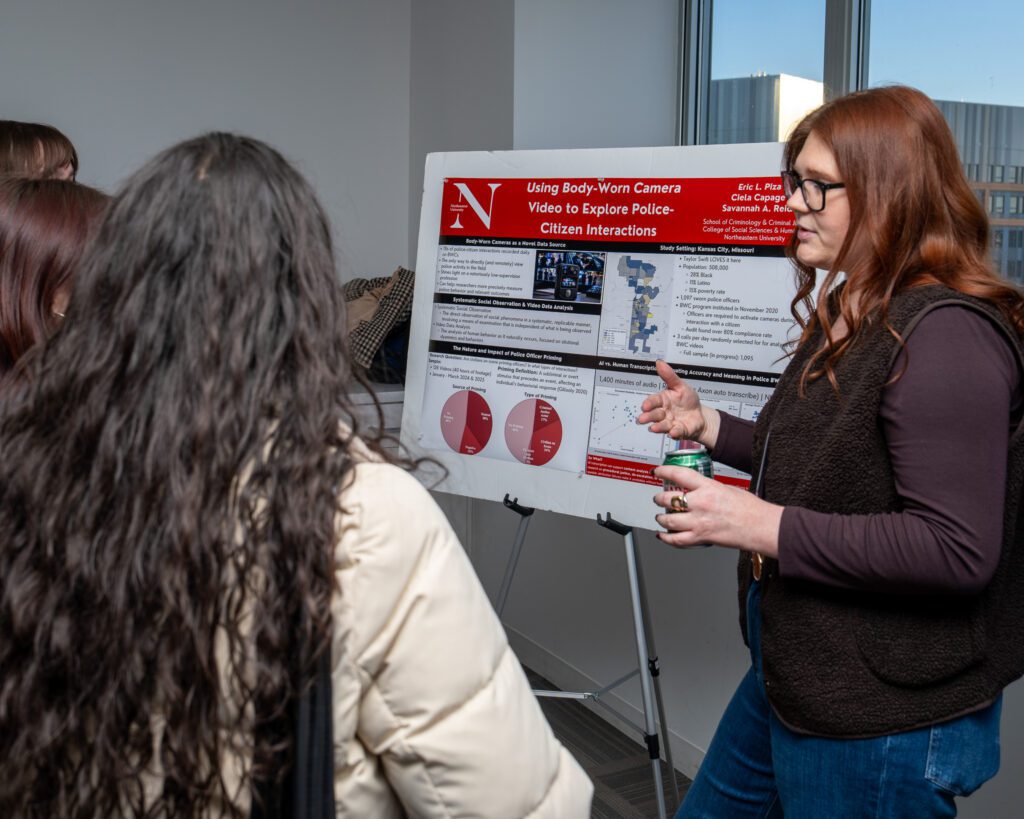
Savannah A. Reid walks attendees through the study’s use of systematic social observation with BWC footage from Kansas City.
Savannah A. Reid and Ciela Capage, along with Professor Eric Piza utilized body-worn camera footage from Kansas City, Missouri to analyze how police officer ‘priming’ shapes the nature of police-citizen interactions. Additionally, the researchers provide a comparative analysis of AI versus human transcription accuracy of body-worn camera footage.
Democracy, Security, and Political Violence
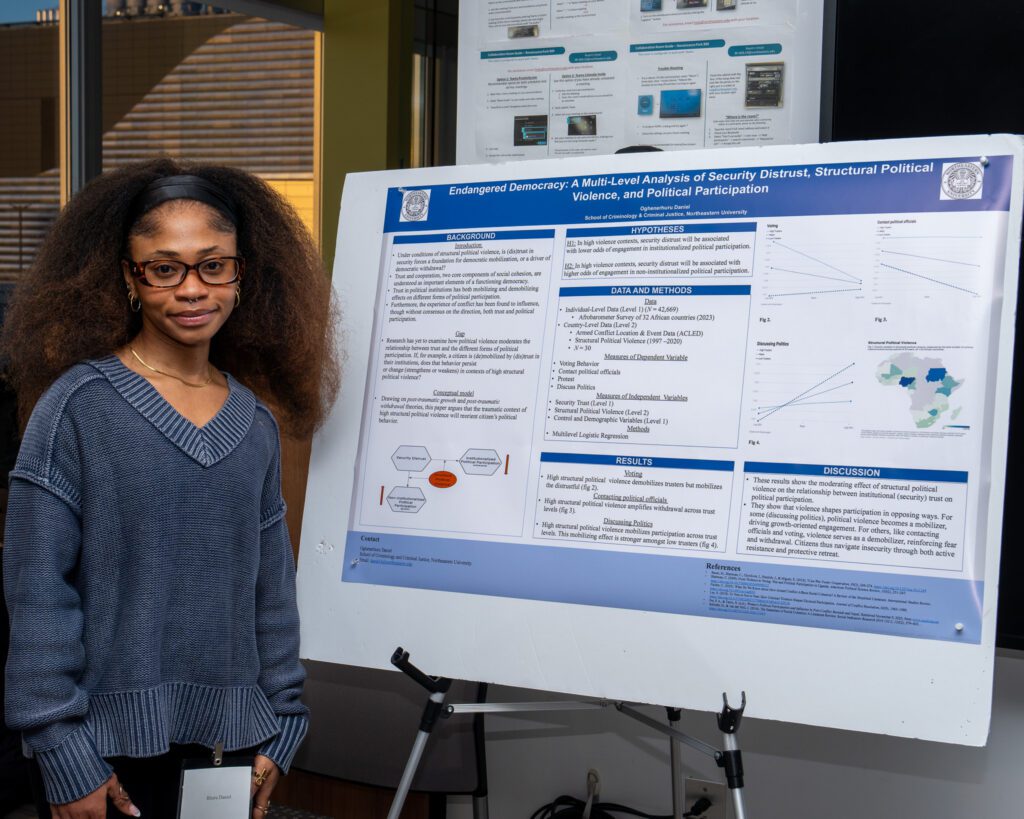
Oghenerhuru Daniel presents “Endangered Democracy: A Multi-Level Analysis of Security Distrust, Structural Political Violence, and Political Participation.“
Oghenerhuru Daniel examined how security distrust and structural political violence influence political participation across 32 African countries. Using Afrobarometer and ACLED data, the study shows that violence shapes participation in opposing ways — for some citizens it becomes a mobilizer driving protest, while for others it reinforces fear and withdrawal.
Juvenile Justice and the Importance of Hope
The Role of Hope in Juvenile Sentences
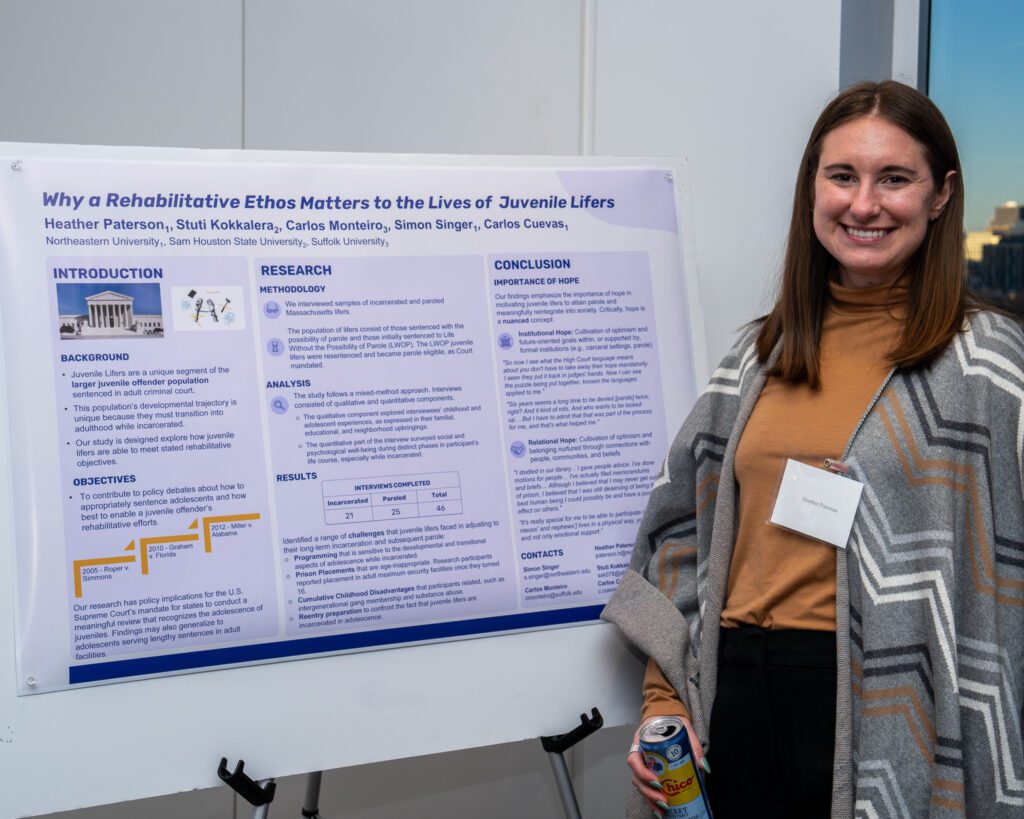
Heather Paterson presents “Why a Rehabilitative Ethos Matters to the Lives of Juvenile Lifers,” a mixed-methods study based on 46 interviews.
Heather Paterson, working with NU Professors Simon Singer and Carlos Cuevas and external colleagues examined the central role of hope in the lives of “juvenile lifers”. Based on 46 interviews with incarcerated and paroled individuals in Massachusetts, the study identifies ‘institutional hope’ and ‘relational hope’ as two critical dimensions of the re-entry process. These findings offer significant policy implications for states reviewing the cases of adolescents serving lengthy sentences under U.S. Supreme Court mandates.
Policy, Race, and the Reach of the Criminal Justice System
Automated Record Expungement
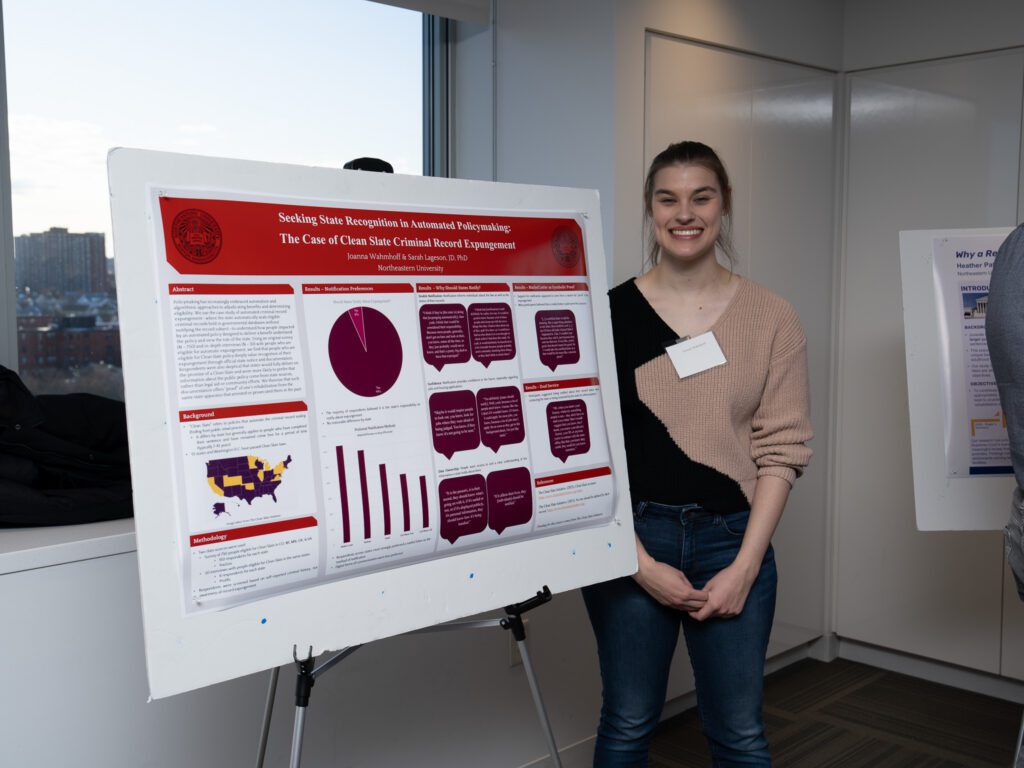
Joanna Wahmhoff presents “Seeking State Recognition in Automated Policymaking: The Case of Clean State Criminal Record Expungement.”
Joanna Wahmhoff and Professor Sarah Lageson explored how people eligible for “Clean State” criminal record expungement interact with automated policy processes. The researchers found that many eligible individuals were unaware of their statuses and those who were informed expressed a preference for proactive state notification over navigating complex digital systems alone. This raises critical questions about whether automation by itself, can achieve the equity goals these laws intend.

Students engage with the poster “How the Purportedly Unpaid Wages of Whiteness Explain Support for the Criminalization of Knowledge.”
Ciela Capage and Christian Law, working with Professor Kevin Drakulich, used the 2024 American National Election Studies data to investigate who supports bans on teaching about race in schools. The findings indicate that economically insecure White Americans and those holding ideologies of racial resentment are significantly more opposed to these curricula, connecting these patterns to broader political movements.
Protecting Vulnerable Communities

Christian Law engages in a conversation with Cassie DiBenedetti about her research on Hate Crime/Bias Victimization Against Latinxs, a multi-site study spanning Boston, Houston, and Miami.
Led by Drs. Carlos Cuevas, Amy Farrell, and Alisa Lincoln, this mixed-methods study surveys 900 Latinx adults across Boston, Houston, and Miami to investigate how bias victimization affects healthcare access, mental health, and community trust. Doctoral students Cassie DiBenedetti and Guisselle E. Cruz Rodriguez served as key research staff.
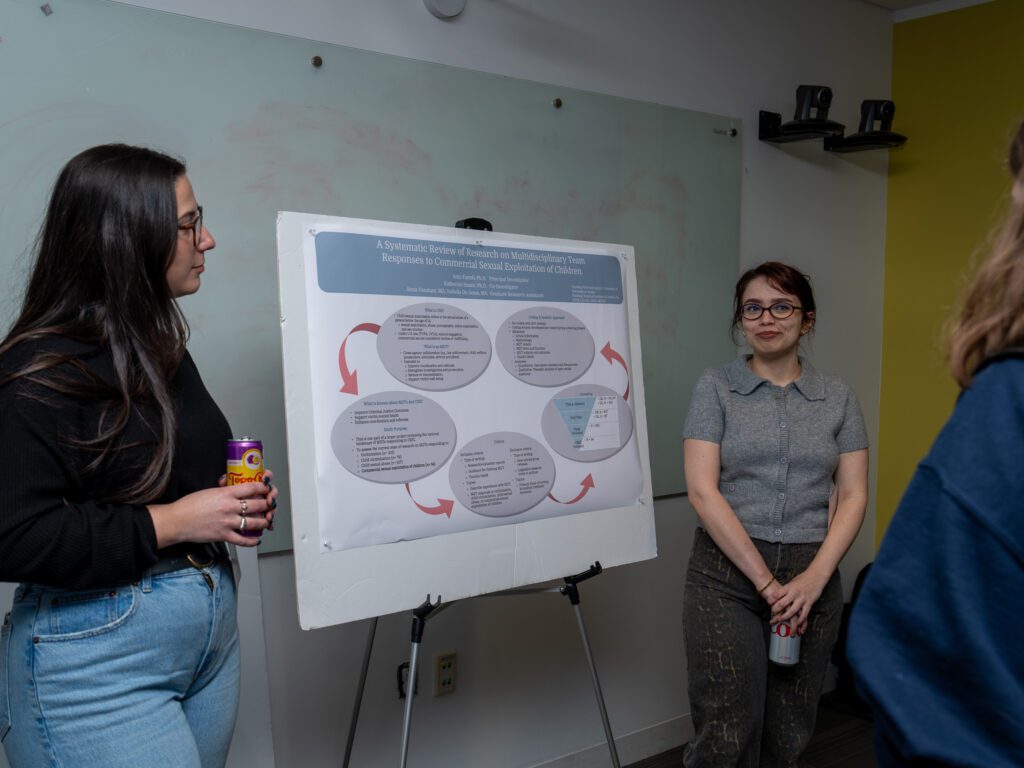
Anna Vasaturo(L) and Isabella De Jesus(R) present their systematic review on Multidisciplinary Team Responses to Commercial Sexual Exploitation of Children.
Working with Professors Amy Farrell and Katherine Hazen, Anna Vasaturo and Isabella De Jesus are conducting a systematic review examining how multidisciplinary teams — comprising law enforcement, child welfare, and advocacy organizations — coordinate responses to the commercial sexual exploitation of children. The research aims to map the evidence base of these models to identify critical gaps where practice has outpaced research.
Understanding the People Who Work Inside the System
Correctional Officer Wellness Study

Delanie Nahikian(L) and Julia Bell(R) present their study on Turning Points in Correction Officer Careers: Violence Exposures, Psychological Distress, and Suicide Risk.
Natasha A. Frost, Carlos E. Monteiro, and doctoral research assistants Julia Bell, Delanie Nahikian, Anna Vasaturo, and Megan Di Russo detailed the first longitudinal study of occupational stress, trauma exposure, and suicide risk among correction officers. Funded by the National Institute of Justice, the study tracked 350 new recruits through three waves of data collection between 2021 and 2025. The research aims to distinguish the long-term impact of chronic stressors from the effects of acute traumatic incidents.
A Community Built on Conversation

Professor Brandon Welsh(L) and Professor Simon Singer(R) shared a conversation during the session.
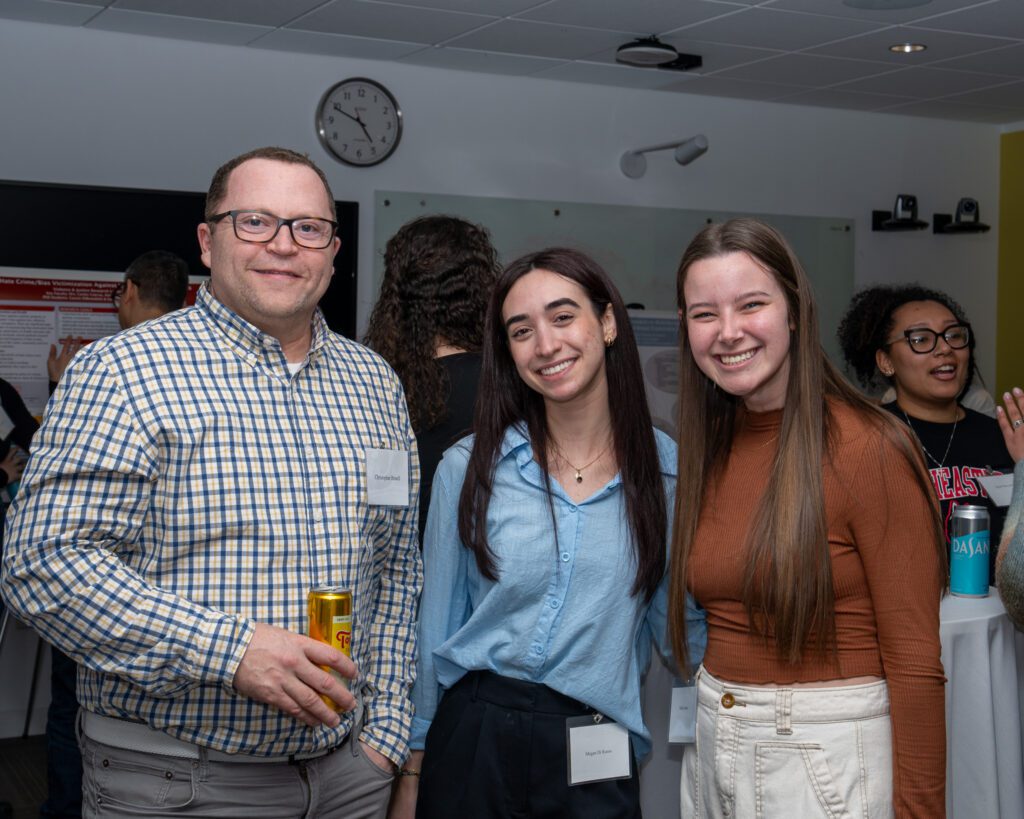
Professor Christopher Bruell(L) and doctoral students Megan Di Russo(M) and Kaley Jones(R) connect at the poster session.