Experiential Impact Spotlight: Vamini Jain
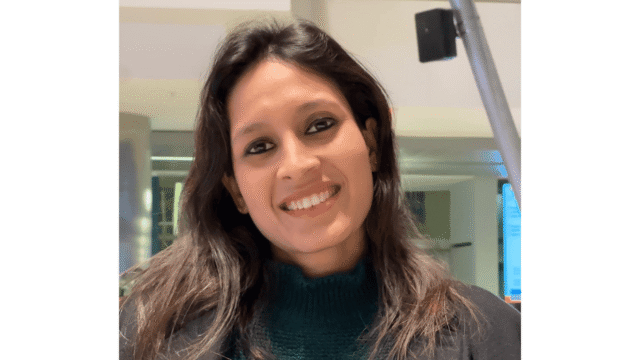
“My work is about community development and access to opportunity, how public dollars decide whether people can reach good jobs, safe streets, strong schools, and reliable services.”
Where do you consider your place of origin?
I am from Pune, Maharashtra, India.
Which Policy School degree do you have?
I graduated in 2026 with a Master of Public Policy and Administration (MPA).
What drew you to the Policy School?
I’ve been close to policymaking from a few angles: working alongside a Union Minister in India on Smart City strategy, helping organize India’s first National Legislators Conference with thousands of lawmakers, and collaborating with the National Conference of State Legislatures through NLC Bharat. Each one showed me how much policy depends on the analysis and structures behind the scenes.
Later, through my work with the National Conference of State Legislatures, I kept wanting to understand the other half of the picture: not just how leaders convene and decide, but how policy actually gets analyzed, funded, and turned into action. That’s what drew me to the Policy School. Northeastern’s co-op model meant I could build the rigorous, quantitative skills behind good policy and immediately test them inside real public agencies.
What policy issues or areas of research are you focused on?
I’m drawn to a deceptively simple question: when a city or town writes its budget, who gets left out? My work is about community development and access to opportunity, how public dollars decide whether people can reach good jobs, safe streets, strong schools, and reliable services. At MassDOT, I brought that lens to transportation, turning congestion and safety data into analysis that shaped equity-focused planning across the state.
At the Town of Norwood, I went straight to the source: the budget itself.Leading Proposition 2½ override research, I benchmarked peer towns on per capita spending and service delivery and helped surface hard truths, like where Norwood was falling behind comparable communities on what it invests in residents. That intersection of municipal finance and community development is where I’ve planted myself: the unglamorous, decisive work of figuring out how cities and towns fund public safety, education, and the services that hold a community together, and who benefits when they do. This builds on earlier research and governance work, including spatial inequality and employment accessibility and ethical AI.
How has your personal background shaped your policy interests and passions?
I grew up watching a paradox up close: economies can grow while opportunity stays locked away from the people who need it most. That gap, between rising numbers and unchanged lives, followed me from India to the UK to the US, and across every role I’ve held. No matter the country or the policy area, the same question kept surfacing: why is opportunity so unevenly reachable, even where there’s growth? That question is the spine of my work. It’s why I’m drawn to access, equity, and the quiet, decisive machinery of how public resources get allocated, because that’s where the gap is either widened or closed.
Where did you complete your Policy School co-op?
The Massachusetts Department of Transportation (MassDOT) in Boston. I also did an internship with the Town of Norwood.
What kind of support or mentoring did you receive prior to and during your co-op?
The Policy School’s co-op advising really helped me prepare going in, and Cristina Stanica and Michele Rosenthal were especially supportive before I started, from sharpening how I presented my skills to knowing what to expect inside a public agency.
During my co-op at MassDOT, I worked closely with my manager Nathaniel Kerr and with Shruti Venkatesh, who gave me real responsibility and steady feedback. And in my internship with the Town of Norwood, I worked directly under General Manager Tony Mazzucco and Assistant General Manager Michael Rosen, who trusted me with meaningful work on municipal finance and gave me the kind of hands-on guidance that made the experience stick.
What skills did you build or sharpen during your co-op your co-op?
I built a strong mix of skills across data, finance, and management: On the data side, SQL and Python analysis for congestion and safety studies, GIS mapping (ArcGIS and QGIS and Geodot) to bring a spatial lens to access and equity questions, and turning complex datasets into clear briefings and policy summaries for senior leadership. On the public finance side, municipal budgeting, Proposition 2½ override analysis, and peer-town benchmarking on per capita spending and service delivery. And on the management side, project management in Wrike, building and maintaining dashboards, and coordinating procurement, documentation, and compliance, the operational work that keeps public projects moving.
What do you consider the highlight of your co-op experience?
A few things really stand out. At MassDOT, I turned complex transportation data into dashboards that let leadership analyze and monitor projects in real time, and I built briefing materials and presented reports that senior staff actually used to support statewide mobility, sustainability, and equity decisions.
And in my Norwood internship, I contributed independently to the Proposition 2½ override analysis, owning real pieces of the research and benchmarking that helped town leaders weigh hard budget choices. Seeing my own analysis feed real decisions, at both the state and local levels, was the moment it all clicked.
What impact did your work make on your host organization, the community, or beyond?
My work strengthened evidence-based, equity-focused planning at the state and local levels and helped keep multimodal projects on track through clearer tracking and reporting.
How did your co-op experience change you?
It showed me what data-driven policy looks like inside a large public agency and clarified that I want work where analysis lands in real decisions, not just on paper.
If you were talking with a prospective student or potential co-op host, what is the one aspect you would want them to know about the value of experiential learning?
Theory tells you how policy should work. A co-op shows you how it actually does, the tradeoffs, the pressure, the moment your analysis becomes someone’s decision. It teaches you what no syllabus can, and it tells you fast whether you’ve found your calling. For me, it was a resounding yes. To any prospective student, I would say: Don’t wait until you graduate to find out how policy actually works. A co-op puts you inside a real agency while you’re still learning, so the theory and the practice sharpen each other. You’ll build skills you can’t get from a textbook, make connections that open doors, and find out fast whether the work is right for you. That headstart is the whole point.
What are you dreaming of for the future? What do you hope to accomplish?
I hope to build a career at the intersection of equity and public decision-making, the place where budgets, policy, and governance quietly determine who gets a real shot at a good life. My ambition is to bring sharp analysis and genuine conviction to that work, helping shape communities where access to opportunity isn’t a matter of luck or geography. If I can help even a few systems serve the people they were meant to serve, and do it in a way that outlasts me, that’s the legacy I want.