From Science to Global Action: Northeastern at UNEA-7 (2025)

Advancing global environmental governance through data art, science, and policy
At the Seventh Session of the United Nations Environment Assembly (UNEA-7) in 2025, Northeastern University demonstrated how universities can help shape global environmental governance at moments of consequence. Through research-driven interventions, data-art practice, and policy leadership, Northeastern’s presence in Nairobi brought science, creativity, and public purpose into direct conversation, while elevating leadership from the Global South.
Between December 8 and 12, 2025, Northeastern faculty and students participated in official UNEA dialogues and affiliated events, engaging with governments, United Nations bodies, civil society organizations, and academic partners. The University’s contributions spanned gender equality, implementation of multilateral environmental agreements, plastics governance, and environmental leadership legacies, reflecting Northeastern’s commitment to experiential learning and global engagement.
The Northeastern delegation was led by Maria Ivanova, Director of the School of Public Policy and Urban Affairs and Co-Director of the Plastics Center at Northeastern. The delegation also included Assistant Professor Carmen Hull from the College of Arts, Media, and Design; PhD students Carmella Uwineza and Rong Bao in Public Policy; PhD student Nicole Vandale in Marine and Environmental Sciences; and Diane Grant, a student in the Master of Engineering and Public Policy program. PhD student Olga Skaredina is completing an experiential semester with the Civil Society Unit at the UN Environment Programme and an important member of the UNEA preparatory team.
Data Art, Gender Equality, and Environmental Governance
Northeastern’s UNEA-7 engagement opened at the World Agroforestry Centre (ICRAF) with Data Art, Gender Equality + Environmental Governance, a high-profile convening that integrated data, art, and policy to reframe how evidence is experienced and understood. The event brought together leaders from international organizations, academia, and civil society to explore how data accessibility and inclusive governance can accelerate progress on gender equality.
Prof. Carmen Hull launched the conversation with an immersive data-art installation. Five Gender Gap Tents were positioned at the entrance to the venue, each translating global gender indicators into physical space and lived experience across health, economic participation, education, and political leadership. The installation transformed abstract data into something felt and encountered, setting the tone for a discussion grounded in both rigor and empathy.
During the panel, Prof. Hull spoke about the power of making stronger connections of people through physical installations of data – using precise projects of data science to demonstrate nuanced social reality of gender equality. Prof. Ivanova presented findings from the Environmental Conventions Index (ECI), a flagship Global Environmental Governance (GEG) project led by a Northeastern-based research team.
She highlighted a central insight emerging from the data: leadership in environmental governance is increasingly distributed, with countries in the Global South often outperforming expectations in implementing environmental agreements. Rwanda, she noted, exemplifies this trend through both its environmental policy leadership and its globally recognized representation of women in governance.
The panel also featured Dr. Eliane Ubalijoro, Chief Executive Officer (CEO), CIFOR-ICRAF; Dr. Susan Kaaria, Director, AWARD; Dr. Rahma Adam, Senior Scientist & Social-Economic Inclusion Impact Lead, World Fish; and Ms. Teresia Gitau, Global Coordinator, UNEP Women Major Group. The event was closed by a motiving speech from Dr. Philip Osano, Chief Operating Officer at CIFOR-ICRAF.
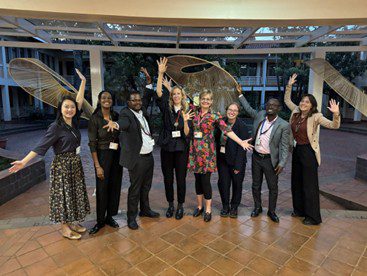
Northeastern delegation and friends in front of Prof. Carmen Hull’s Gender Gap Tents. From left to right: Rong Bao, Carmella Uwineza, Peter Katanisa (Government of Rwanda), Carmen Hull, Maria Ivanova, Nicole Vandale, Patrick Umuhoza (Rwanda Environment Management Authority) and Diane Grant.
Strengthening Multilateral Environmental Agreement Implementation
Inside the United Nations Office at Nairobi, Northeastern’s engagement moved into the formal heart of UNEA-7 during MEA Dialogue 1: “Signed, Sealed, Delivered?”, chaired by David Obura, Chair of the Intergovernmental Platform on Biodiversity and Ecosystem Services (IPBES).
Speaking as a member of the Scientific and Technological Communities Major Group, Professor Ivanova delivered a formal intervention focused on whole-of-government and whole-of-society approaches to implementing multilateral environmental agreements. Drawing on ECI research, she shared three key findings:
- No country performs equally well across all major environmental conventions, revealing distributed and diverse forms of global leadership.
- Countries in the Global South demonstrate expanding leadership capacity, where political commitment often outweighs economic wealth.
- Small states are among the most consistent innovators in mobilizing society to meet international environmental commitments.
She emphasized the essential role of education and knowledge communities in connecting science, policy, and society, and called on governments and international organizations to systematically elevate scientific expertise in environmental decision-making. The intervention resonated strongly with national delegations and intergovernmental organizations participating in the dialogue.

Prof. Maria Ivanova delivered a formal intervention as a member of the Scientific and Technological Communities Major Group.
Honoring the Legacy of Wangari Maathai
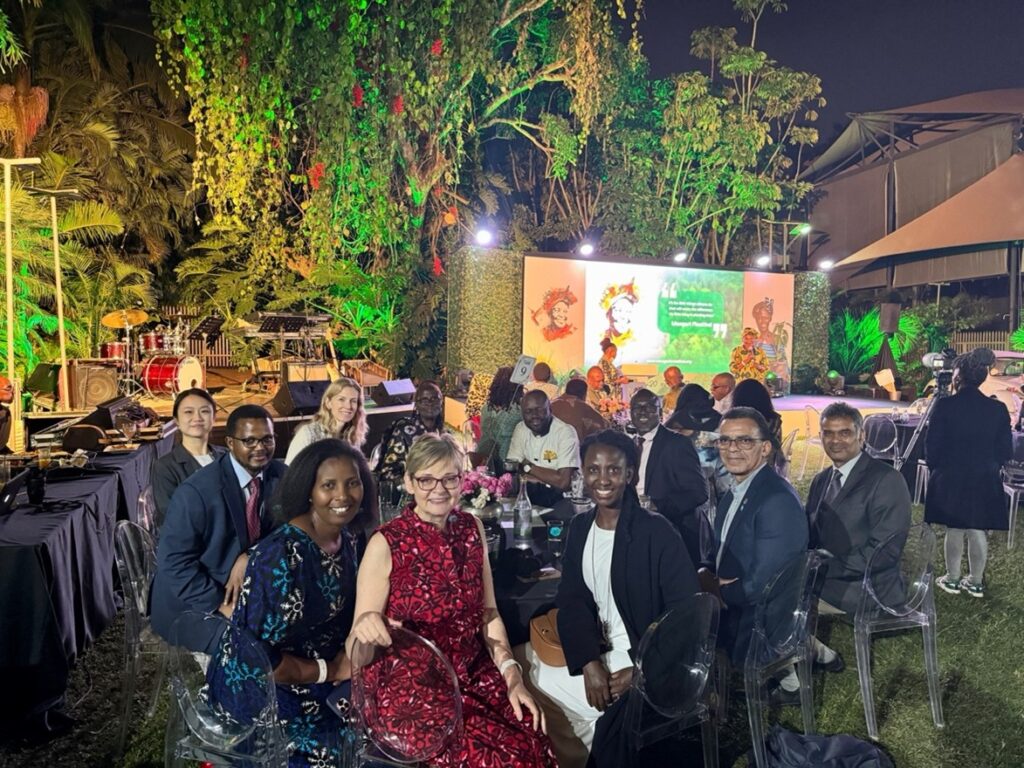
That evening, Northeastern convened with African leaders, policymakers, and long-standing collaborators at the Wangari Maathai Nobel +20 Gala Dinner in Nairobi, honoring the legacy of the Green Belt Movement founder and the first African woman to receive the Nobel Peace Prize.
Northeastern hosted a table that reflected both institutional commitment and enduring partnerships. Attendees included Maria Ivanova; Carmen Hull; Venantius Robert Wesonga, Senior Assistant Director of the Northeastern University Nairobi Campus; Rong Bao, PhD student; and long-term collaborators and friends of Northeastern, including Dr. Joe Ageyo (Television Journalist at NTV Kenya), Annabell Waititu (Executive Director at the Institute of Environment and Water Management, Founding Partner & Vice President of Programs of the Big Five Africa Ltd.), Juliet Kabera (Director General of the Rwanda Environment Management Authority), Peter Katanisa (Advisor to the Minister, Ministry of Natural Resources of Rwanda), Dr. Satishkumar Belliethathan (Head of Africa Regional Office, NABU), and Dr. David Obura (Chair of IPBES and and the founding director of the Coastal Oceans Research and Development—Indian Ocean “CORDIO” East Africa).
In a tribute address, Prof Ivan.ova reflected on Wangari Maathai’s philosophy of the “power of one”: one tree, one action, one community. She emphasized how individual leadership, sustained over time, can catalyze collective environmental transformation, a lesson that continues to shape environmental governance across generations.
Shaping the Global Plastics Treaty
Northeastern’s UNEA-7 engagement culminated in a high-level panel organized by the Government of Norway, Towards Greater Alignment throughout the Plastics Value Chain, held in the Agora, a space symbolically associated with public deliberation and collective choice.
Opening the session with her scene-setting remarks after Executive Director Inger Andersen, Prof. Ivanova framed plastics as a global material system that no country can govern alone. Drawing on examples from Rwanda, Seychelles, and Norway, she underscored that leadership already exists, but that national action, however courageous, cannot address fragmentation across design, production, trade, and waste. She argued that design is the bridge between production and waste, shaping material choices, chemical composition, reuse, recyclability, and long-term value.
She emphasized that transformation must come from the middle out, through cities, companies, and campuses where policy becomes practice, and highlighted the role of culture and art in shifting what societies accept and demand. Closing her remarks, she called for the creation of a “Courage Coalition”: a voluntary leadership space for countries ready to speak honestly about the pathways toward a strong and effective global plastics treaty, grounded in trust, informal dialogue, and shared vision.

Prof. Ivanova delivering scene-setting remarks in front of the High-Level panel on plastics.
A Continuing Commitment
Through data art, research, formal UN interventions, and community engagement, Northeastern University’s participation at UNEA-7 in 2025 demonstrated its distinctive contribution to global environmental governance. By integrating evidence, creativity, and policy impact, and by centering leadership from the Global South, Northeastern continues to position itself as a trusted academic partner in shaping the future of multilateral environmental cooperation.
