Indo-Pacific Minilateral Cooperation Ideas Lab

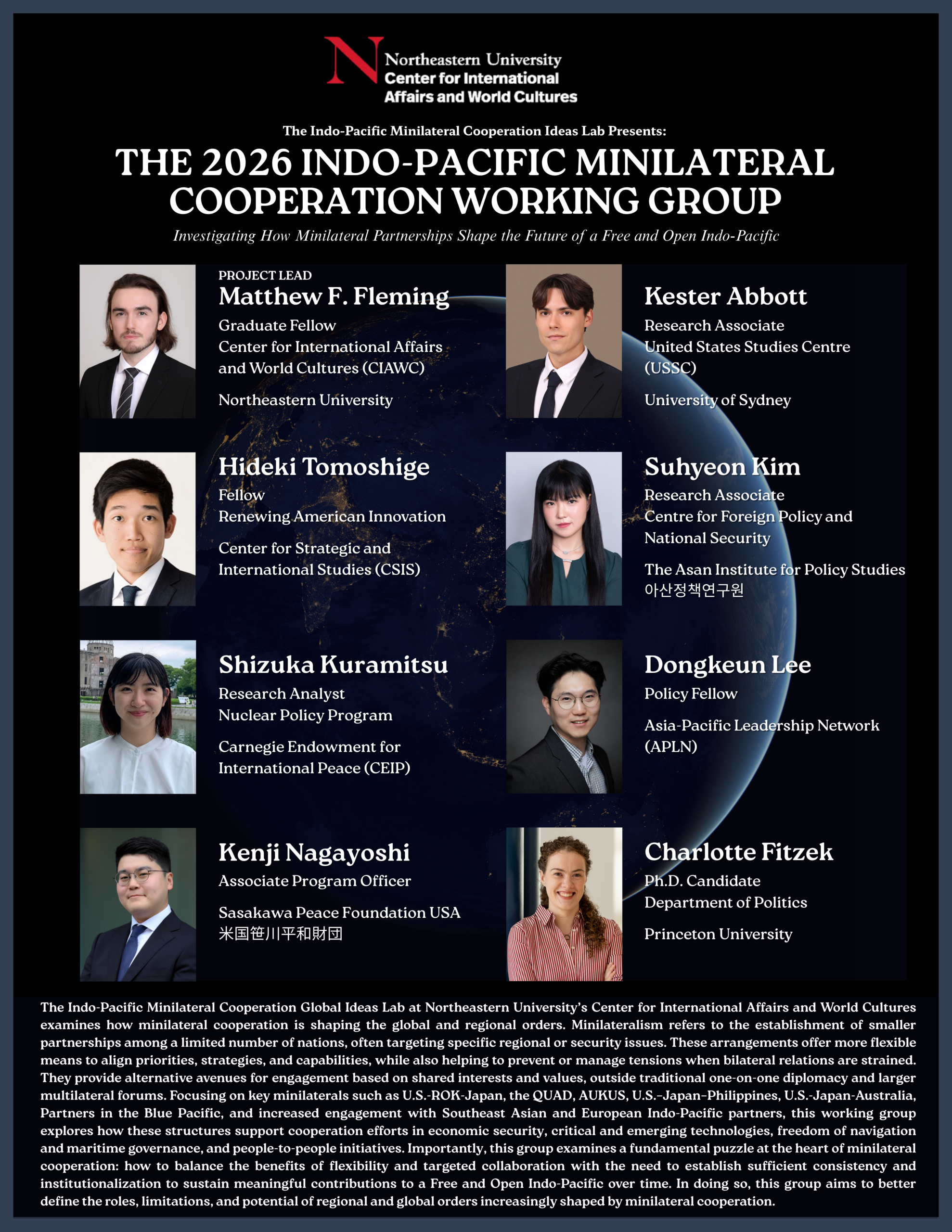
Investigating how minilateral partnerships shape the future of a Free and Open Indo-Pacific
The Indo-Pacific Minilateral Cooperation Ideas Lab at Northeastern University’s Center for International Affairs and World Cultures examines how minilateral cooperation is shaping the global and regional orders.
Minilateralism refers to the establishment of smaller partnerships among a limited number of nations, often targeting specific regional or security issues. These arrangements offer more flexible means to align priorities, strategies, and capabilities, while also helping to prevent or manage tensions when bilateral relations are strained. They provide alternative avenues for engagement based on shared interests and values, outside traditional one-on-one diplomacy and larger multilateral forums.
Focusing on key minilaterals such as U.S.-ROK-Japan, the QUAD, AUKUS, the U.S.–Japan–Philippines, U.S.-Japan-Australia, Partners in the Blue Pacific, and increased engagement with Southeast Asian and European Indo-Pacific partners, the 2026 working group explores how these structures support cooperation efforts in economic security, critical and emerging technologies, freedom of navigation and maritime governance, and people-to-people initiatives.
Importantly, this working group examines a fundamental puzzle at the heart of minilateral cooperation: how to balance the benefits of flexibility and targeted collaboration with the need to establish sufficient consistency and institutionalization to sustain meaningful contributions to a Free and Open Indo-Pacific over time. In doing so, this group aims to better define the roles, limitations, and potential of regional and global orders increasingly shaped by minilateral cooperation.
Project Lead: Matthew F. Fleming