Policy Insights
Coming soon: Policy reports on (1) Dark & Quiet Skies, (2) Nature Preservation & Restoration, (3) Youth-led Peace Movements, (4) Human Rights Defenders, (5) Critical Minerals, (6) Track 1.5 Diplomacy & Conflict Resolution, (7) Water as a Foundational Commons, (8) Maritime Security, and (9) Digital Public Infrastructure.
Authors

Mai’a K. Davis Cross
Department of Political Science and Center for International Affairs & World Cultures, Northeastern University

John Basl
Department of Philosophy and Religion, Northeastern University

Gokce Altin Yavuzarslan
Department of Chemistry and Chemical Biology, Northeastern University

Brian Helmuth
Department of Marine and Environmental Sciences and School of Public Policy and Urban Affairs, Northeastern University; Proteus Ocean Group

Ryan Morhard
Georgetown School of Foreign Service; Center for International Affairs & World Cultures, Northeastern University

Ann C. Thresher
Department of Philosophy and Religion and School of Public Policy and Urban Affairs, Northeastern University
Read our Report titled, A Policy Framework for International Cooperation in Space Biotechnology
Biotechnology is an indispensable tool for long-term human space exploration, especially if the goal is for humans to not only be able to survive in space, but to flourish. At the intersection of simultaneous advancements in both space and biotech is the capacity to engineer closed-loop space systems that generate food, oxygen, medicine, habitats, and other materials sustainably without having to bring everything from Earth. Future scientific, resource, and security benefits are tremendous, but there are also many ethical risks. In this report, a team of interdisciplinary experts in the fields of political science, international affairs, biotechnology, philosophy, ethics, environmental science, and chemistry, argue that deeper and deliberate international and transnational cooperation will be crucially important to expand space diplomacy and governance as the genomic and space revolutions collide.

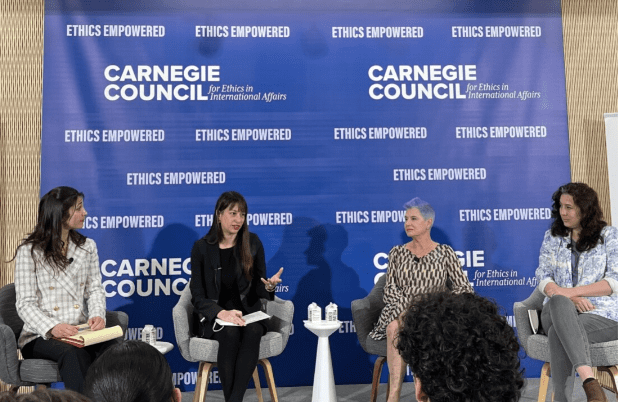
Also, check out our Space Diplomacy panel at Carnegie Council for Ethics in International Affairs as part of the Unlocking Cooperation series where we discuss the opportunities and challenges for a new space age. Novel ethical questions, governance challenges, and new forms of cooperation are emerging across sectors and technologies.
Northeastern University’s Ethics Institute partnered with Carnegie Council to host this special convening on the future of international space governance, diplomacy, security, and sustainability.